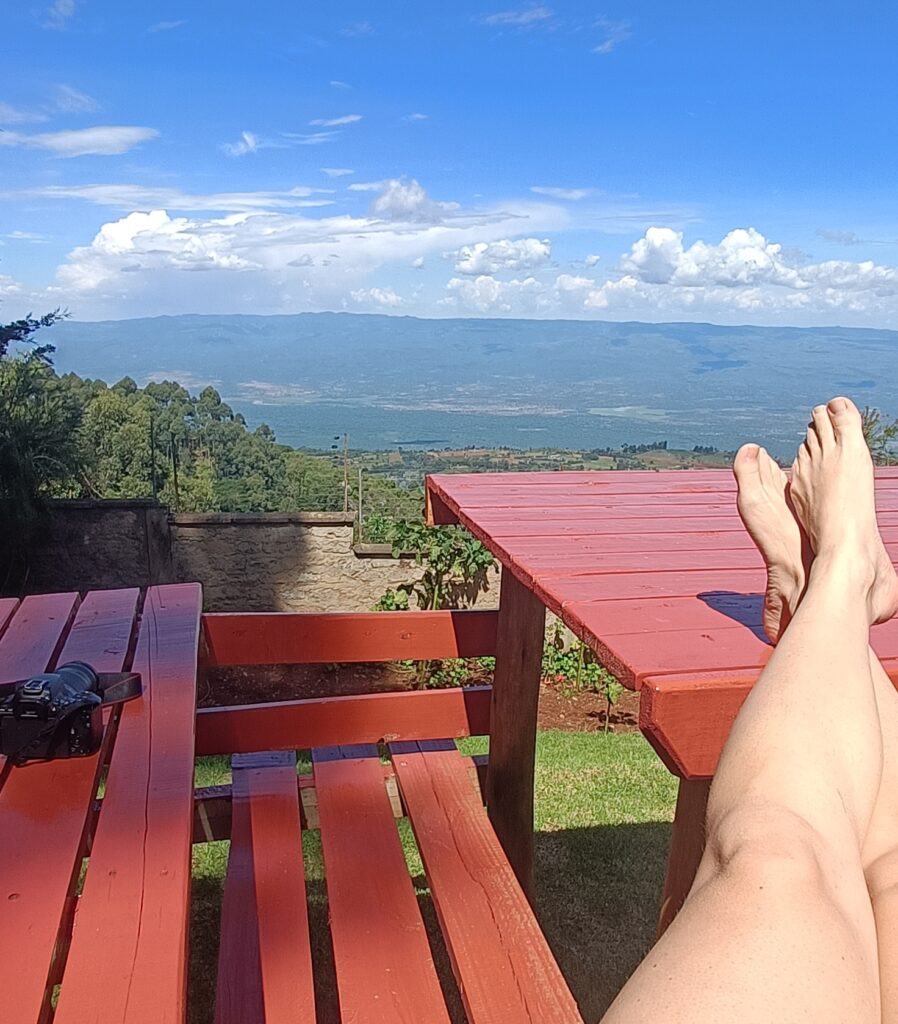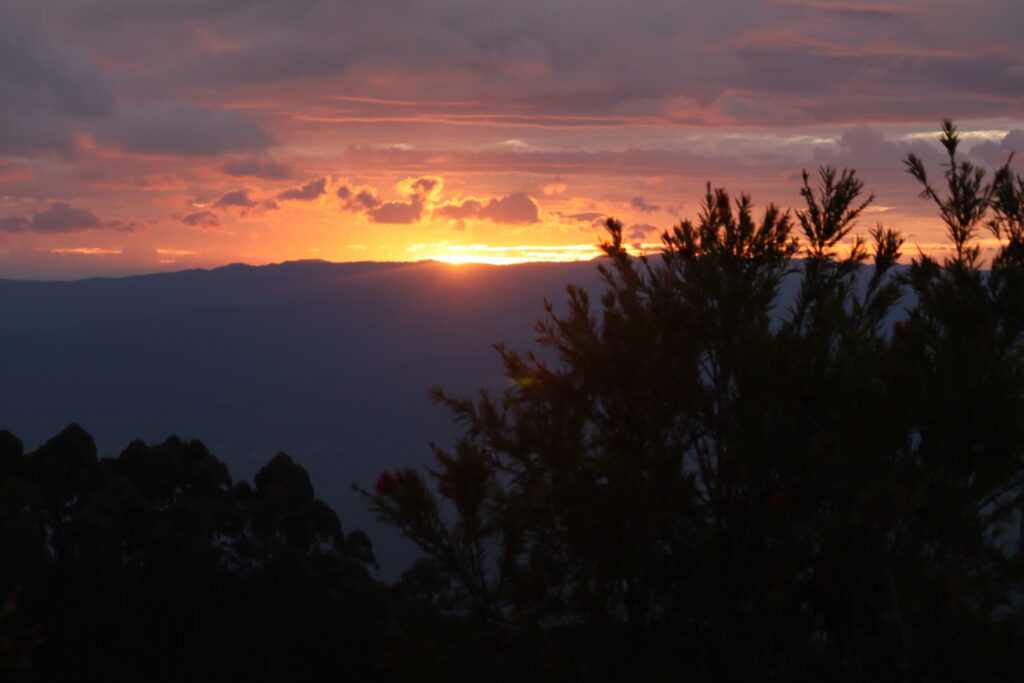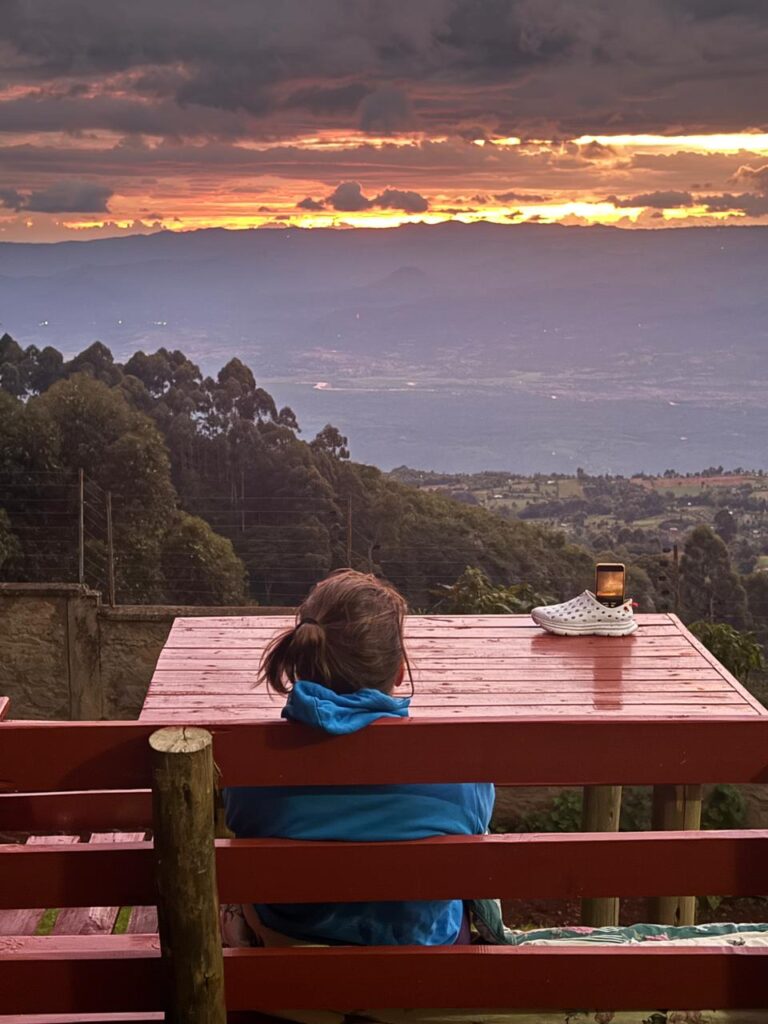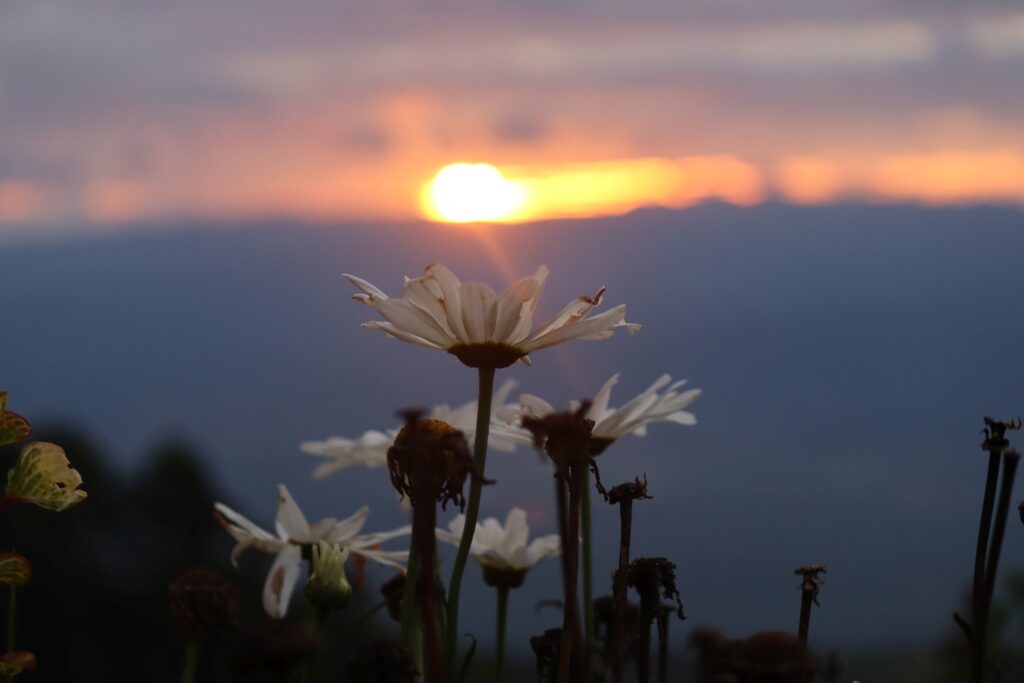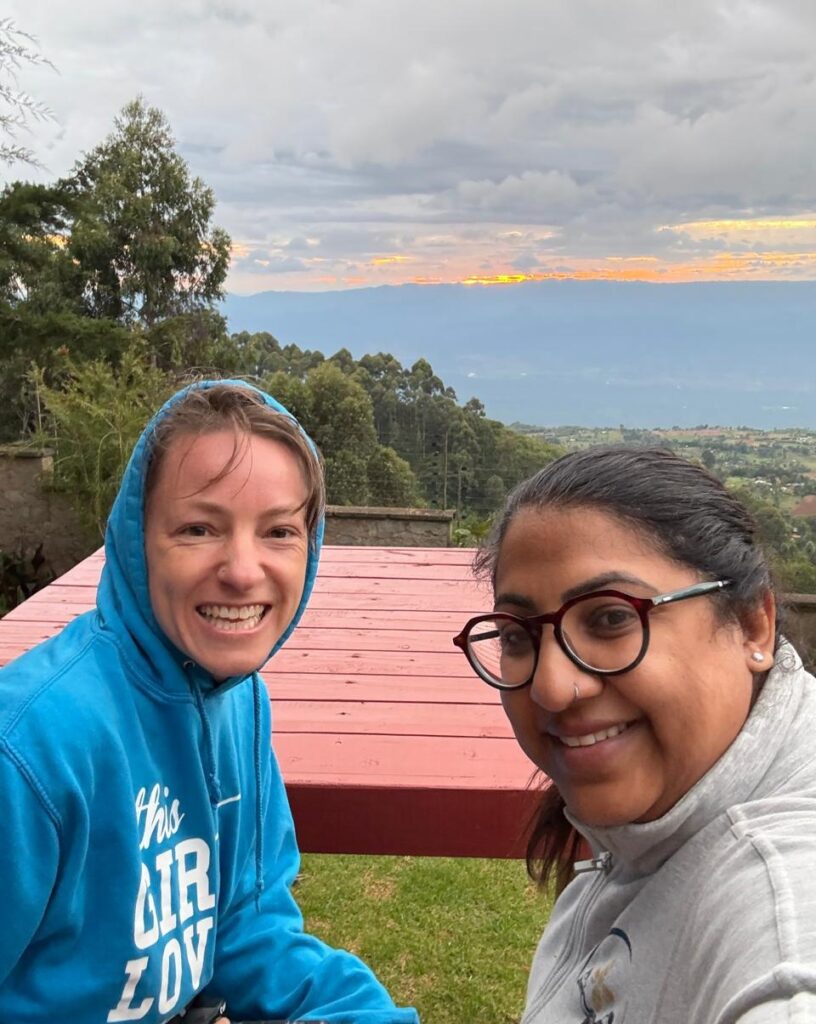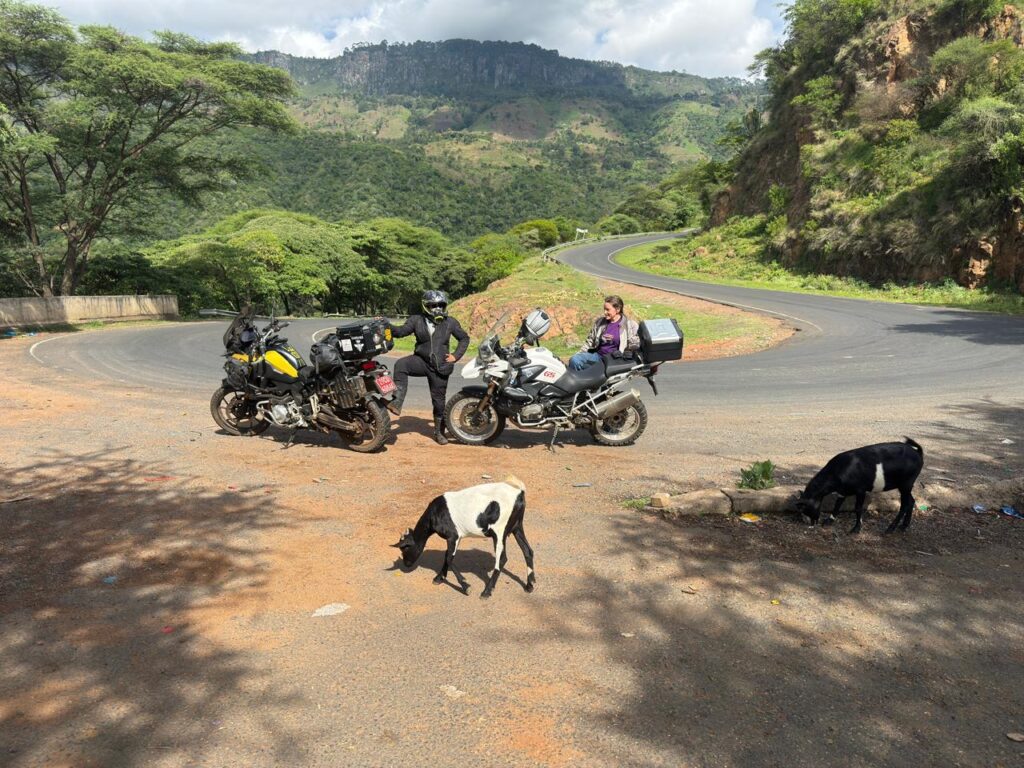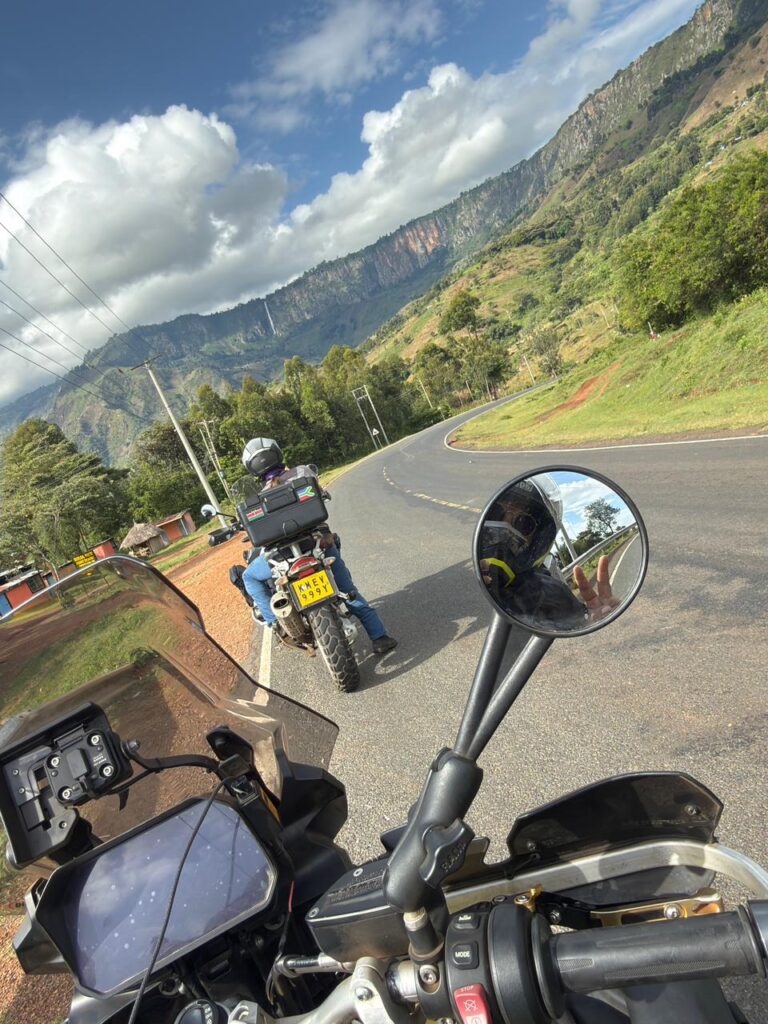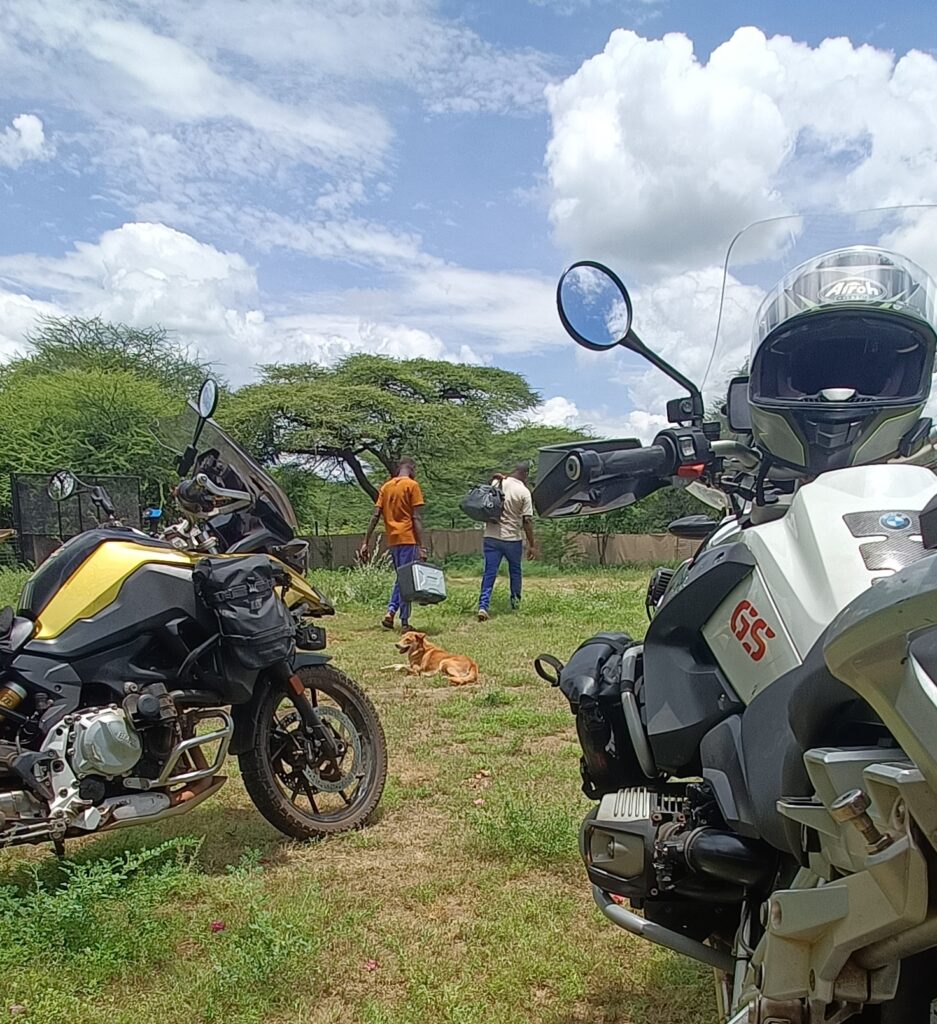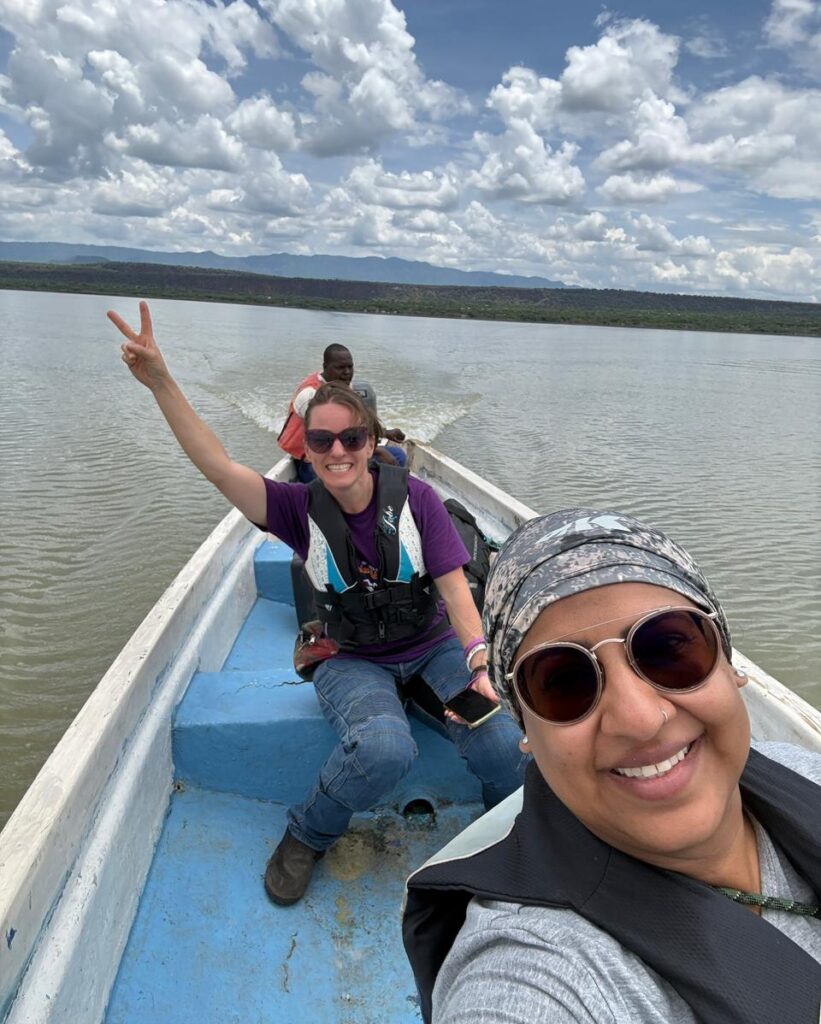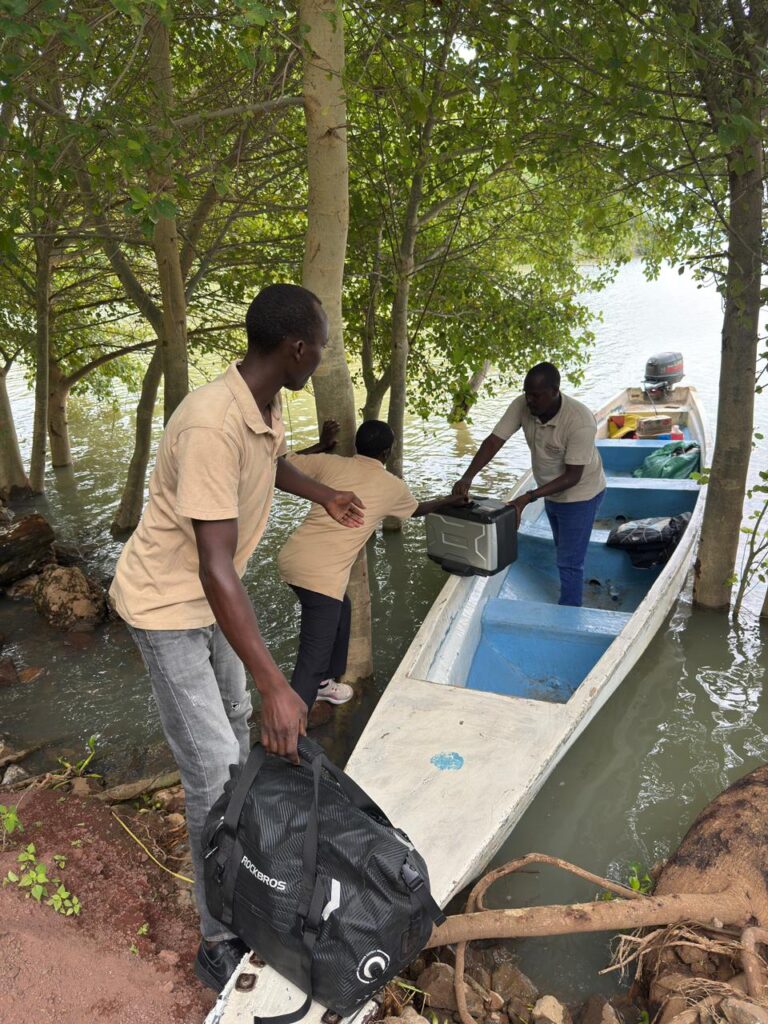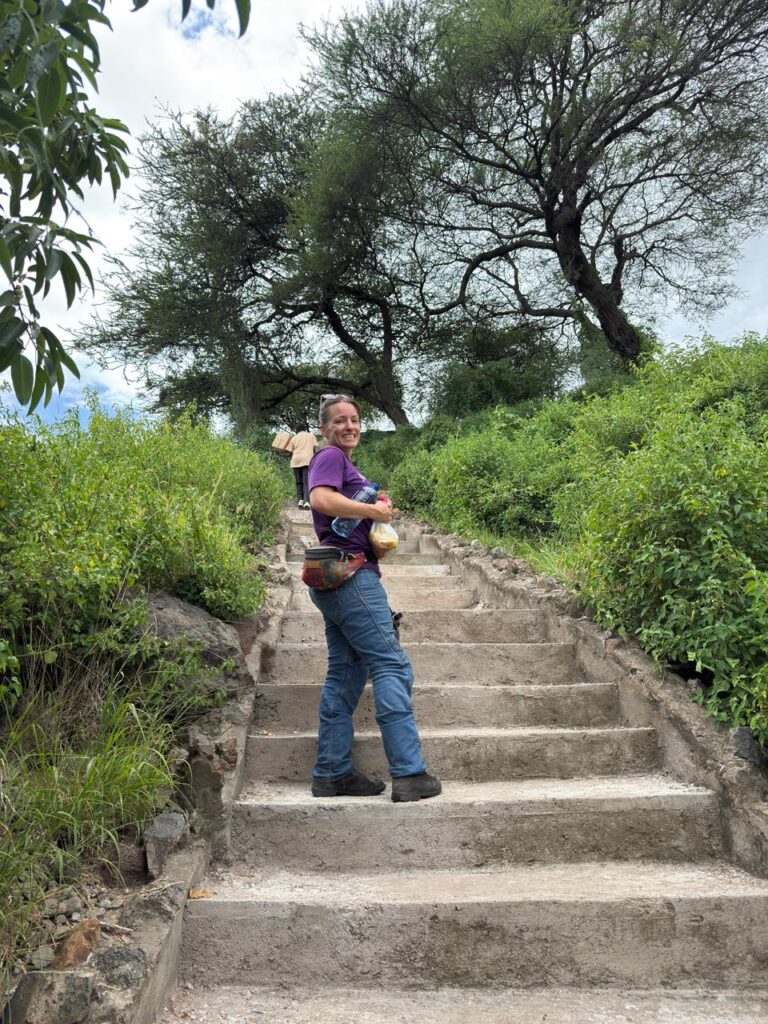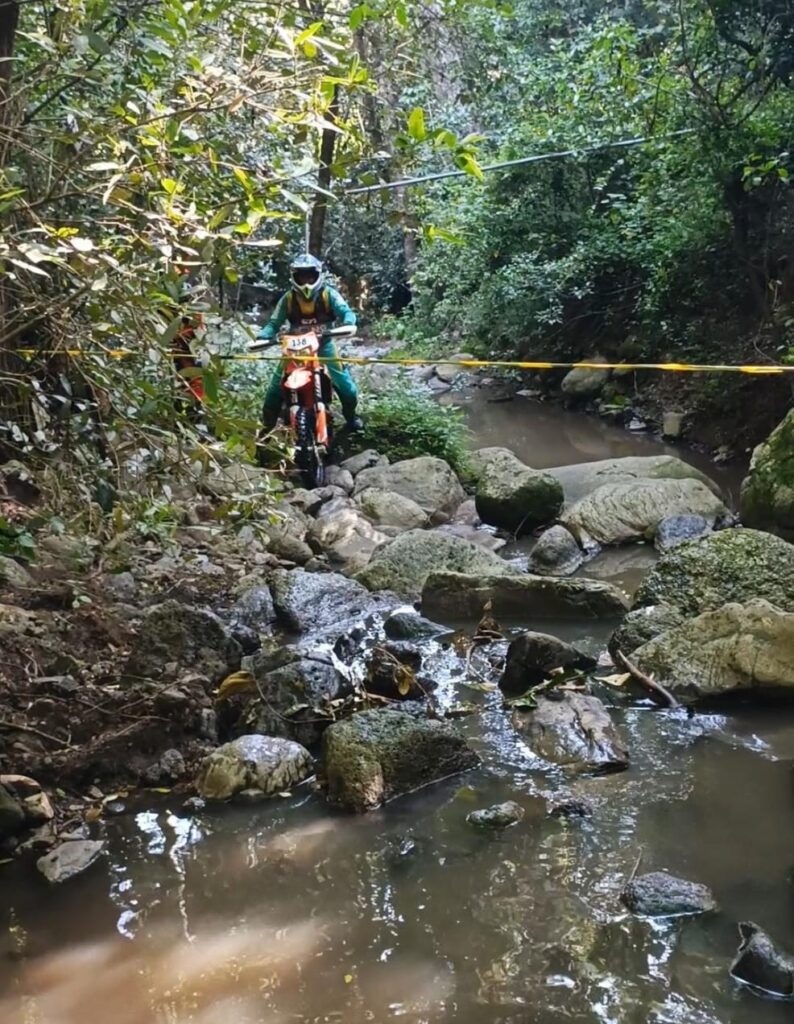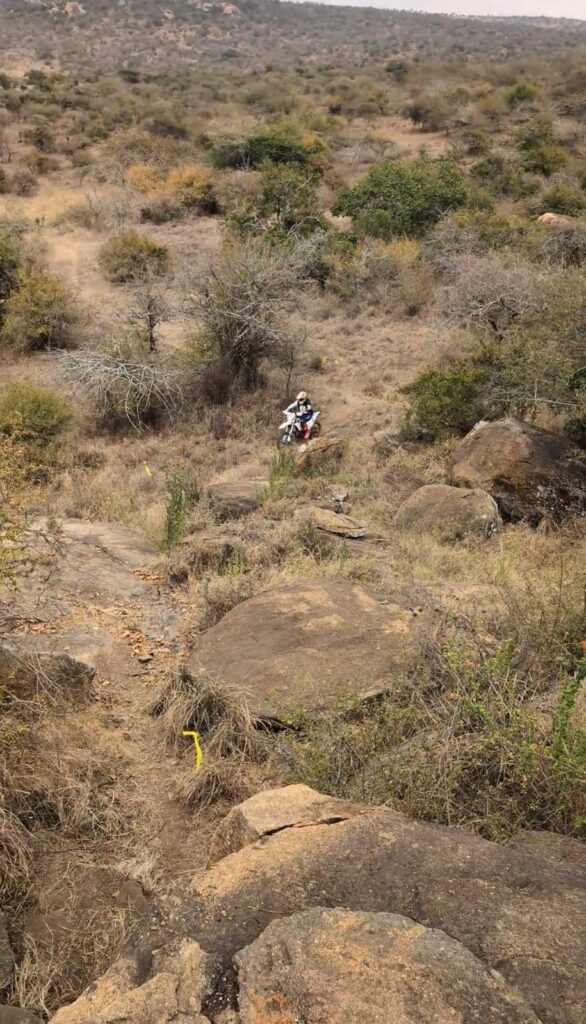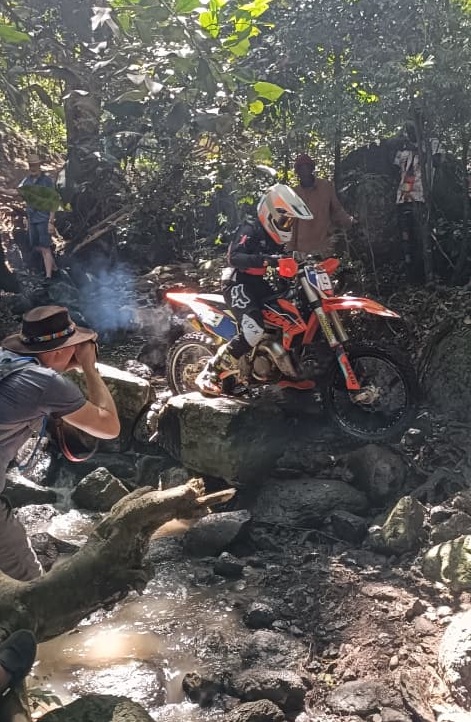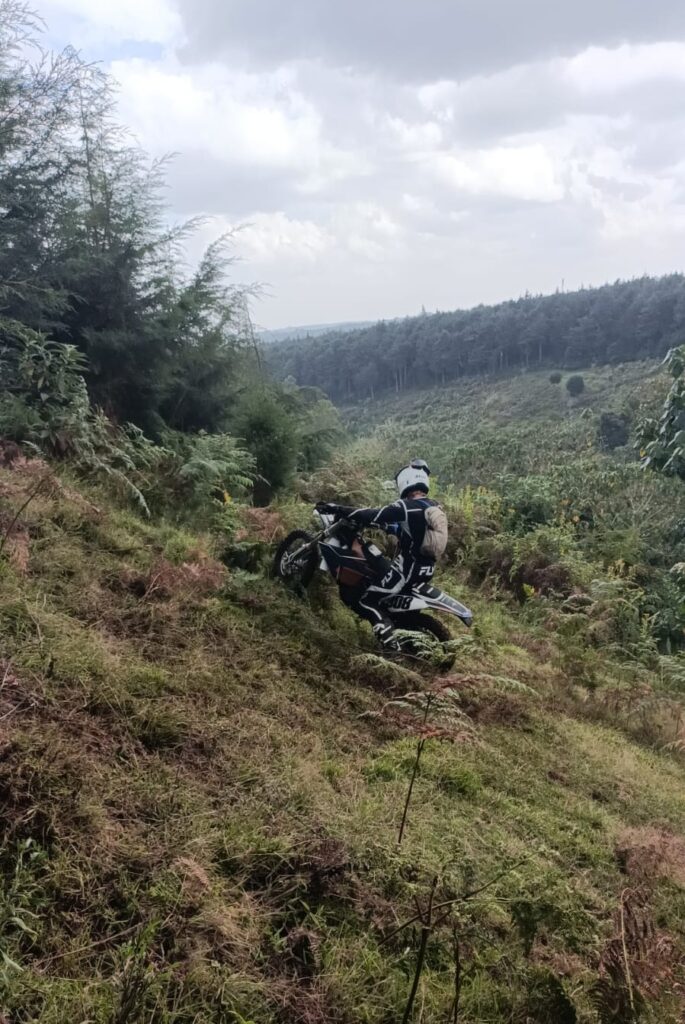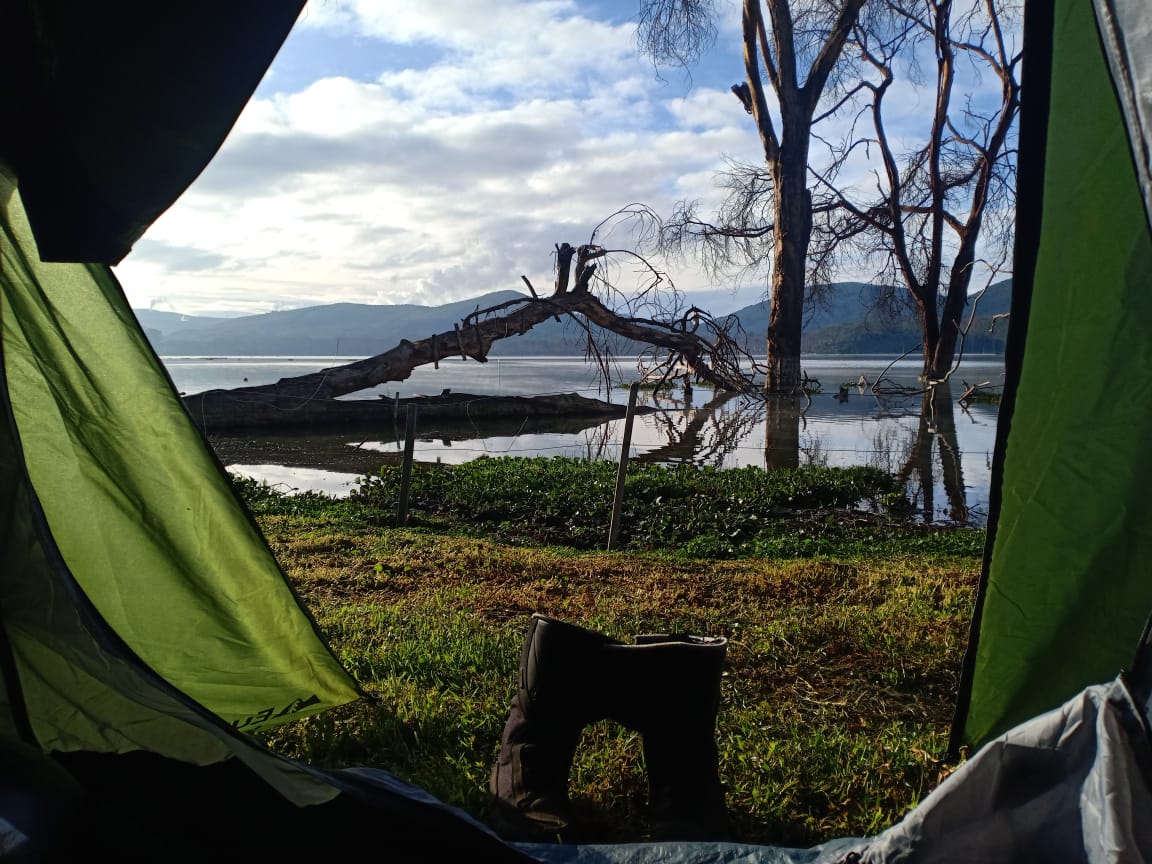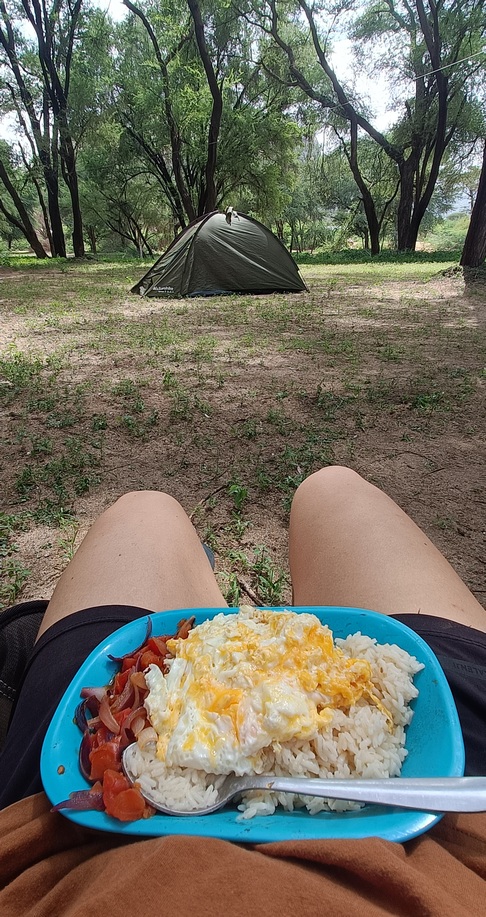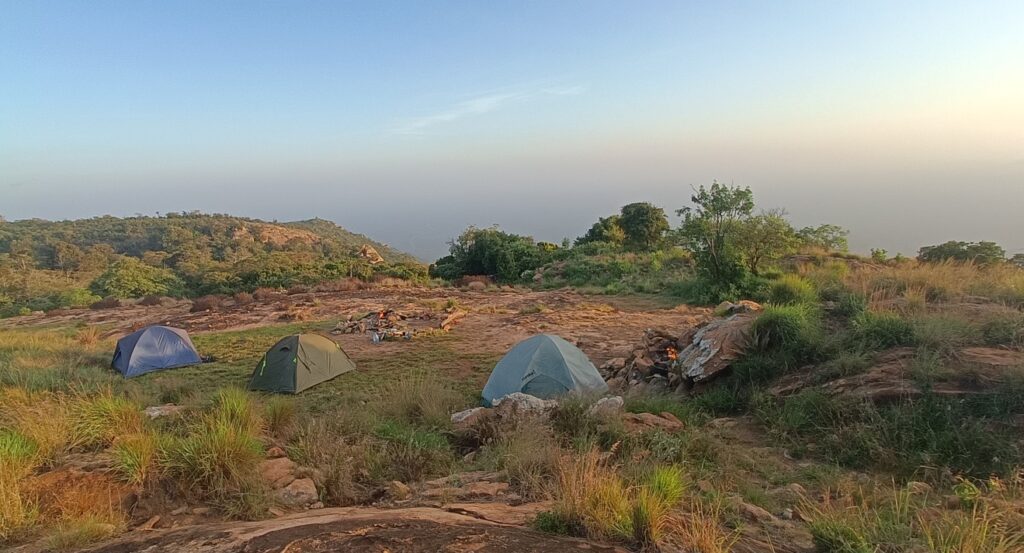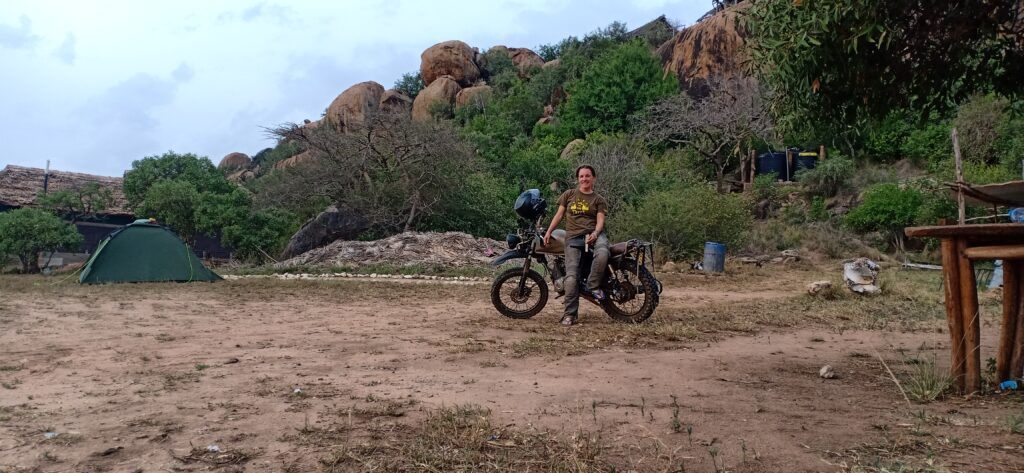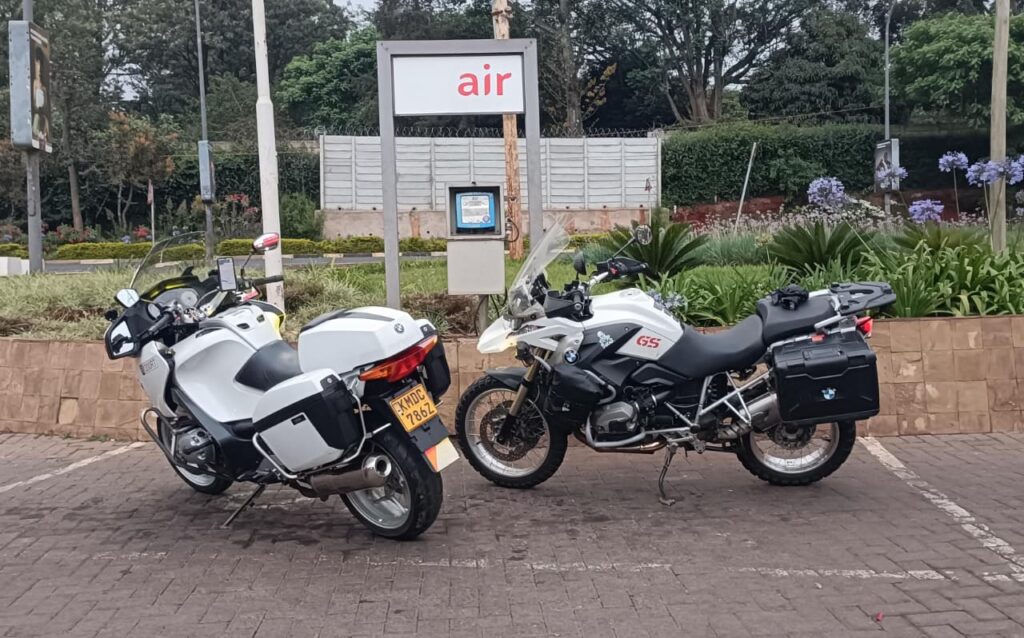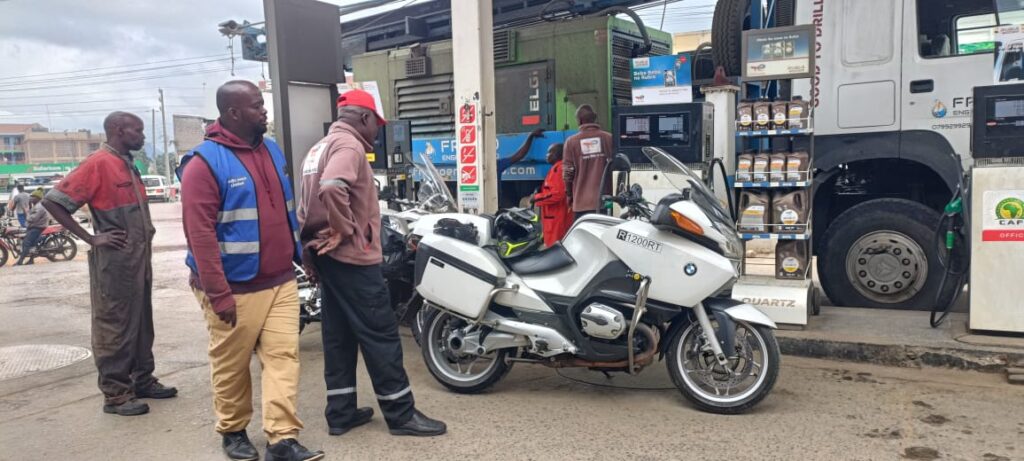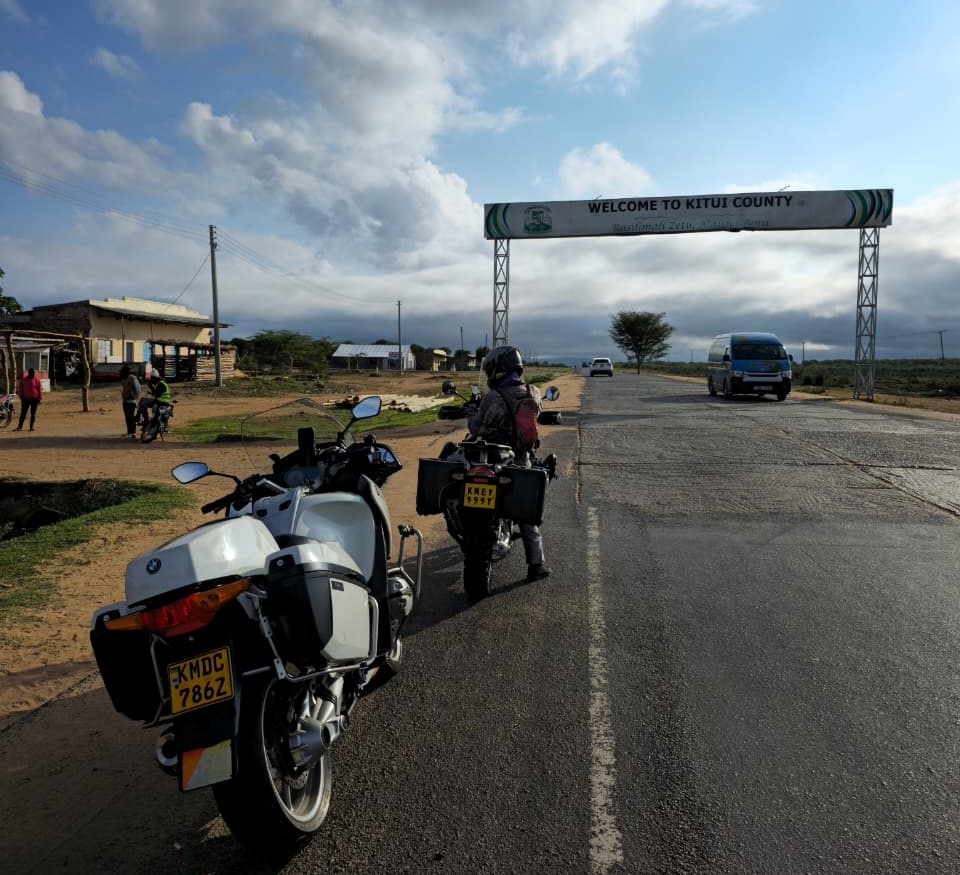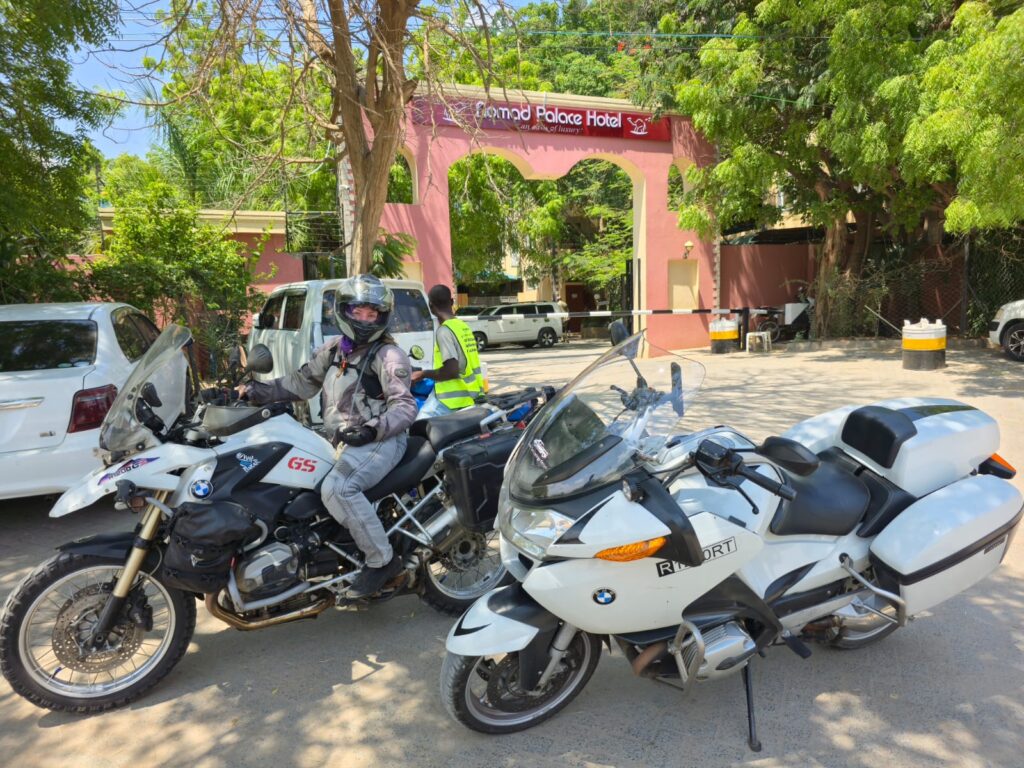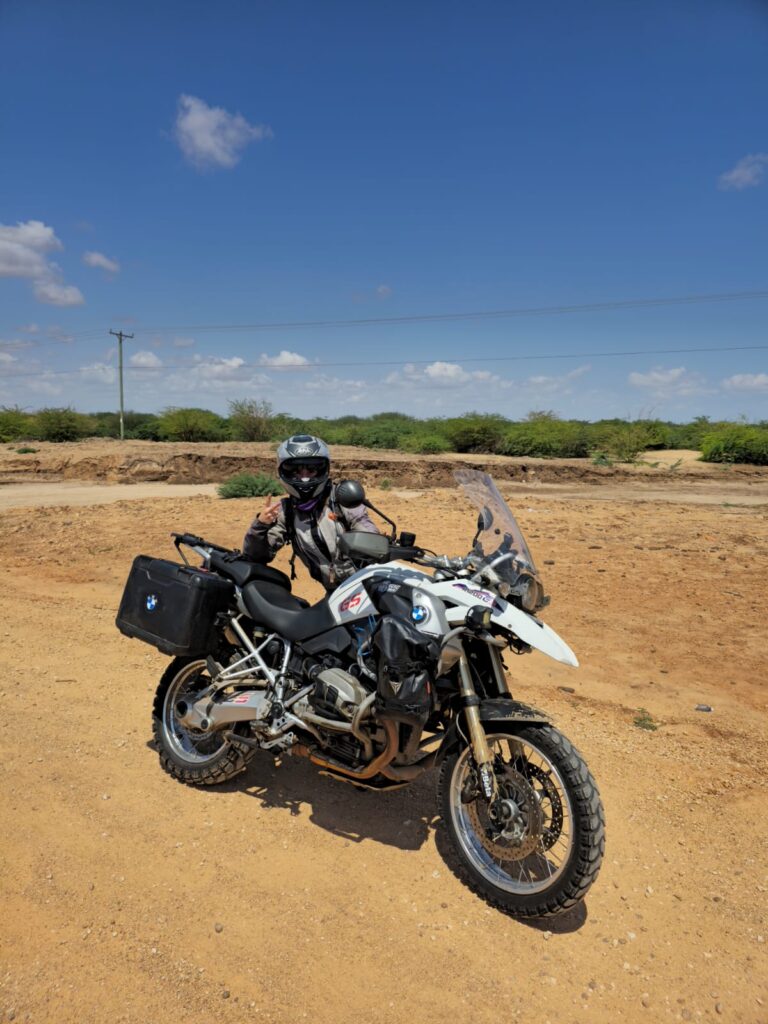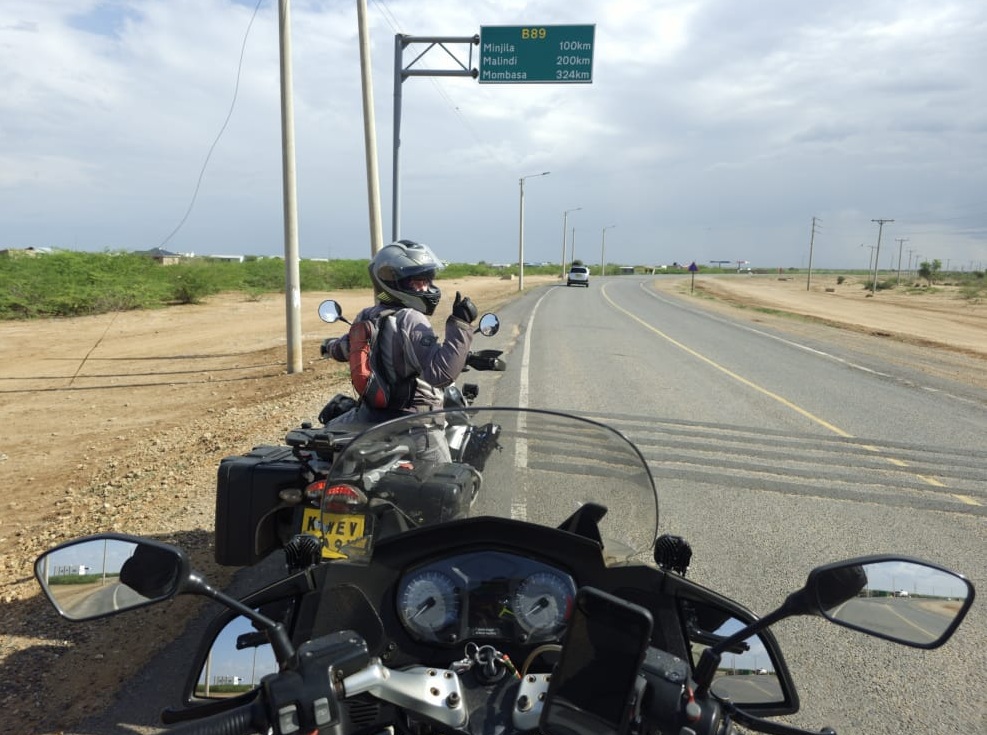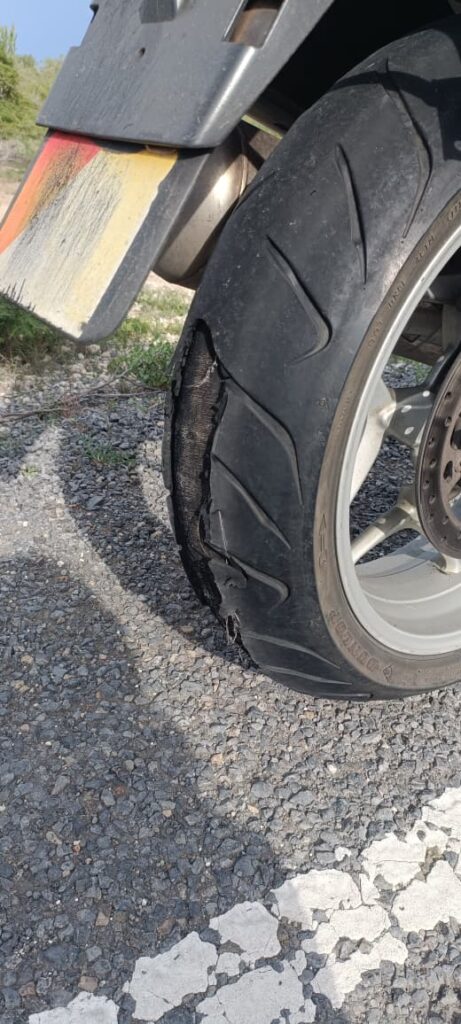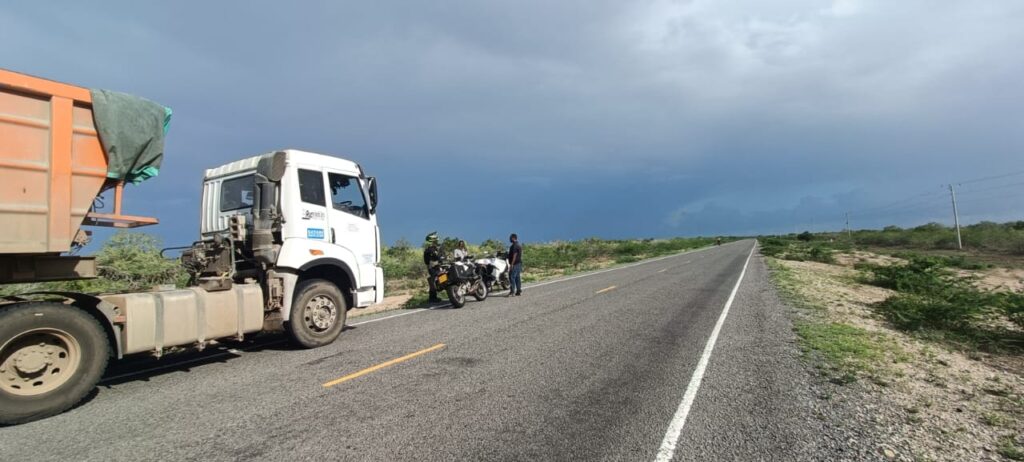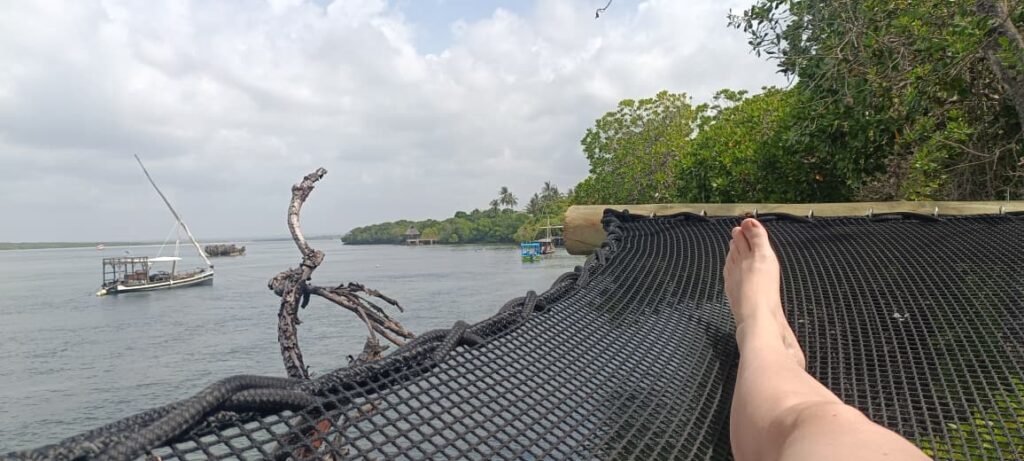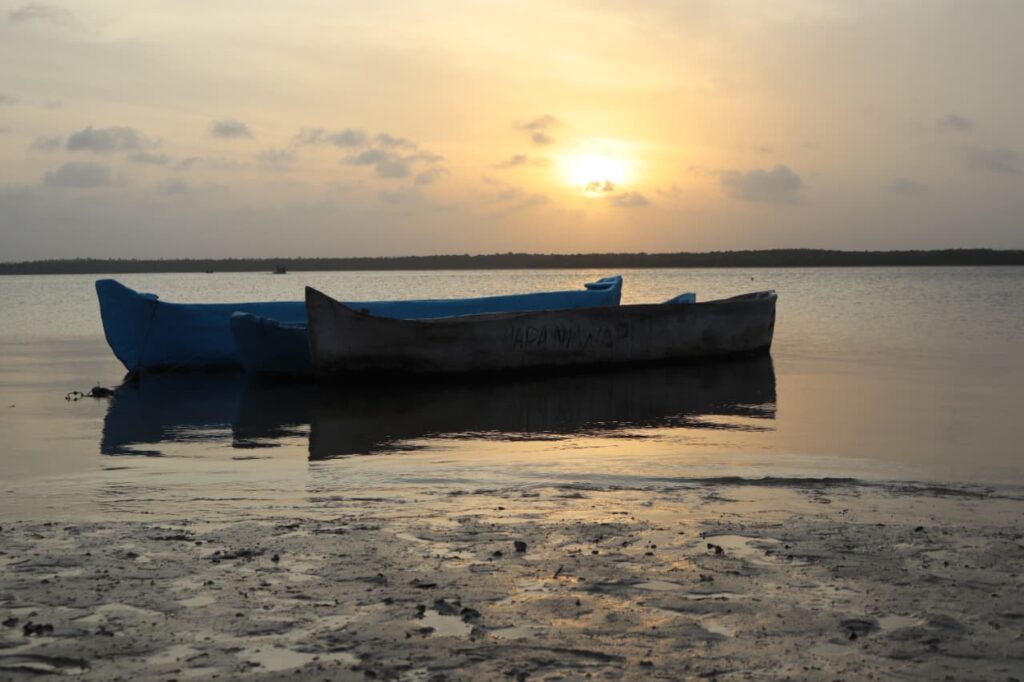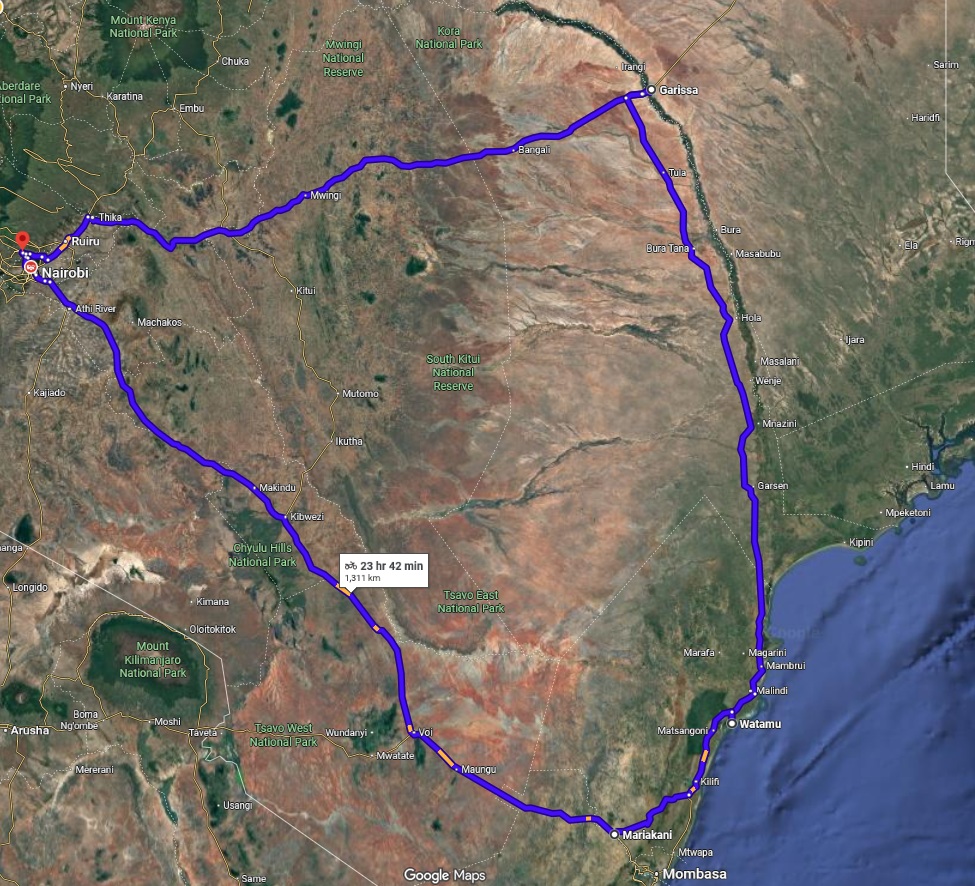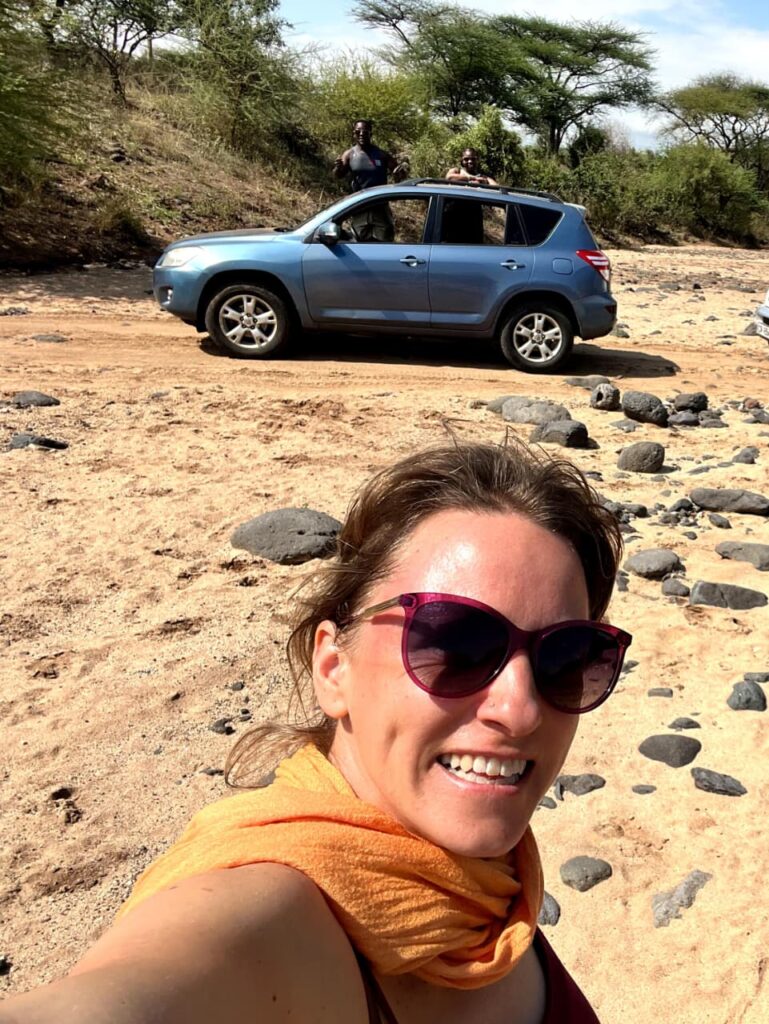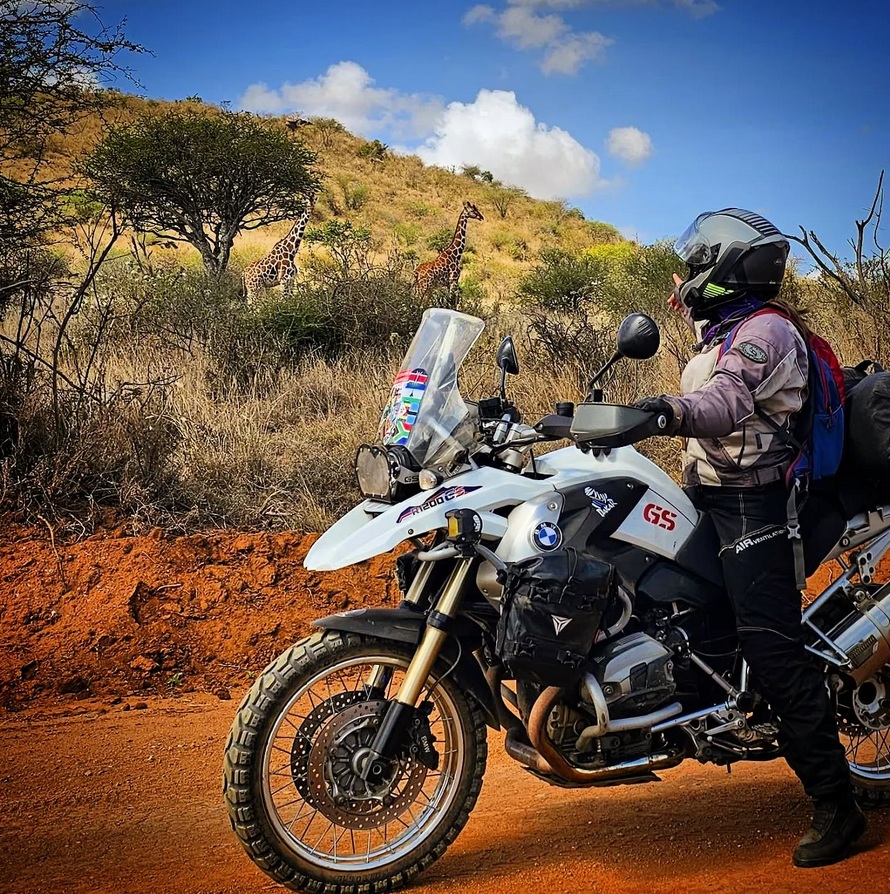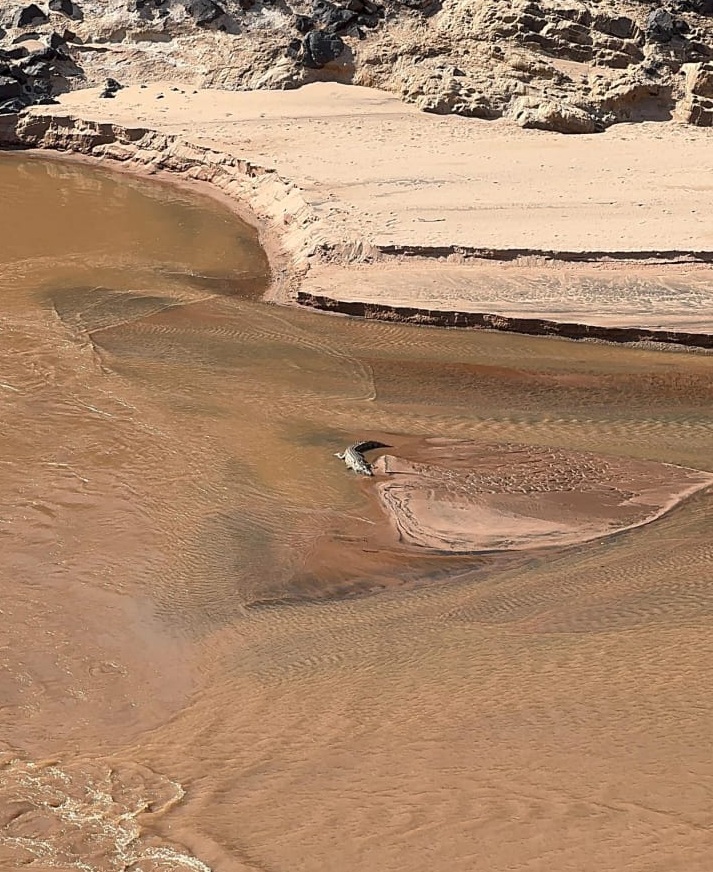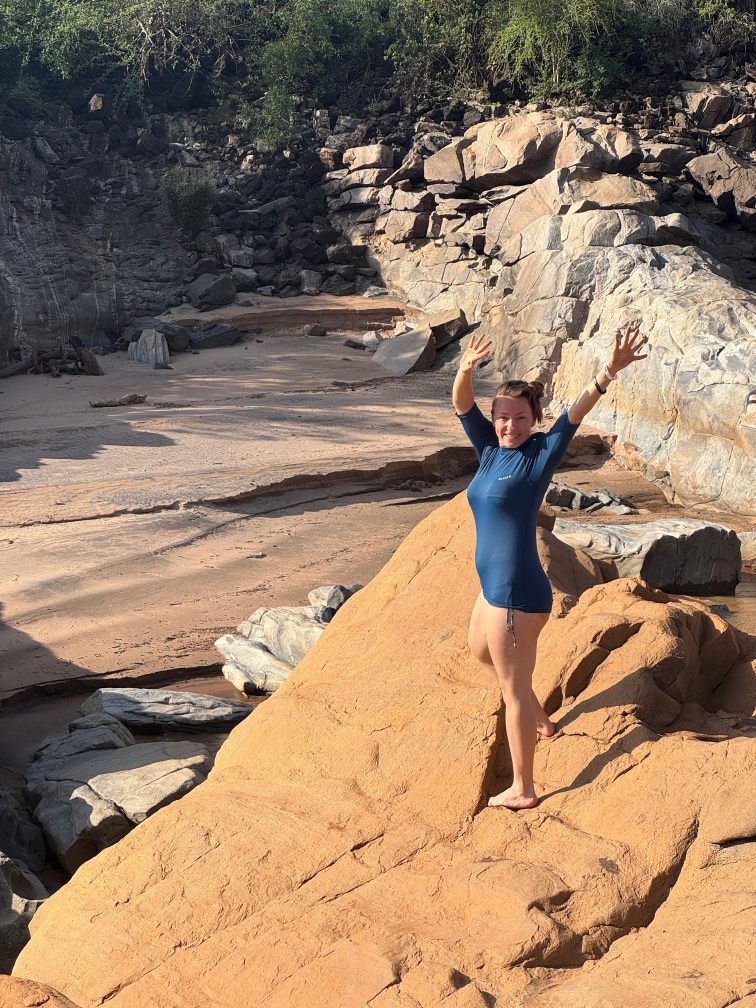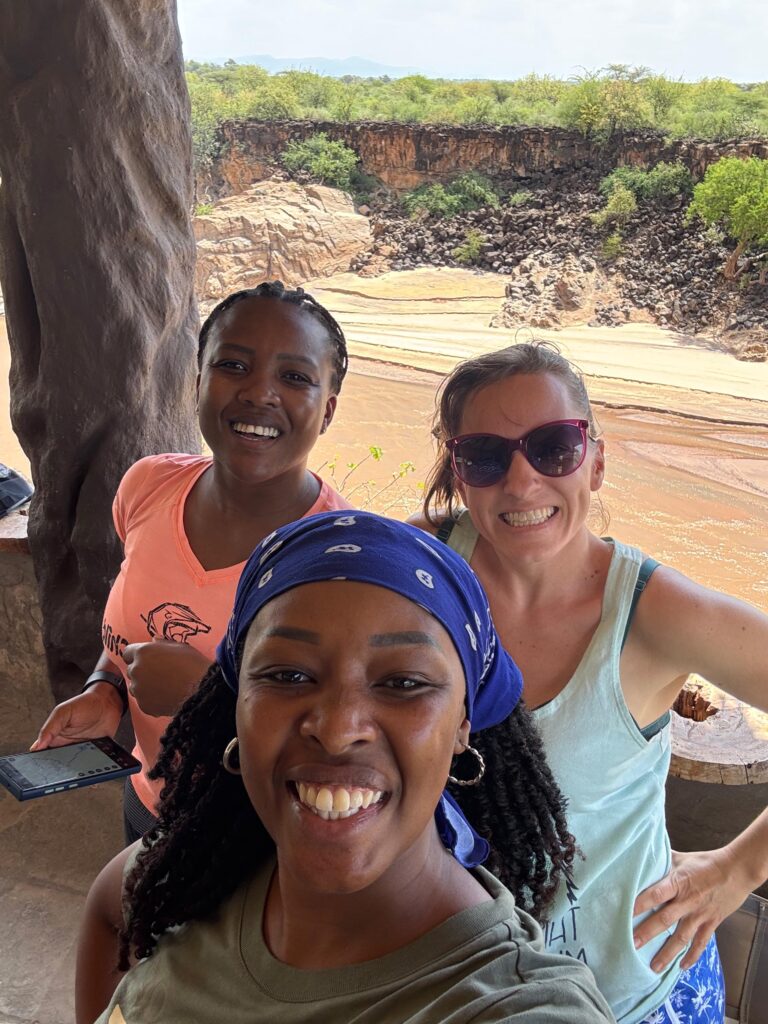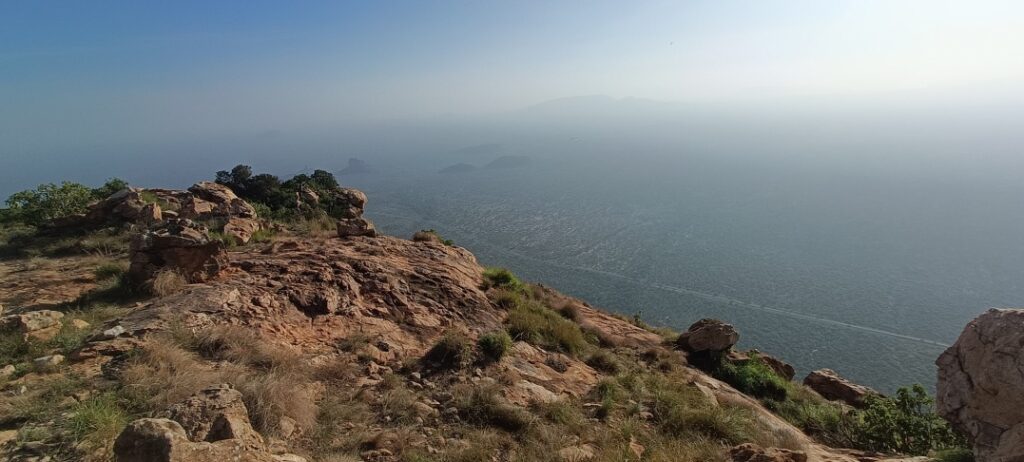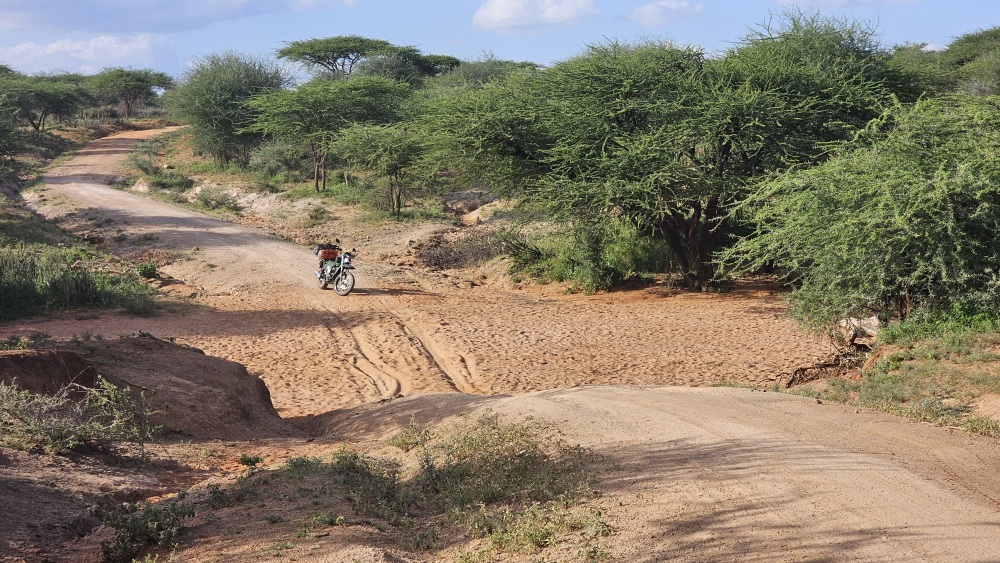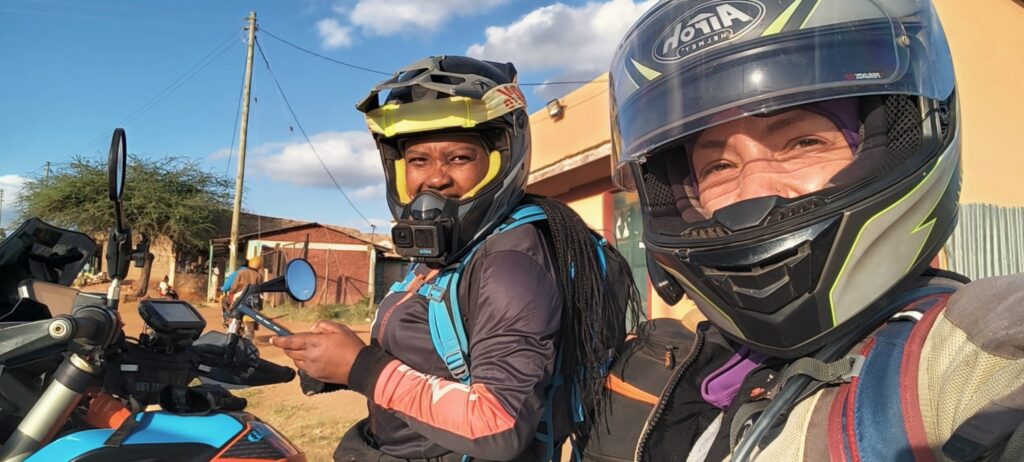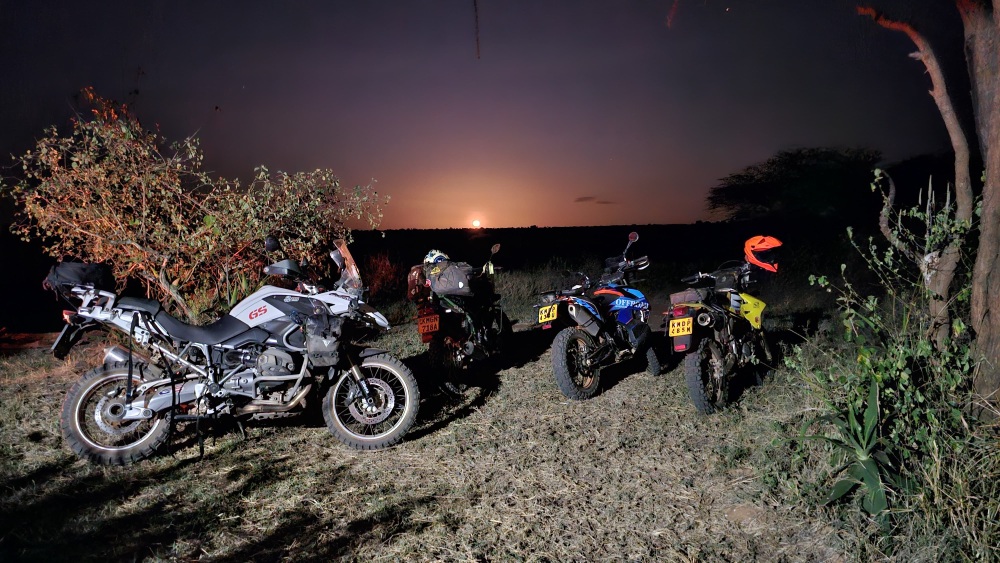
I fell in love with camping young – and never looked back. I’ve been pitching tents since I was about nine. Trading walls for wild places and the freedom of making do with what I carry.
Sure, there are great guesthouse-to-guesthouse routes, and campgrounds with tents or cottages. But my own tent has fewer bugs, my mattress beats most guesthouse beds, and I can go truly remote, always ready if the road throws a surprise. I’ve camped all over Kenya (from church compounds to literal roadsides) and even hauled my kit by bike to Botswana.
People joke that camping is an expensive way to look homeless. Maybe at first. But in the long run, it’s cheaper than rooms and restaurants – and far more rewarding.
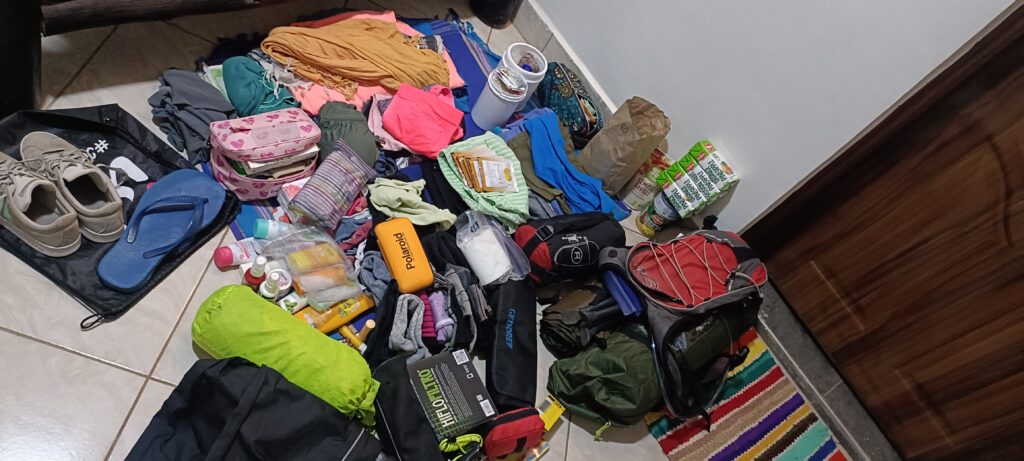
A few of you have asked me for my packing list for motorbike or car camping trips. So here you go!
The items are grouped under 5 headlines. Some of the mentioned items will apply more to a car than bike trip based on volume. And much will depend on your route and personal preference.
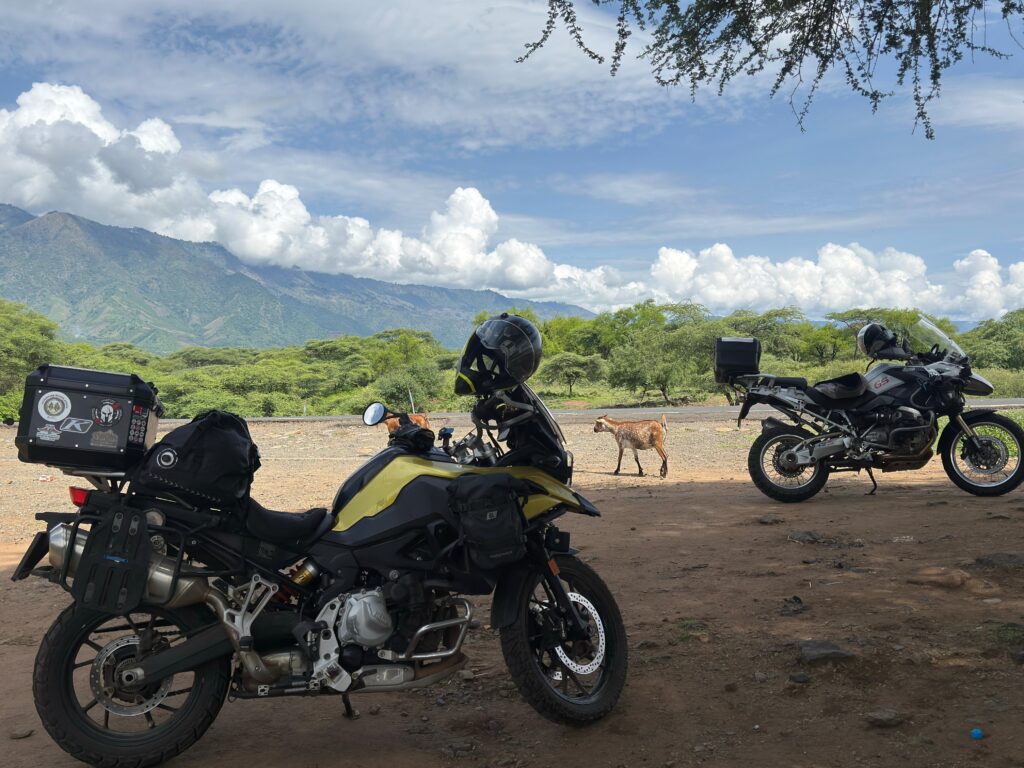
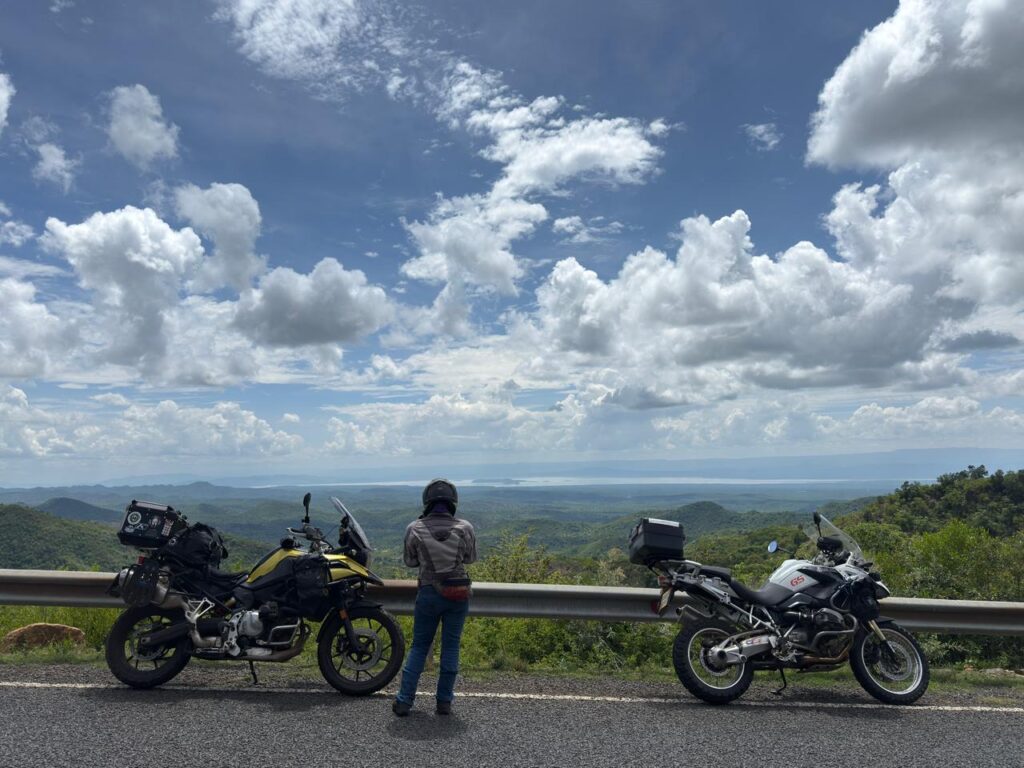
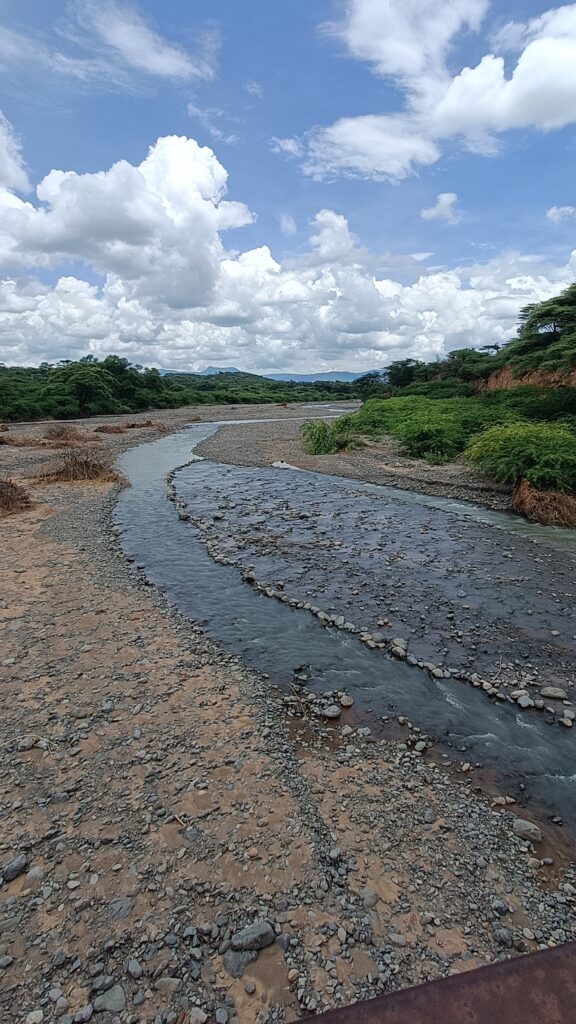
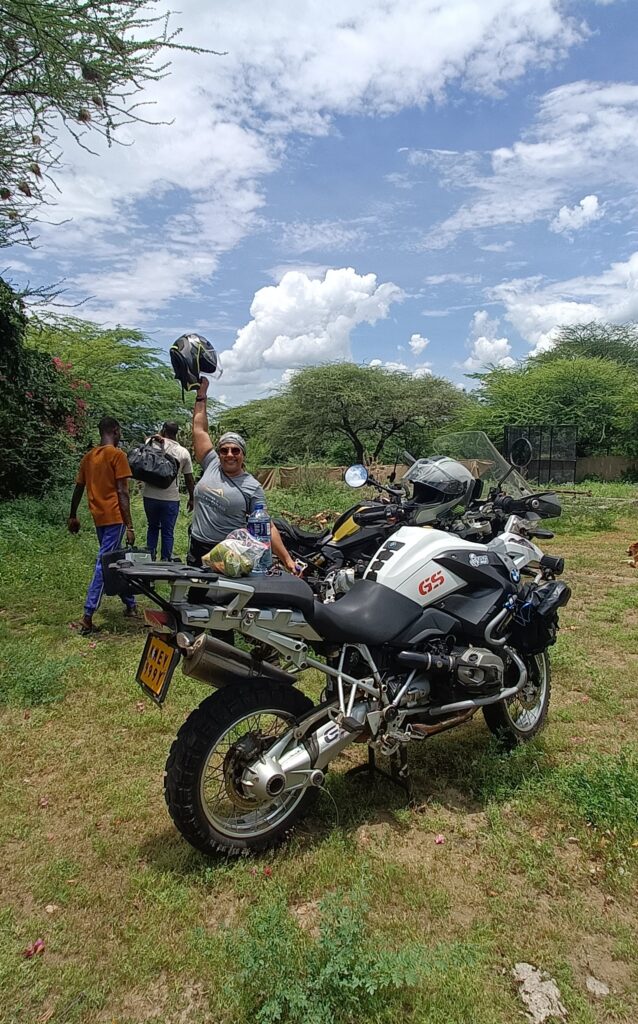
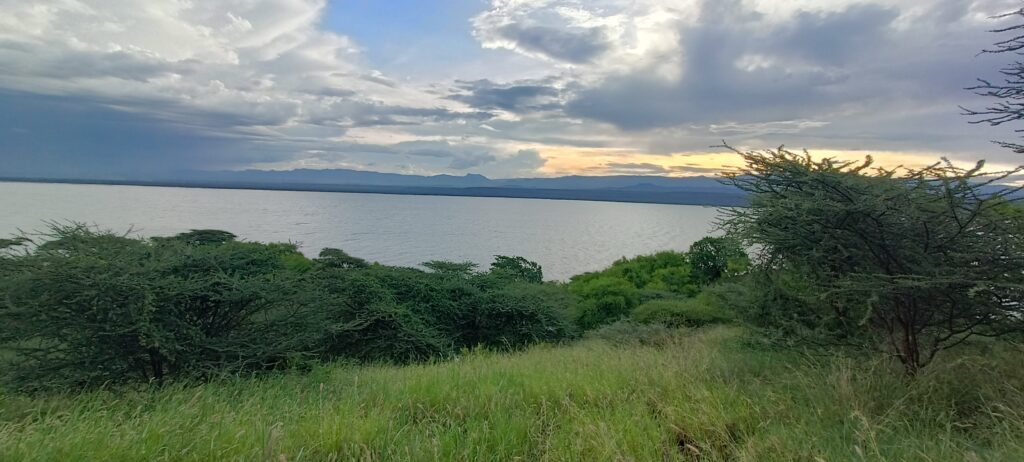
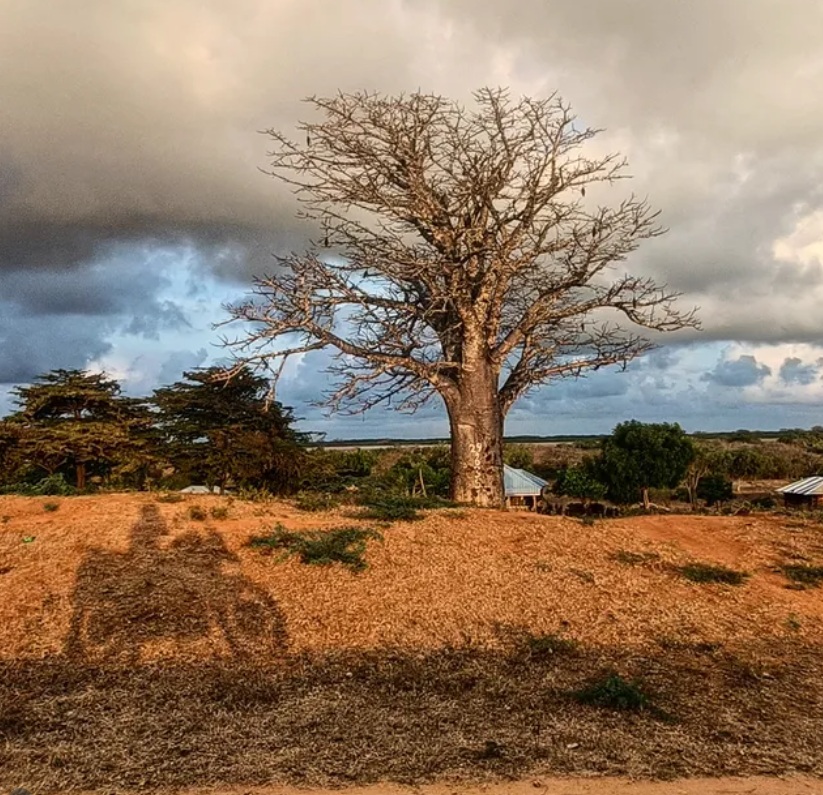
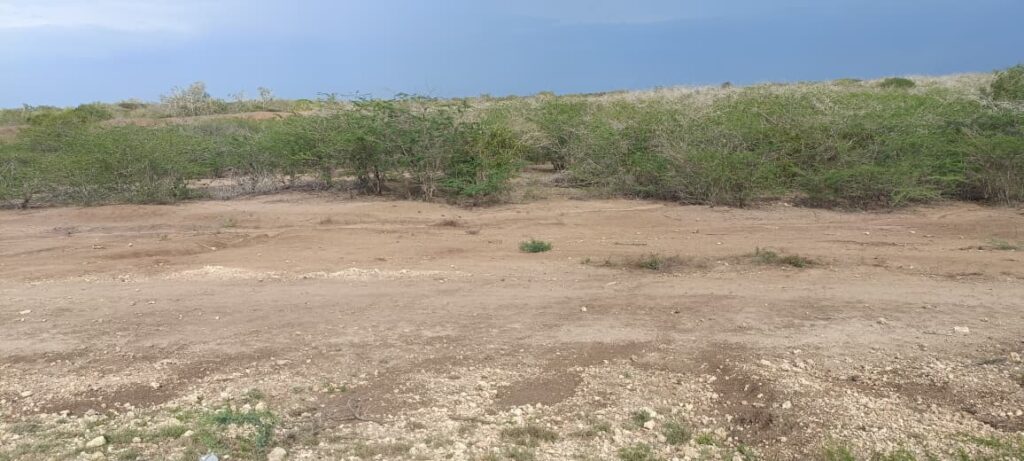
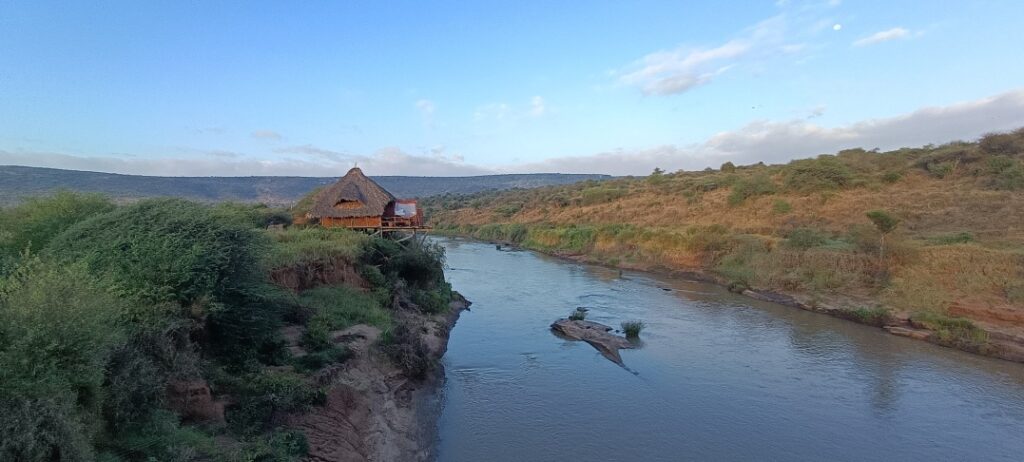
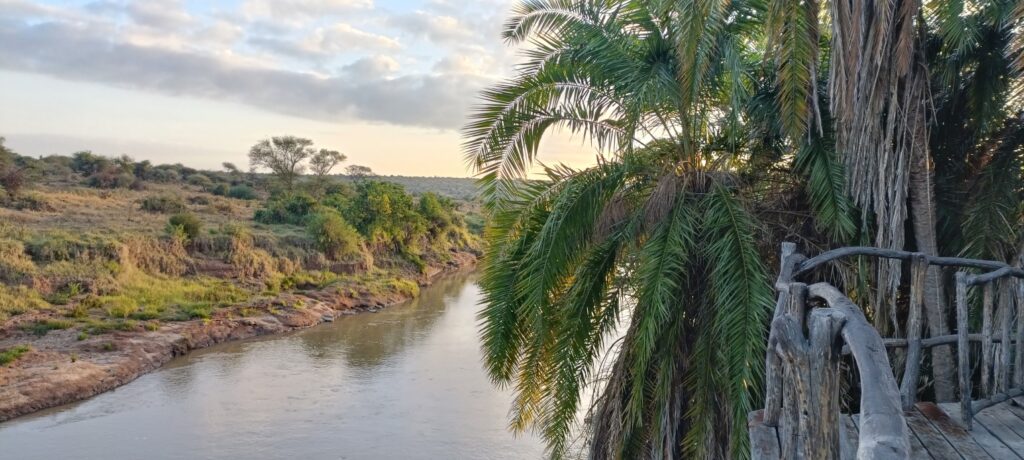
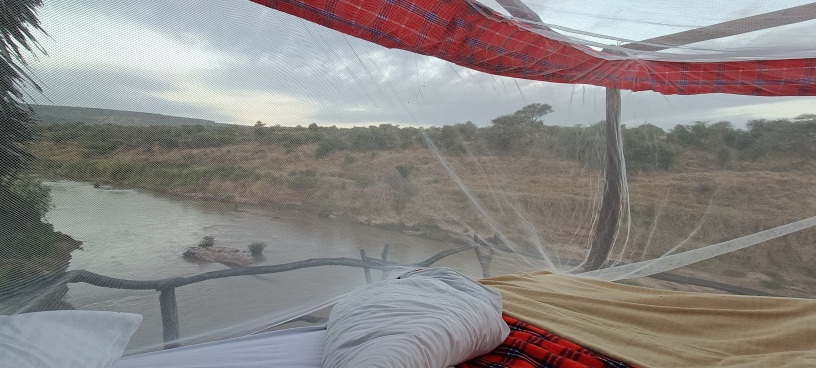
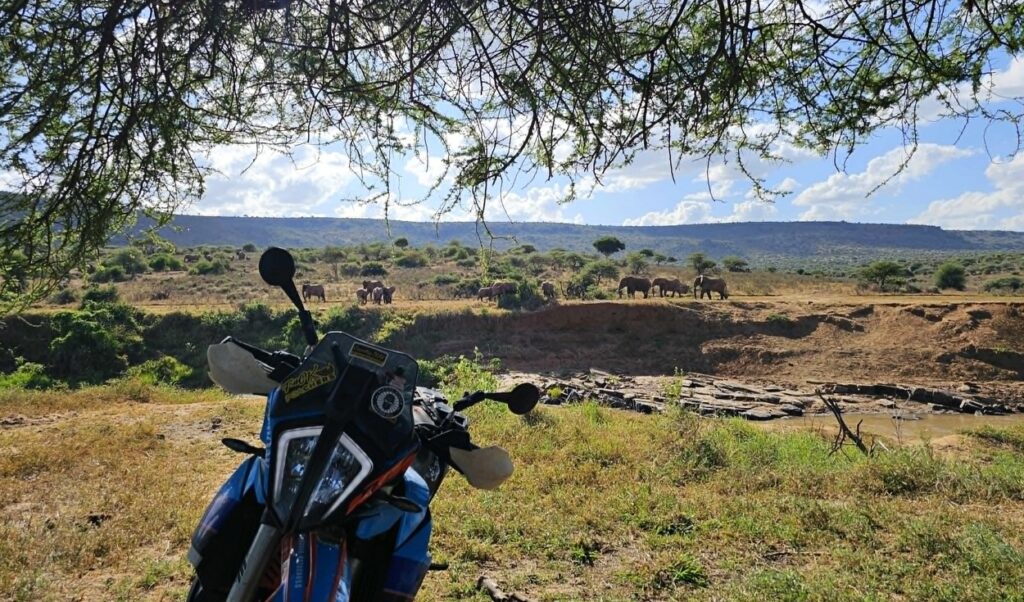
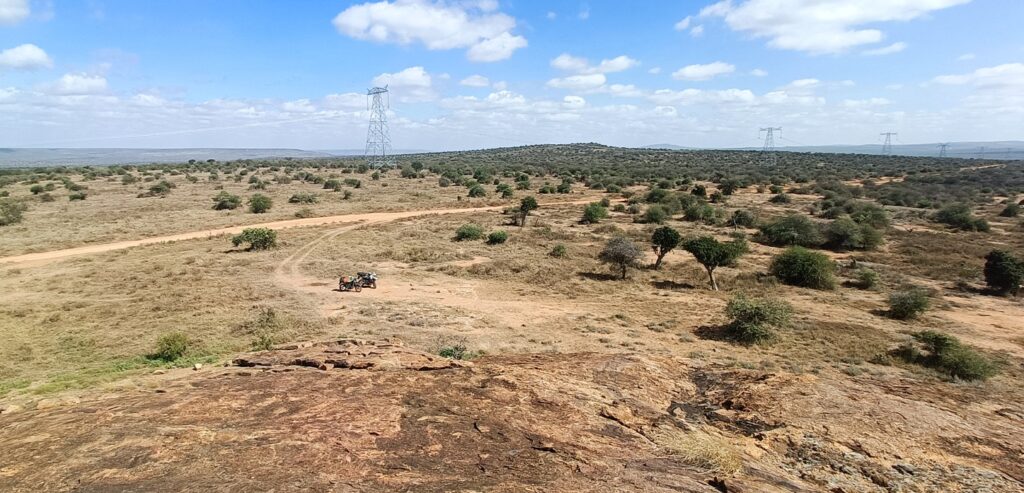
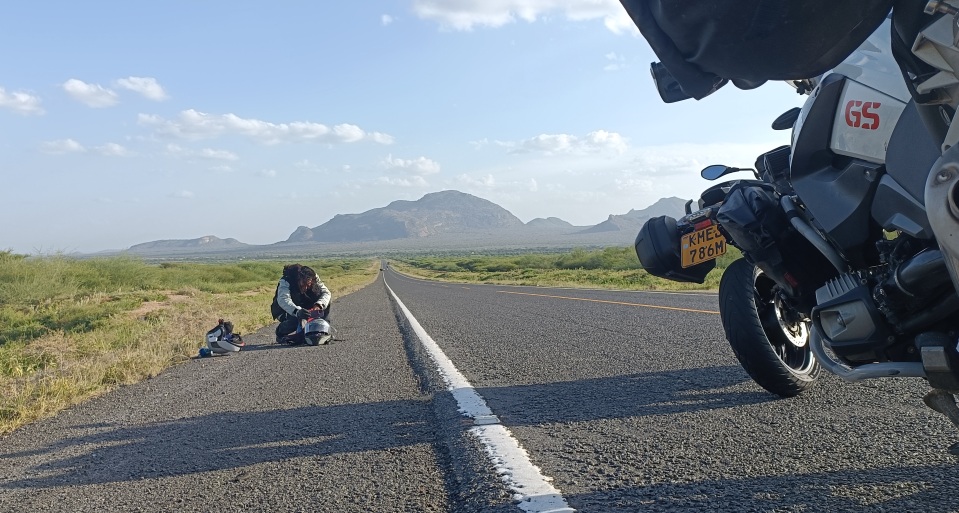
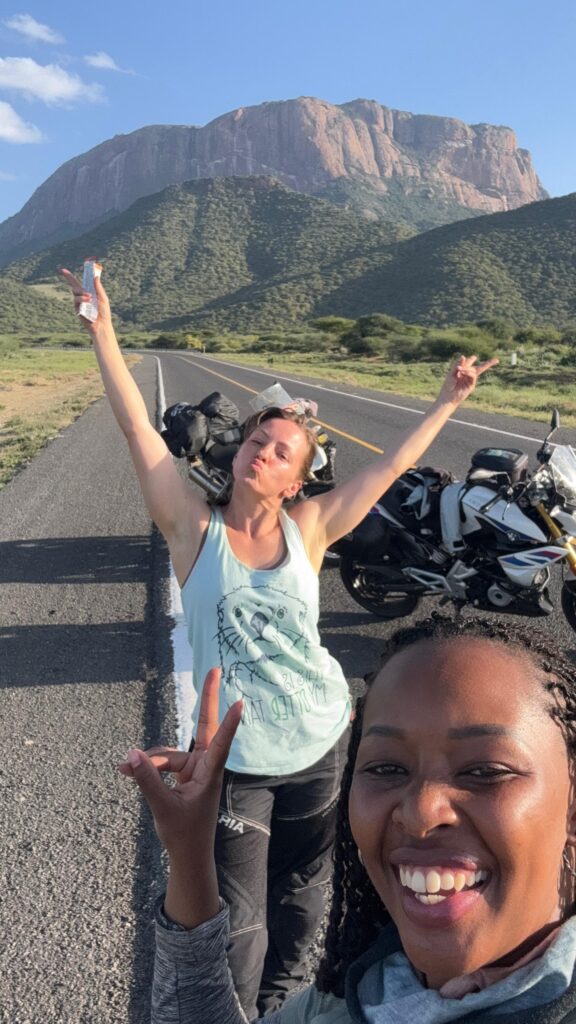
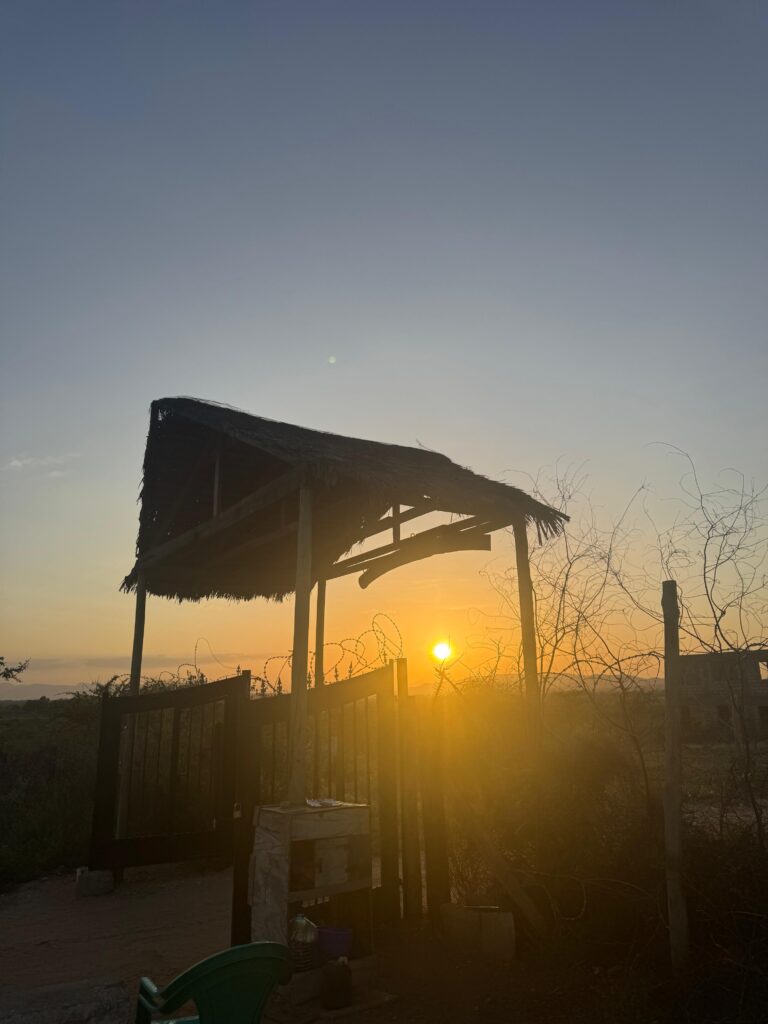
Somewhere in Samburu. 100km from Kenya Power grid in any direction
(1) Food & Cooking
First question, what will you eat? 3 options: rely on restaurants/locals, eat cold/ready foods, or actually prepare hot meals.
Second question, what kitchen equipment is available where you’ll be? (three stones and fire also counts)
Third question, what supplies can you keep stocking up as you go and what needs to be carried from home/civilization?
Ziplock bags or airtight containers can help prevent luggage disasters:
Drinking Water: Often, you end up buying dozens of plastic bottles – on a trip where you wish to connect with nature. On the bike, depending how remote things get, I carry a small portable water filter (Katadyn). Also, 2 liter emergency water is key in case of remote breakdowns. When traveling with the car, I carry a big 10 litre container from home. I also carry about 10l tap water that I keep refilling (car issues, first aid, dishwashing, handwash, etc)
Food I found good to carry (some need cooking, some are ready to eat): Canned tuna, canned githeri, tomato paste, canned pinapple, pasta, rice, lentils, musli, tea/coffee, sugar, milk in 250ml boxes, dried sausages/meat, eggs (car).
Oil (in a screwtop plastic container), spices, onions, garlic. (makes even canned githeri delicious!)
Pot, pan, lid, a knife. (Optional: Cooking spoon)
A few spoons, forks, plastic/emaille cups, melamine/plastic plates (not too flat), small bowls. I usually just carry stuff from my kitchen. Not a big fan of single-use plastic.
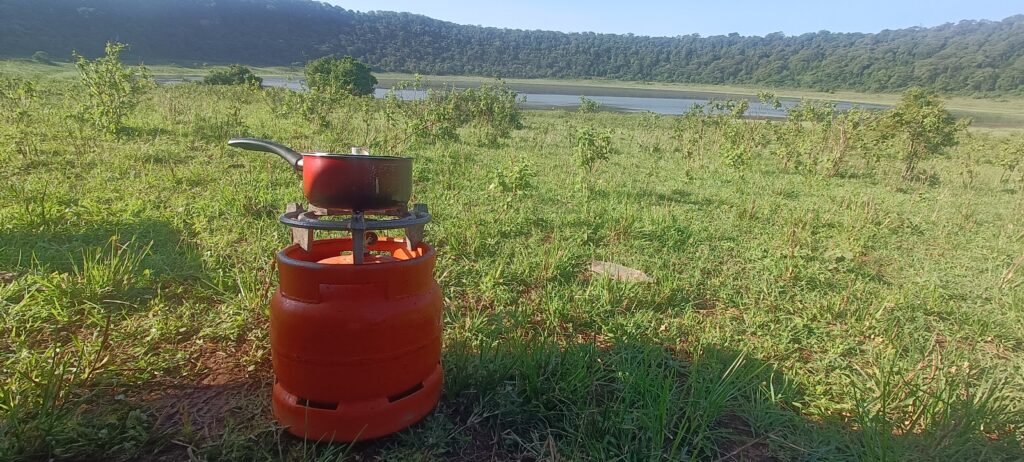
Optional: Gas cooker (ideal for car) or mini gas or kerosine stove (for bike). You could also rely on bonfire or campsite kitchen.
Matchbox or lighter. Dishwashing bar/liquid and sponge. Kitchen towel for wiping hands. Some garbage bags.
Snacks: Juice boxes, peanuts/almonds, dried fruit, musli or protein bars.
Frozen sausages or meat usually thaw by evening and hence should be prepared (thoroughly) on the day of purchase.
(2) Camping
Here the climate plays a key role. (a) What will the night temperatures be? (b) chances of rain?
Tent with all its sticks and pegs.
Mattress (+pump).
Kikoy/sheet for under, blanket or sleeping bag according to climate. Hot water bottle for really cold places.
Nice to have: headlamp, camping stool/chair.
Tissue Paper. Consider something to pee into at night if you’re in hyena territory. (Depending on toilet accesss: Spade for digging holes for number 2s.)
Optional: Hammer, pillow (inflatable or the real deal). Solar light (+panel for longer trips)
(3) Car/Bike needs
Obviously, they must be serviced and vital things working well (oil level, coolant level, tires holding air, brake pads, …)
Fuel range and budget calculated. Petrol stations along route researched.
Tools, some zipties, electric tape, …
For car: Spare tire (check pressure), tire jack, tools.
For bike: Puncture Kit.
You might find someone who knows how to help you, if you have the tools. (even YouTube)
(4) Medical
You are going into nature, where plants and animals live. And where it’s hot and dry and/or maybe unexpectedly cold and wet.
First aid kit. Knowledge how to use it.
Oral Rehydration Salt sachets.
Mosquito repellant.
Long pants that can be tucked into your socks. 🐜🐜🐜
Closed shoes (reduces risks related to thorns, snakes, scorpions and their friends)
Sunscreen.
Basic meds as per discussion with your doc/pharmacist: antihistamine creme, painkiller, an anti-inflamatory and broadband antibiotic. Any other personal meds.
EpiPen in case you have any reason to believe you might need it.
In the same breath: Do not wear/carry perfume or scented lotions. 🐝🐝🐝 Leave people at home who insist on using them. (Not kidding)
Emergency contacts briefed. Health insurance updated and call numbers saved. Closest hospitals researched.
(5) Personal needs
This comes last because by now your space will be limited.
Charging cables (phone, camera, etc). Powerbank. Ideally a bike/car charger.
Clothes (layers, from hot to cold). I like arranging them in smaller bags (red = new clothes, black = dirty clothes, …).
Your toiletries. (Again, no perfumes or scented lotions!)
Menstrual items. (sometimes travel changes the cycle)
Sunglasses. (Contact lenses. Glasses.)
Laundry soap, a few pegs.
Towel. Slippers for shower.
Gear for planned activities: Swim suit, camelbak and shoes for walks, sports bra, …
Optional: Camera, binocular.
Optional: Fun stuff (books, card games, diary, arts stuff, …).
Trip budget completed. 20% emergency cash.
Haha, this list looks long. I usually arrange everything, then see how to pack it in a way that I find things on the road. (Car: boxes, bags. Bike: smaller bags in the big bag)
UPDATE: SOLD. Thank you for your interest and messages.
————————————————————————–
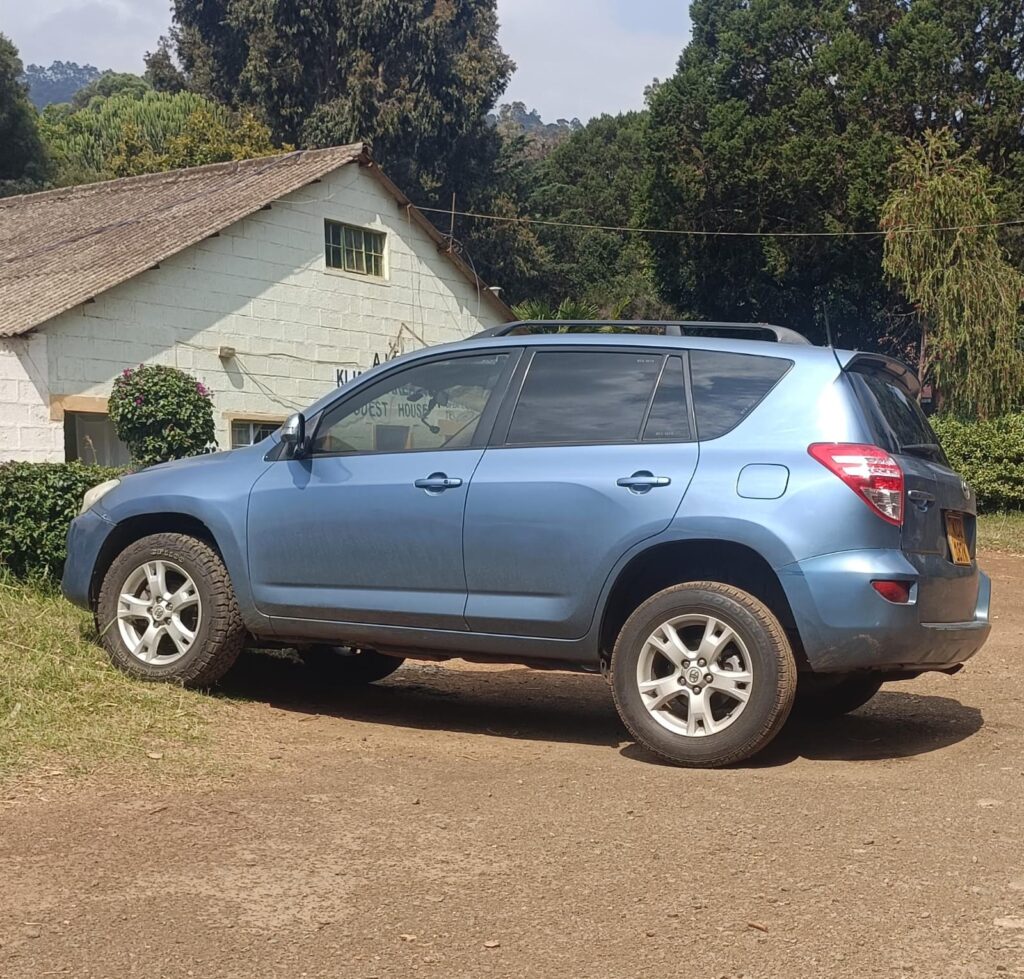
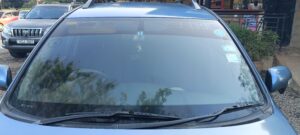
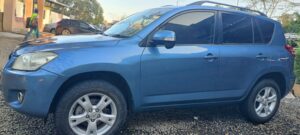
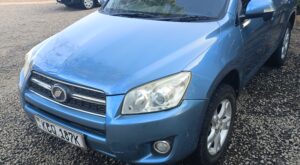
I’m selling my RAV4 2011 at 130,000 km. It’s a 2.4l engine, automatic 5-speed transmission and two wheel drive.
Have a look at the details below and if interested, reach out. Viewing in Ruaka. See more photos and video at the bottom.
What I love about this car
Keyless system. Took me some weeks to figure it out but now I love it. The cars opens and locks if you just touch the driver, passenger or boot door handle, as long as the key is in range (my bag or pocket). The other advantage of this is that the car can’t lock with the key inside. (You can still use buttons on the fob or an actual key to open or lock the car).
Headlights. They are the stock LEDs. They don’t blind oncoming traffic but I see very well with them at night.
Comfortable. It’s my first “SUV” (well, compact crossover SUV) but it handles our Kenyan road really well (rumble strips, the bumps, uneven surface, rough roads). Seats are comfy and great leg space for everyone.
Ground clearance. I did a few light offroad road trips and not needing to worry seeing rocks or wash-outs is really a win. Same for speed bumps.
Smooth and stable. If you need to overtake, it picks up sporty (it’s 2.4l producing around 160 hp). On highways and bypasses you cruise easily at 80-120 without any strain. It can probably do much more but you know our speed limits. – I found it very stable when cornering or swerving as well.
Electronics: It has every function I ever needed.
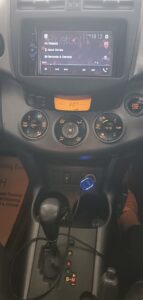
The best part is putting the climate control on automatic, with AC on or off depending on the season. Never had to handle windscreen fog.
Even better is the reverse camera, great for parking in tight spots.
All electronics are working (window, central lock, cigarette lighter/charger).
The Pioneer Radio connects to your phone via bluetooth to play music or display caller info. It also has a USB to play music from. No maps function, so when needed, I use Maps using my phone.
If you have a heavy foot 😬 the “eco” light helps you stay within a good fuel range.
The car has cruise control, but I’ve never tried it.
What you need to know: This is a used car in excellent state
Accident free.
I have done a bunch of out of town rides and have never had to worry about a breakdown. Engine, cooling system, suspensions, etc are in great shape.
This is a 2 WD. I have done some fun offroad drives with it (Laikipia, Namanga, Mt Kenya, …) – but it’s not a Landrover that chews steep long gravel hills.
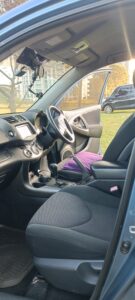
Interior: All seat fabric is perfectly neat. Some scratches on interior plastics.
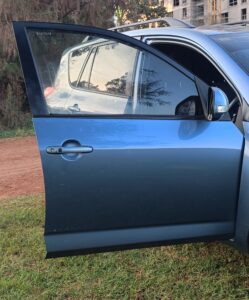
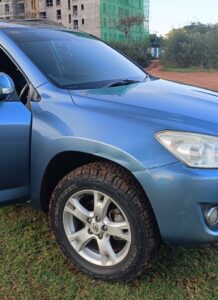
Paint: I repainted the left side (kids scratched both doors) and the right front and rear wing (scratched in parking lot). Has scratches on front and rear bumper and driver door. It’s Nairobi, right? (I can share the number of the paint guy who does a great job matching the blue shade incl. the sparkles)
Sale Price
The car is being sold at 1.5m KES – ONO.
It is comprehensively insured, and at 14 years old you should not have a challenge to do the same. I got two valuations for this car (1.6m KES in 2024 and 1.52m KES in 2025), reports available.
Reason for selling: I was given a very similar car to watch over while the owner is abroad and I don’t need two.
Car History
It was imported to Kenya in 2018 from Japan. The first owner used it mostly in and around Meru town and I bought it from her in great condition in April 2024 at 118,900 km.
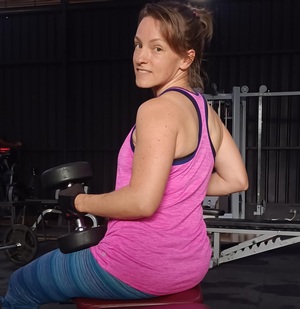
The correct title of this post should be “strength training”, but that sounds less exciting, right? Lifting weights, aka strength or resistance training is when you move heavy metals against gravity to grow muscle over time to increase your physical strength. Fun fact: Weightlifting is a competitive sport, with the 2 main lifts you see on TV during olympics
I started out around my 40th birthday and my goals broadly was to get fitter and build a great foundation of strength to keep my lifestyle and hobbies going for the next forty years.
I got three tips when starting out. They 200% worked for me. I thought they would helpful to others as well so I’ll share them below and explain how I worked with each of them in my first months.
Tip 1: Let your objectives guide your program.
“You need a program. What are you trying to achieve?”
Such a hard question!
I don’t need to lose weight. I am not going to compete in a bodybuilding or weightlifting competition soon. I’m not heading to the Himalayas.
Should I focus on lower body strength, because my yoga workout already gives me a lot of upper body strength – or might that create imbalances?
I landed at “be stronger, leaner, fitter, and healthier”. How my body would feel climbing a certain mountain or staircare. How my lower back will feel in a few years from now. How my knees feel walking down a steep hill. That I might one day be able to lift up my heavy motorcycle if it falls. Nicely shaped arms and legs. And if the exercise could over time heal my cardiovascular system and help manage my blood pressure that would simply be epic!
Coach Rob (Women Who Lift Weights) on his podcast suggests to set goals for both, the process and the outcome. Interesting, right?
Process goals could be a heavy lifting session at least 10 times a month, or doing squats every single week, or always warming up for 15 minutes before starting the workout, or not giving a damn about who sees you sweat.
An outcome goal could be an ability to do your first pull-up, or reducing belly circumference by 5cm, or being able to jump up on a 1m high box without using your hands.
I would take this a bit further and suggest setting outcome goals in 3 areas: health (what changes will you notice in your health?), lifestyle (what changes will you observe in your ability to use your body?), and aesthetics (what changes will you see?). The more measurable the better!
So what is a program? It is a plan towards your goals, something that tells you what exercise you do on which day. Basically it should answer questions like: How many days will you lift weights? Which muscles will you work on which day and using which exercises? How intense will the workout be? How many repetitions do you do per exercise? What other exercise or workouts or movements will you do besides lifting weights?
Having goals and a program helps you not panic when you see these
Whatever program you go with, three aspects are key:
Consistency. Working out one week a month won’t get the results, and could lead to frustration or even injury. To grow muscle you need to work them regularly over an extended period of time. Also other important supportive tissues like tendons, ligaments and fascia will be strengthened slowly and over time. Designing a plan you can do consistently is the most important.
Progressive Overload. This is a fancy way of saying that you will increase the difficulty of an exercise as you get stronger. Difficulty could mean chosing a heavier weight, doing more repetitions or moving the weight more slowly, hence increasing time the muscle is under tension. So if you do 8 repetitions (reps) of a certain exercise with 5kg weights today, maybe next time you will do 9 or 10 reps. And the week after you might try to lift 7kgs, but maybe only manage 6 reps. Until one day you lift 100kgs. Or not, but you get the idea.
Recovery. If you work the same muscle heavily seven days a week, when is it going to regenerate and grow? Muscles take 48-72 hours to recover from intense strength training. If the idea is to overwork the muscle to break it, so it regrows stronger and bigger, you need to rest the muscles.
My good friend and gym role model suggested a 3-day split: Back Day, Leg Day, Shoulder/Chest/Arms Day. You basically split the body into 3 parts in a way that minimizes overlap in muscle activation, promoting better recovery and muscle growth. There is a lot of info online about a closely related approach called Pull-Push-Legs.
I dove right in and have been using it with a few variations for nearly two years now! I love that I go to the gym only 3 days a week, having other days for my yoga, forest walks, and my weekends for trips and fun. (I’ll share more info on the program and how I’ve kept it interesting for almost two years in an upcoming post).
I later realized that most gyms put people who start out (especially women) on full body workouts, focusing more in the cardio (many reps, little weight) and encourage 4-5 sessions a week. I’m glad I wasn’t victim to that, as it could have discouraged me, and didn’t fit my goals.
If you have more complex goals or previous injury, you could develop a personalized program with a personal coach based on your objectives.
The day I actually lifted 100kgs!
Tip 2) Eat for Fuel
The second tip I got was to look into my diet. I was eating relatively clean already, minimizing refined sugar, processed or fried foods, white/empty carbs, prioritizing unsaturated over saturated fat, loading up on veggies, etc.
But to build muscle, I would need to up my protein I was told.
Heads-Up: I am not a nutritionist, so please do your own research. Also, esp for women our hormones and where we are in our monthly cycle and life cycle plays a role in this.
But I worked with a few basic principles:
Heavy workouts need fuel (=carbs).
You can’t turn fat into muscle. Those are two different things: Reducing fat and building muscle. That consequently means doing lots of abs workouts without getting food intake right will not burn belly fat.
Muscle is made of protein. If I want to build muscle, I need to eat protein. There’s more to it: Different amino acids come through different food, some more important for muscle building. Different guidelines recommend 1g or 2g protein intake per kg bodyweight. So I aimed for around 60-90 grams of protein every day!
Having more muscle means using more calories, even when I’m sitting on my desk. In addition, regular heavy workouts raise your metabolism. In my first months, I was always hungry.
Consistently taking in more calories than I use will make me weight. On the flipside, eating at calory maintenance level or in a slight calorific deficit will over time lead to weight loss – and if I eat enough protein and work out heavy, then this loss will be fat, while muscle is maintained and built. Voilá: Lean Body Shape!
Does this mean counting calories now? Maybe, depending on your goals. Personally, I calculated my need for the 3 macronutrients (carbs, protein, fat) with this online calculator purely for curiosity, but I never actually ended up weighing food or counting calories.
I simply prioritize protein in every meal, shopping more chicken breast, chick peas, tuna and their cousins – and reduced liquid empty carbs like iced caramel lattes and juices. Turns out that ordering water in restaurants saves money too! 🙂
I think it has worked so far!
Tip 3: Form is important
Form is about doing the exercise mindfully and putting the intended muscles under tension without abusing or straining other parts of the body.
Here’s an example: If you do push-ups (whether against the wall, on a box or the floor), you are trying to work your chest muscles, triceps, shoulders and core. But if your elbows are at an awkward angle, you might hurt or inflame your shoulders over time.
Another example: If you move dumbbells up and down in front of your body with straight arms, you are trying to work the front of your shoulders, and your traps and sides of your shoulders to some extent as well. Doing a slow, controlled up and down movement will hit those muscles best. Swinging your arms up or dropping them down quickly means you’re reducing the difficulty. (“time under tension”)
Let me tell you: There are 100 different exercises. They have names like Stiffleg Deadlift, Romanian Deadlift, Bulgarian Split Squat, Bent Over Row, Single Leg Hip Thrust and so on.
At first, I was quite confused.
Am I supposed to feel my back or my legs right now? How much should I lean forward exactly? What do you mean, “which part of my back is working!?” 😭
🤦🏼 I mean, wow…
Whether you remember the names or not. (Apps can help, don’t worry! I use Hevy.)
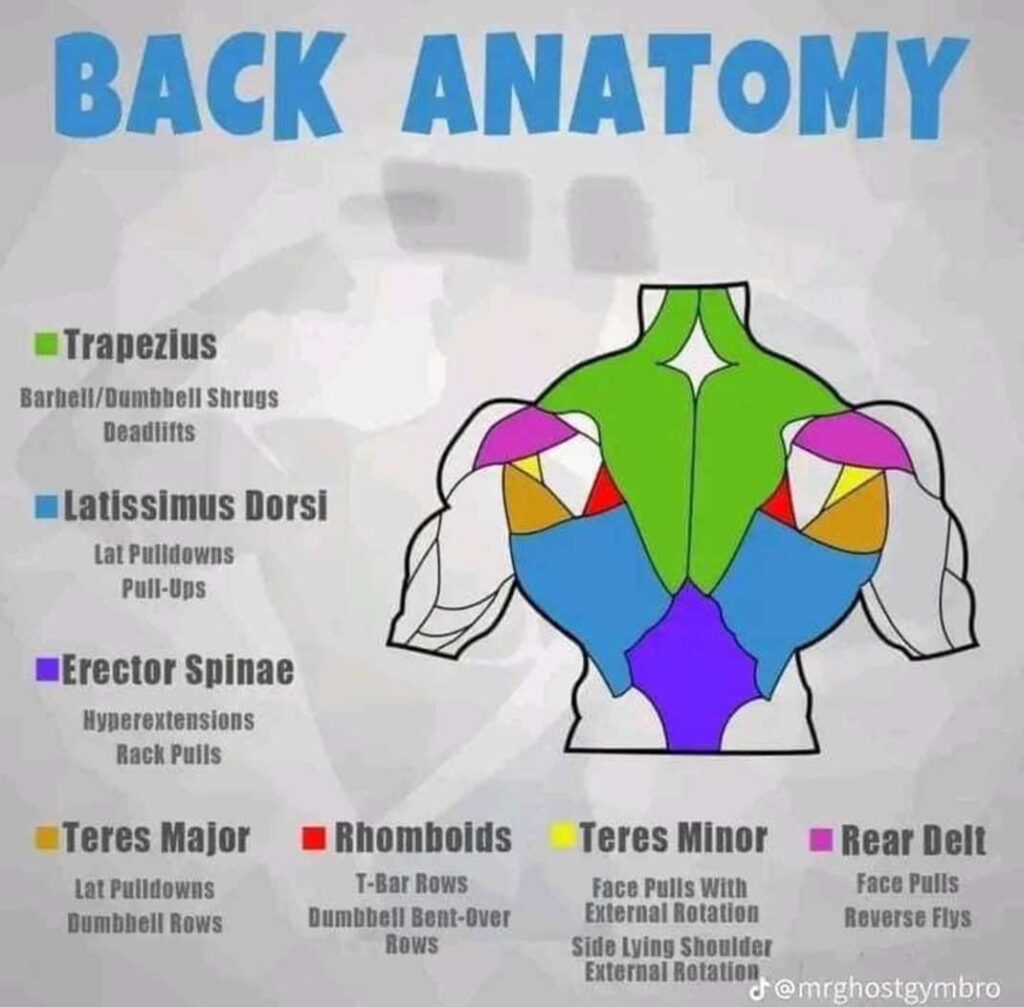
What you should know is which muscle(s) you are training. That allows you to feel into that muscle while performing the exercise to potentially adjust your technique. (“Muscle Mind Connection”)
Otherwise it just becomes mindless moving of weights, which is much less effective but could also create injuries or strain on joints or soft tissue, even in a different body part due to compensation – particularly as you are moving heavy things, not just your body weight.
The good news is that we typically do only around 3 sets of any exercise before moving on to something else. A set tends to have no more than 12 reps, or even 3-5 reps if you chose a very heavy weight.
There is something beautifully geeky about mustering up the concentration to do a perfect squat, one that protects your knees and your back.
Form is why some people take videos of themselves in the gym or perform exercises in front of the mirror. It helps compare with online resources or share with more experienced weight enthusiasts or your coach for feedback.
So these were the tips I got early on.
Hope you found this useful!
Feel free to leave a comment or reach out! Your questions and responses will help me in refining this article and adding more in-depth ones lateron!
PS: Instagram Channels I am finding helpful – by trainers who aim for technique and safety:
I previously hiked along three of its routes, but not yet the Chogoria route – which is said to be the most beautiful one! More rain, thicker forest, several lakes and water falls, the Eastern side of the mountain has been on my bucketlist for some time!
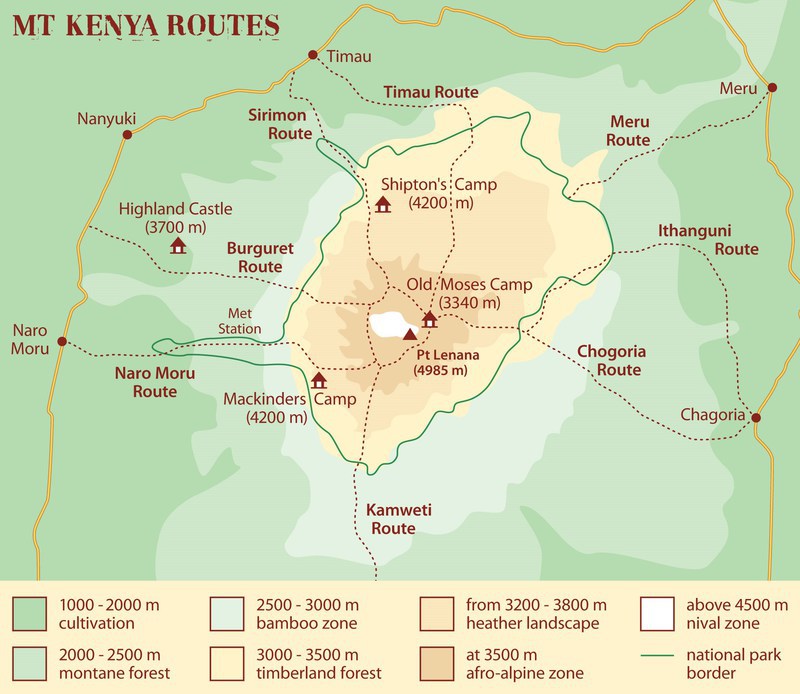
There are several routes up Mt Kenya, you ask? The below map (source) gives a better idea. Depending on preference people spend at least 3-7 days exploring this beautiful mountain, admiring the various vegetation and zones! Did you know that both KFS and KWS are involved in protecting and managing it?
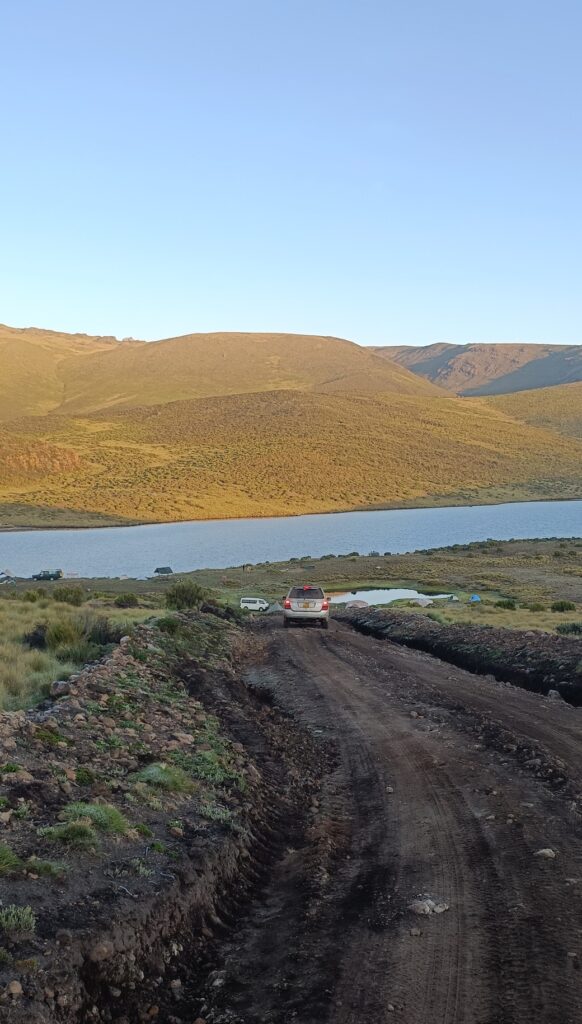
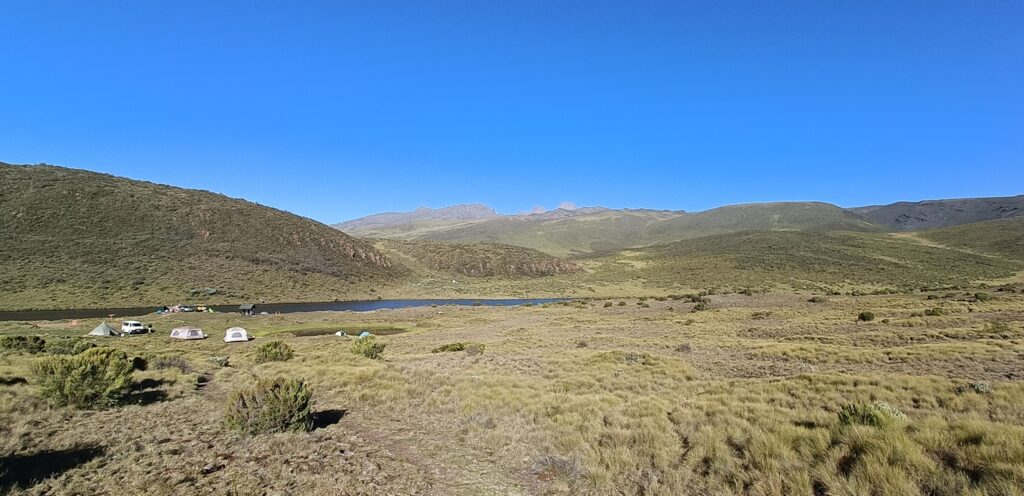
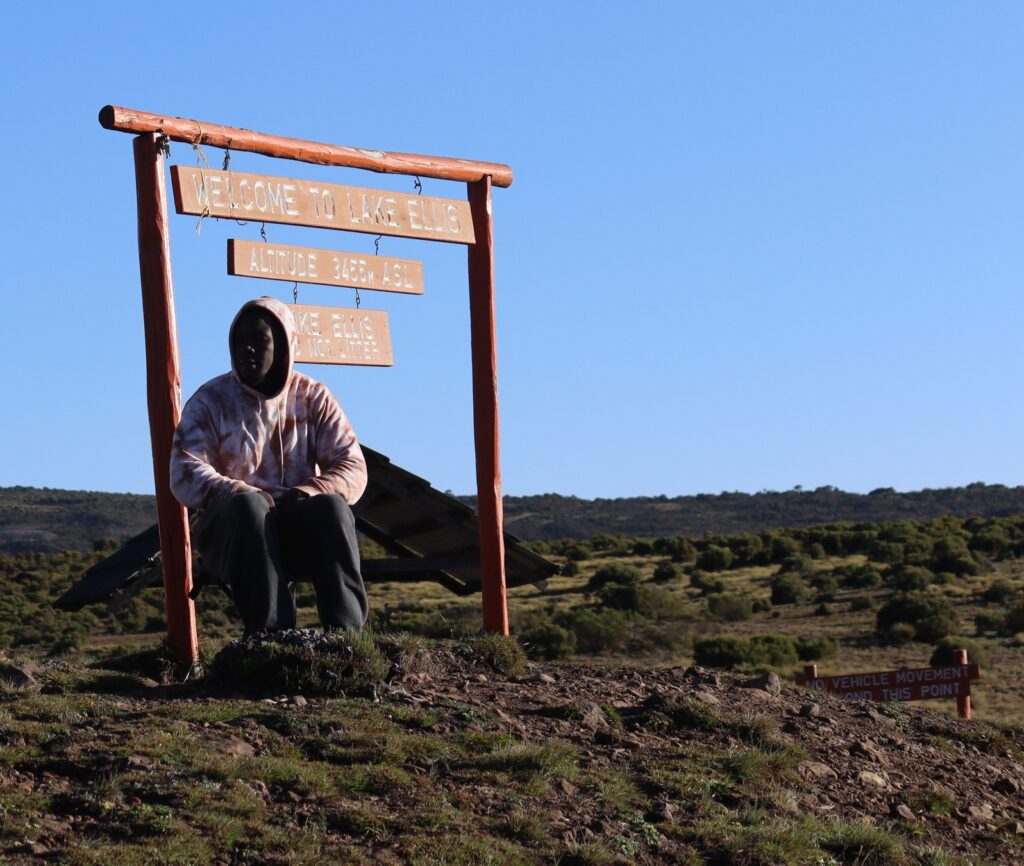
My dream was to camp at Lake Ellis. A sunrise at 3470m! It seemed doable for a two-day trip: About 200km good highway to Chogoria town, then about 22km forest trail from the lower to the upper barrier and finally about 10km to the lake, where it gets pretty steep.
I pitch the idea to my adventurous pal and we pull together a budget. 430 KES pP, 300 car charges and 450km fuel.
For reassurance I call the KWS Warden in charge of Chogoria Gate, who informs me that if camping inside the National Park, the 3-day ticket applies (to us and to the car). Wow! In other national parks like Tsavo the 1-day ticket lasts 24 hours, meaning you can enter in the afternoon to camp, then leave in the morning. Well, this special Mt Kenya rule significantly brings up our budget, but we think it will be well worth it.
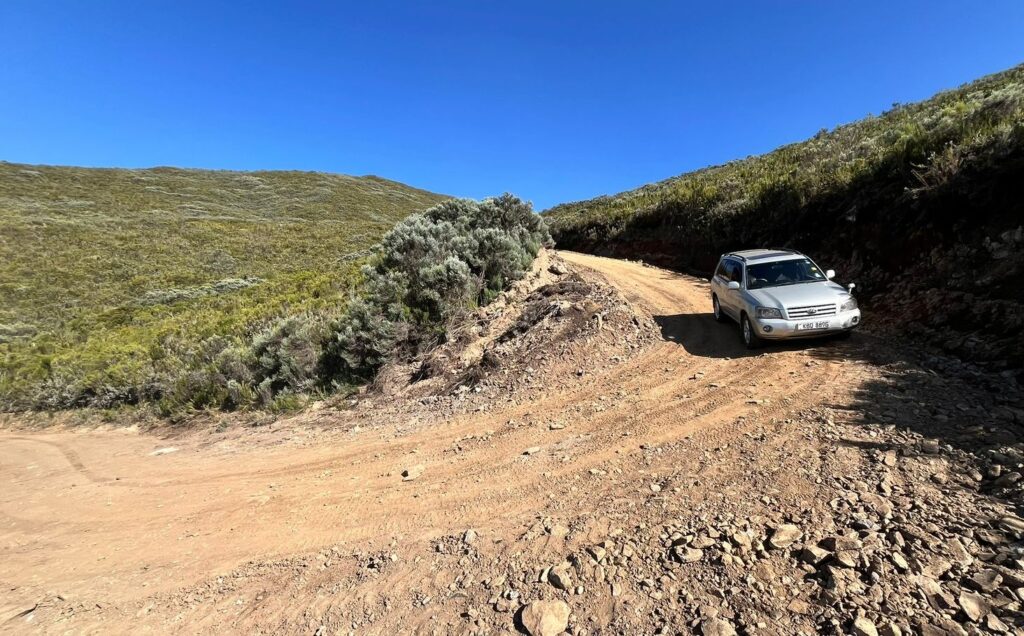
And so we stuff the car with camping gear, firewood, food, stove and utensils. The warden was optimistic that a powerful 4×4 car would make it up to the lake and as the road was recently made, ground clearance would not be as important. Still: I am mentally ready to hike the last few kms if needed. 💪
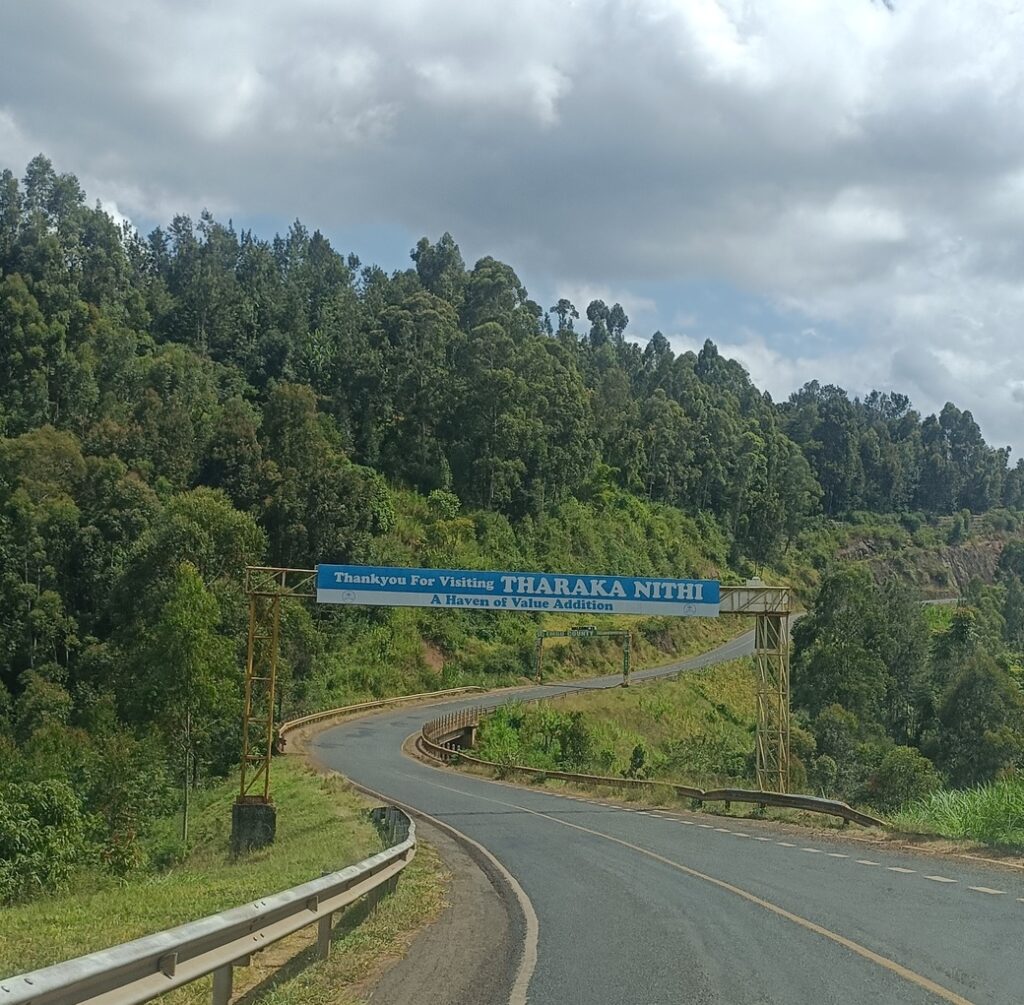
The drive to Chogoria town is quite scenic, first enjoying the Sagana highway, then the twisties especially once past Embu town.
Following the KWS signs, we make it to the lower barrier/gate, where payments happen (as there is no network at the upper barrier/gate). And now we learn about another rule that we had not been aware of:
To manage safety in the vast mountain, anyone planning to sleep inside the national park must be accompanied by a local guide. Someone who will ensure we follow the park rules and don’t get lost, causing an expensive rescue search. The KWS team shares a number of a local guide – his charges: 4,000 KES per day – meaning 8,000 KES for the overnight trip.
This would double the entire trip budget! We are well past lunch time and he is not close by! 🤯 Change of plans? Head to Meru National Park instead?
Then the KWS officer share another suggestion: If we camp at Anabas Lodge (link) located at the upper barrier instead, we technically won’t enter the National Park today and we could then drive up to Lake Ellis tomorrow – on a day ticket, and without needing a guide.
We happily agree! Now that we have a solution, we proceed to fill the paperwork. KWS is doing a thorough job with several books and forms to capture the details, planned route and even emergency contacts for each person entering the mountain.
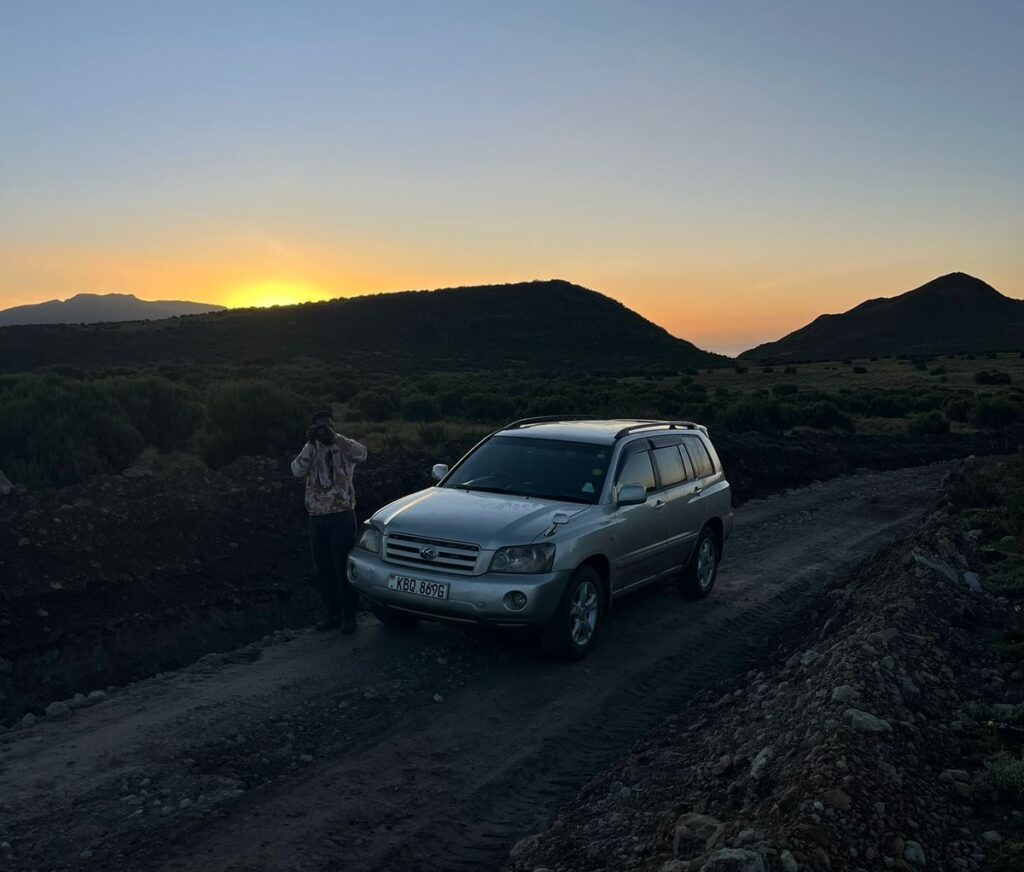
The next 20-ish-km up the mountain are very beautiful. Lush forest. A gradual incline from about 1,700m to 2,900m asl. Thankfully it hasn’t rained in a while and the road is well passable. In about half an hour we reach the upper gate and share our plan with the guard. He mentions that we are allowed to head up towards Lake Ellis with the first light at 6am and should reach there within 30 minutes in time for sunrise.
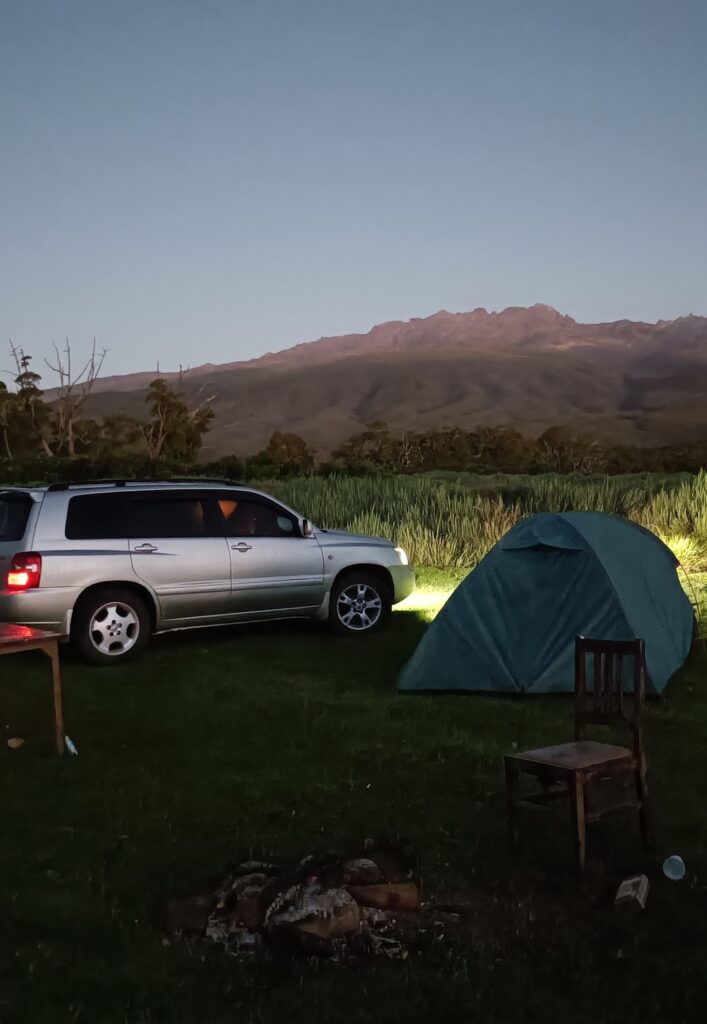
We proceed to Anabas which is a minute away – a rustique lodge built on a vast forest clearing. They do have wooden cabins as well (call for prices). There’s even Starlink and sockets in the restaurant.
The place is huge! How do you pick a place to pitch your tent?
We enjoy some nice views towards the forest and valleys and watch the clouds moving in and out of the various mountain peaks as the day ends!
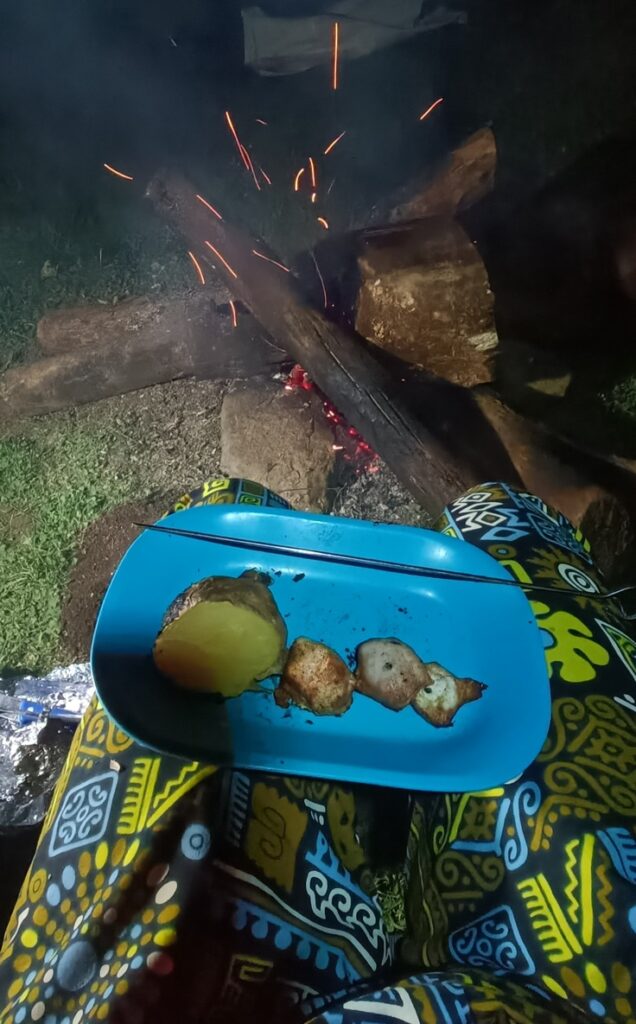
My pal skillfully lights a beautiful bonfire and we prepare a yummy dinner: Foil potatoes and chicken skewers 😋
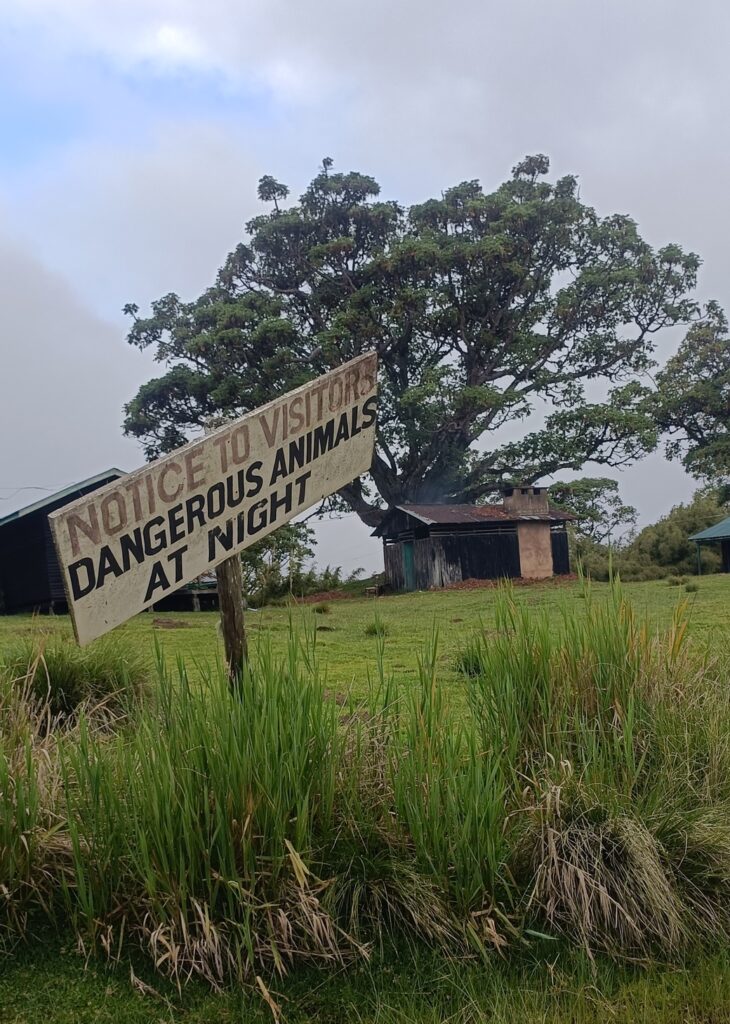
Pro tip: It gets really chilly at this altitude – hot water bottles come in handy to stay warm in the sleeping bag. 🥶
By 5:30am we are up. As we warm the car, the display tells us it’s 2 degrees! Yo!
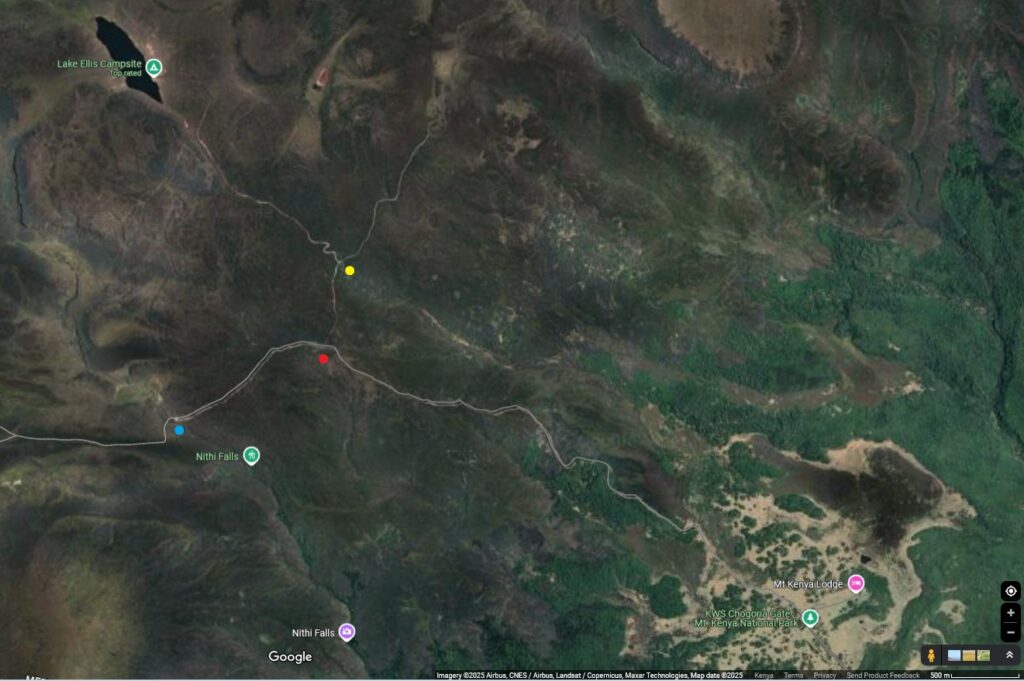
Let me show you the routes up here on Google Maps Satellite view: The upper barrier and Anabas Lodge are well visible at the bottom right. Red dot = turn-off to the lake / roadhead. Yellow dot = another roadhead near the really steep sections. Blue dot = Waterfall parking
Even without mobile network I am confident we will find our way.
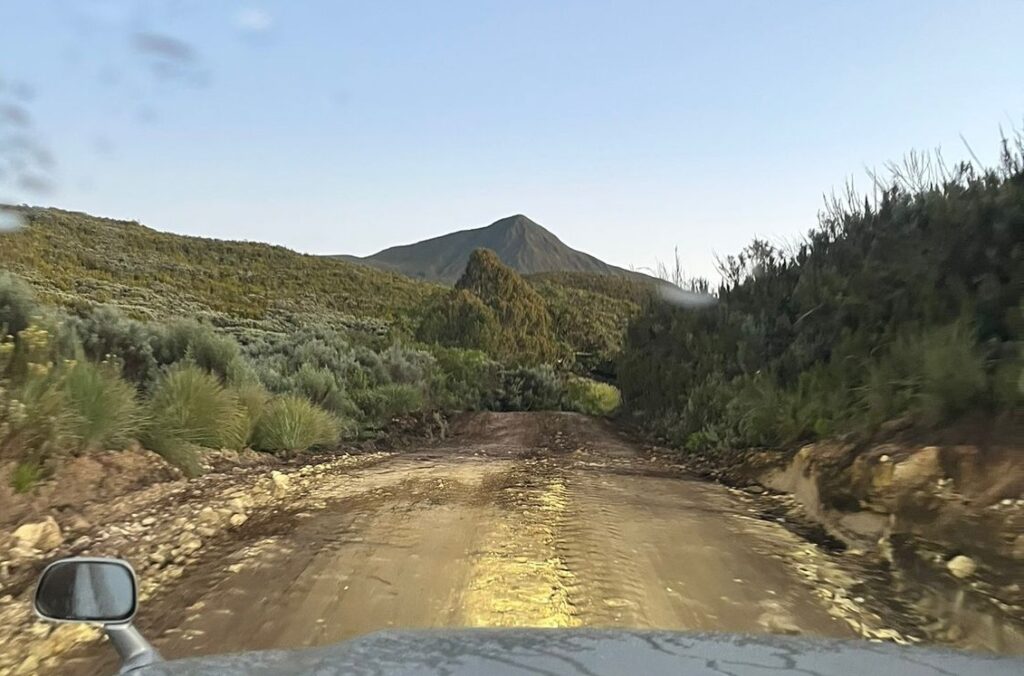
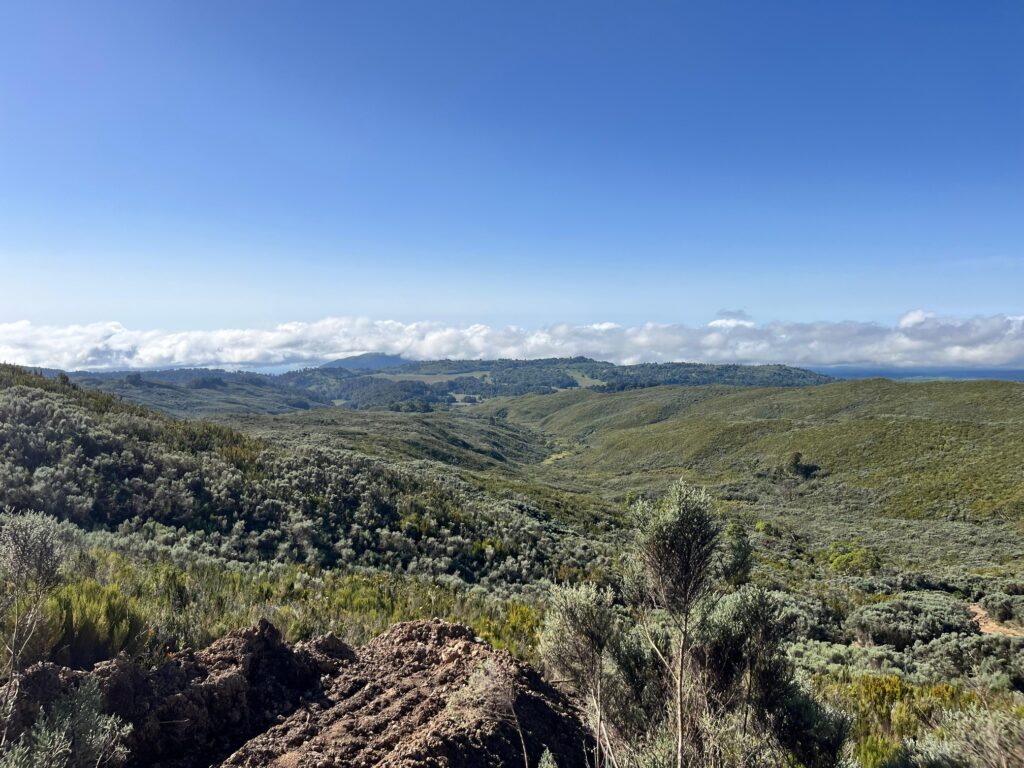
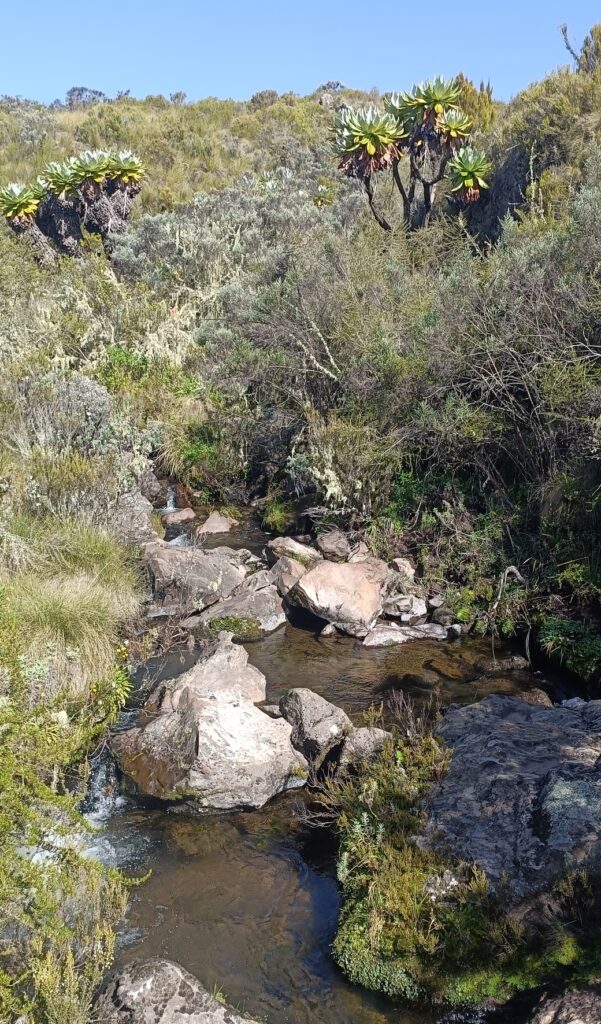
We embark on some very steep ups and a few steep downs. In just 8kms we climb another 500 meters! We are now above the treeline and the afro-alpine vegetation is stunning as always!
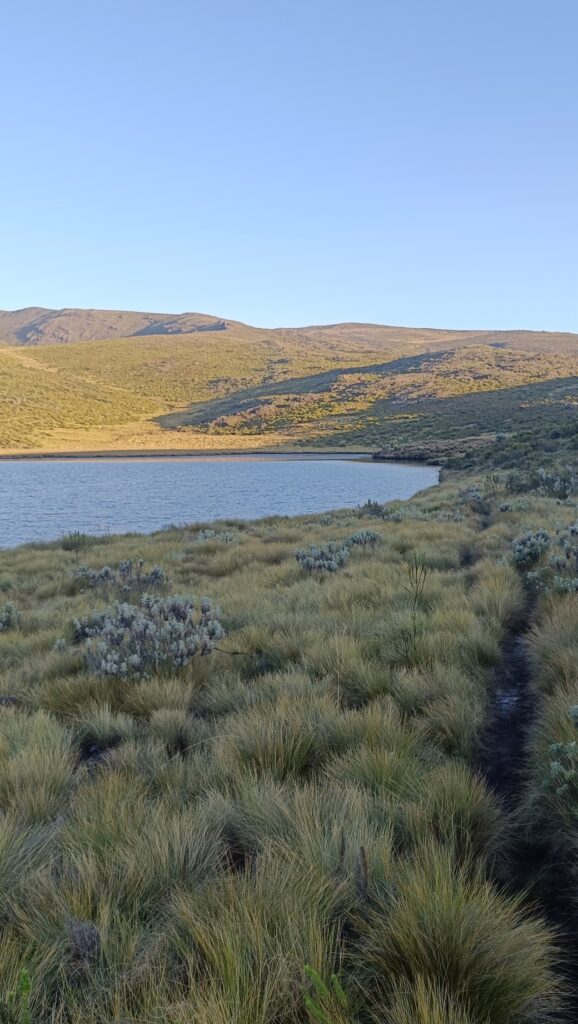
And then we spot the lake!
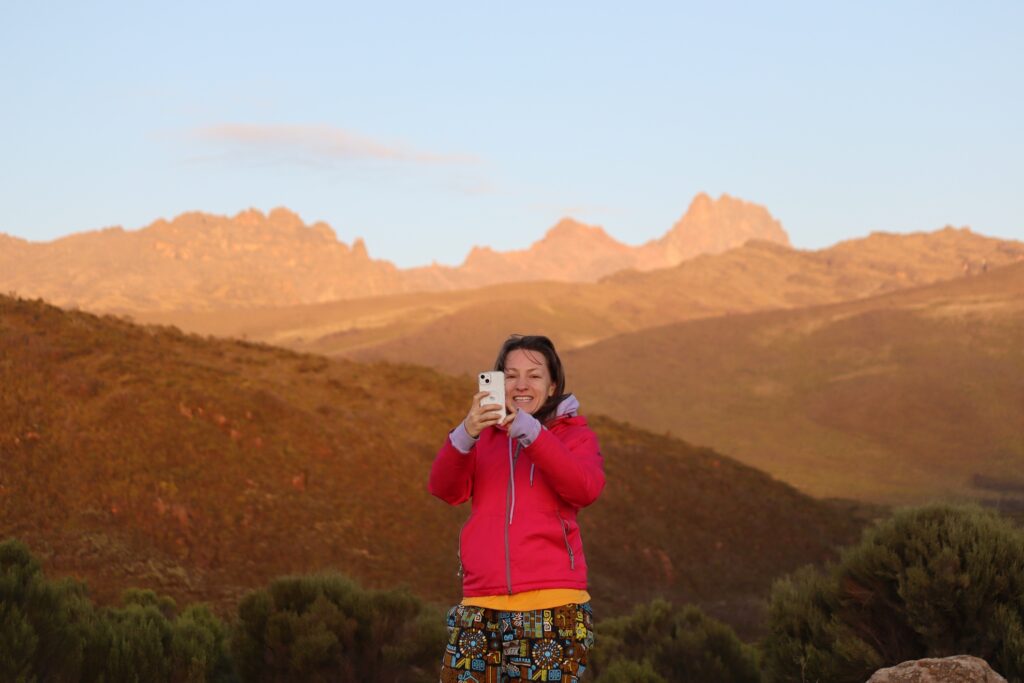
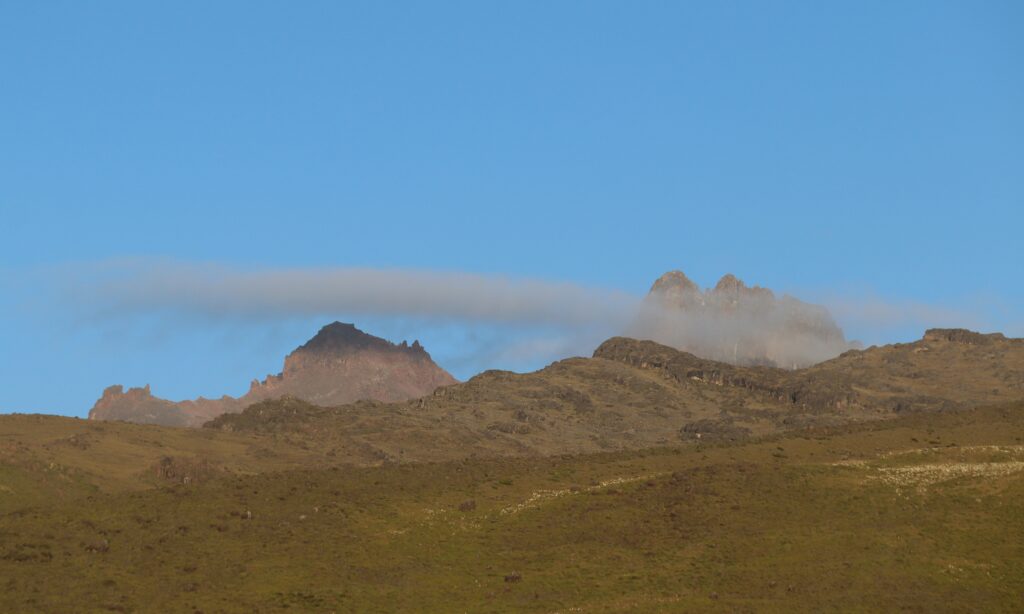
We take lots of photos and absorb the beautiful views. The three highest peaks are clearly visible! Stunning
Then we whip out our stove and utensils and prepare breakfast right here at Lake Ellis.
Watching the many tents and cars lined up along the lake, I am suddently relieved that we camped at Anabas. Peaceful, empty, and probably 2-3 degrees ‘warmer’. And we still caught sunrise, just like everyone else.
The rule of the mountain is to carry out all garbage you bring in. Because it’s not just harmful to the animals and ecosystem, but who is supposed to pick it for you, honestly? Sipping our tea, we watch a group of campers collect their many beer cans.
Next stop: Nithi Waterfall. As we drive back down in sunlight, we realize just how steep this is.
The road to the lake was recently graded, a controversial move. While it is meant to improve emergency rescue access, and certainly helps because we don’t have extensive ground clearance, the hikers now walk in dust.
The views down are quite beautiful – we are above the clouds!
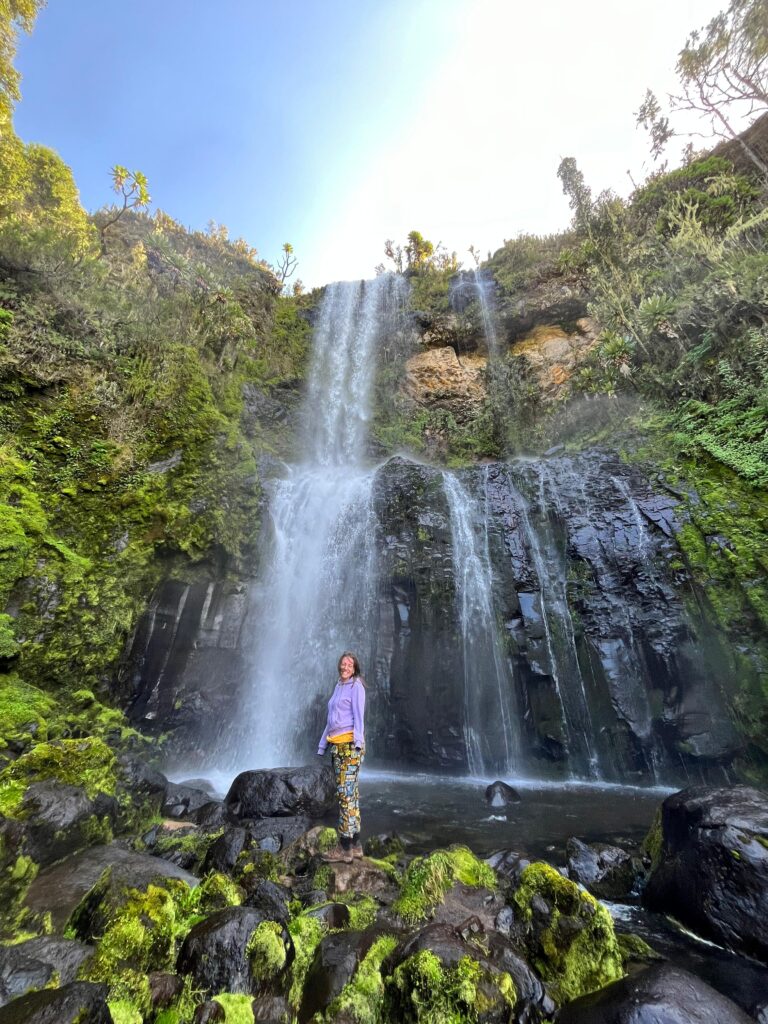
Once back at the roadhead, we take the right-turn towards the waterfall. We park where the road ends, and talk a stunning 15-minute walk to the breathtaking Nithi waterfall!
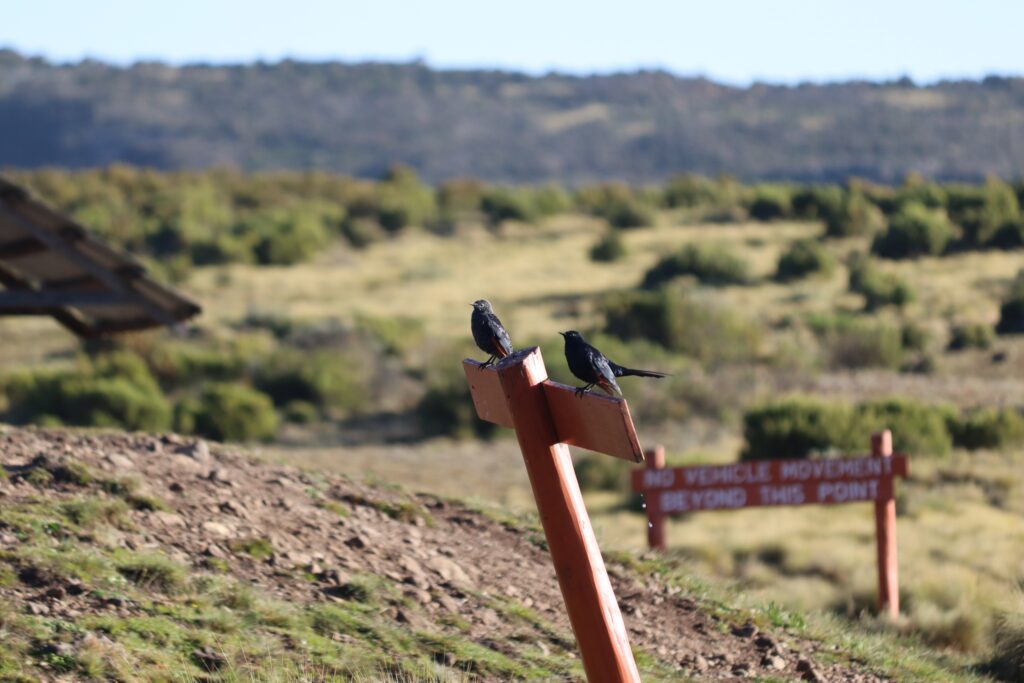
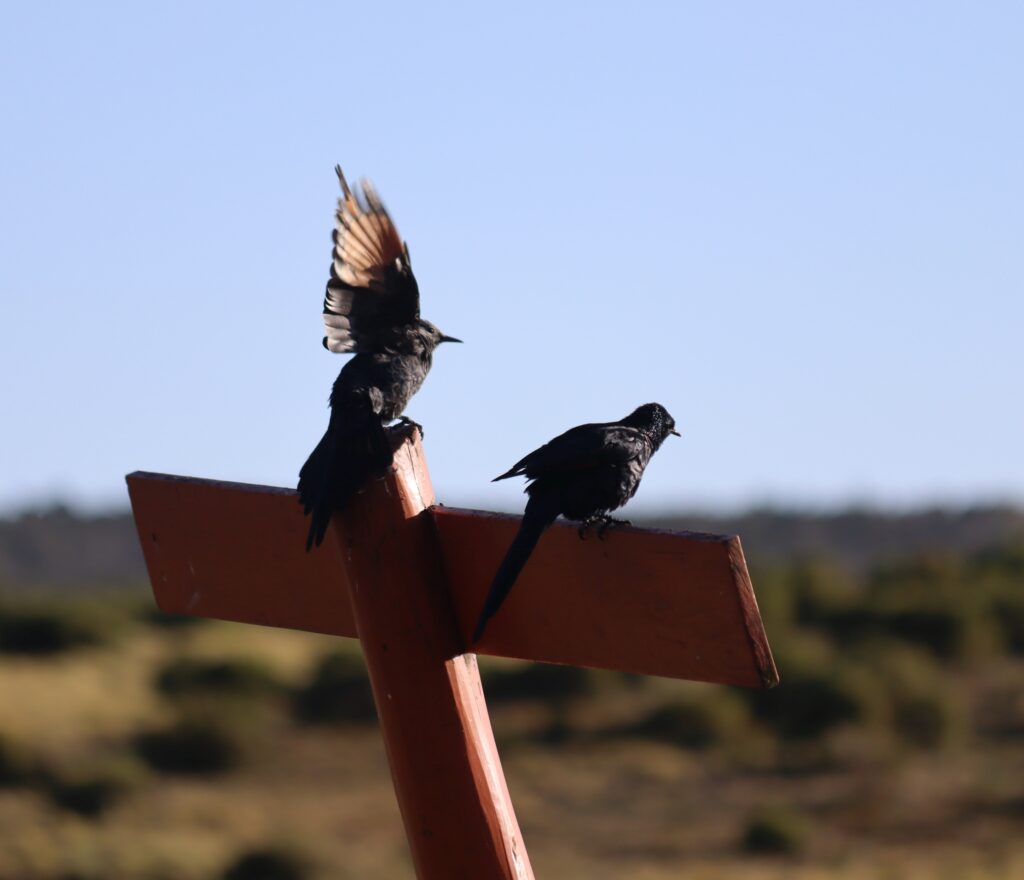
The fresh air and the incredible plants and bird life: Absolutely worth it!
Connecting with untouched nature!
What a wholesome expereince for body and soul 🌈🌞🌸
Now I am excited to climb Mt Kenya once again soon, using the full Chogoria Route!
The group ride to Moyale was amazing! The taste of Shiro still in our mouths, Nyawira and I camp by Ewaso Nyiro river at Archers Post. From here, I want to explore Samburu and Laikipia with friends. Equally excited and nervous to take my new bike off-road, because this means sand!
From here, we will take it off-tarmac. Grace and her friend join us at Archers Post. They are so excited for the hike up Mt. Ololokwe and the dusty roads for the next few days. But first we enjoy the beautiful scenery by the Ewaso Nyiro river and the pool!
Then Nyawira heads out for futher escapades in the Mt. Kenya region. Clearly she’s the extrovert in the squad, making new friends everywhere!
After lunch, the remaining trio heads over to Sabache Camp and we arrange ourselves for the hike. We plan to camp on top of the mountain.
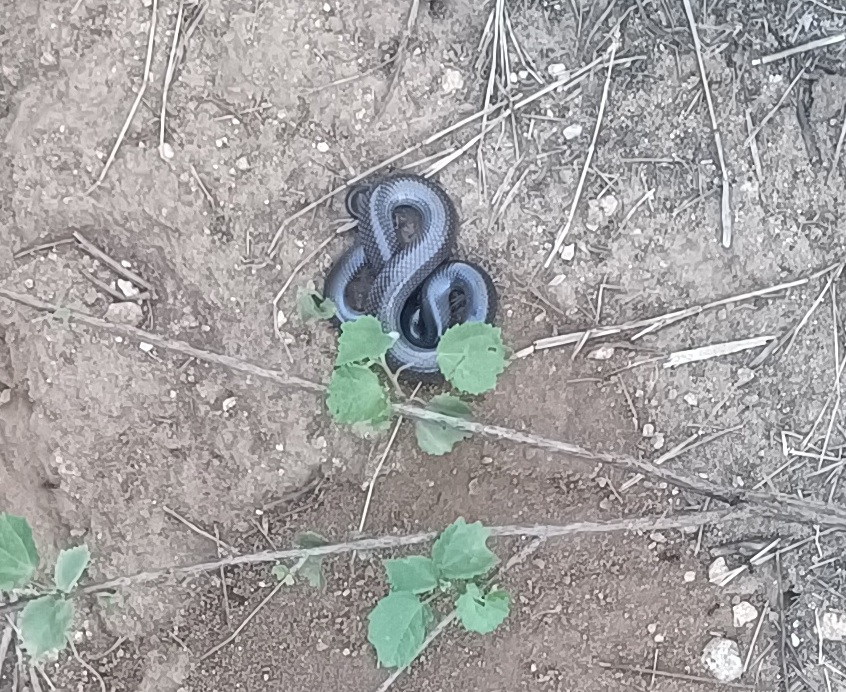
Our local guides were not bothered by this snake. We later seek an identification on an expert facebook forum: Cape Wolf Snake (Lycophidion capense), harmless, non-venomous.
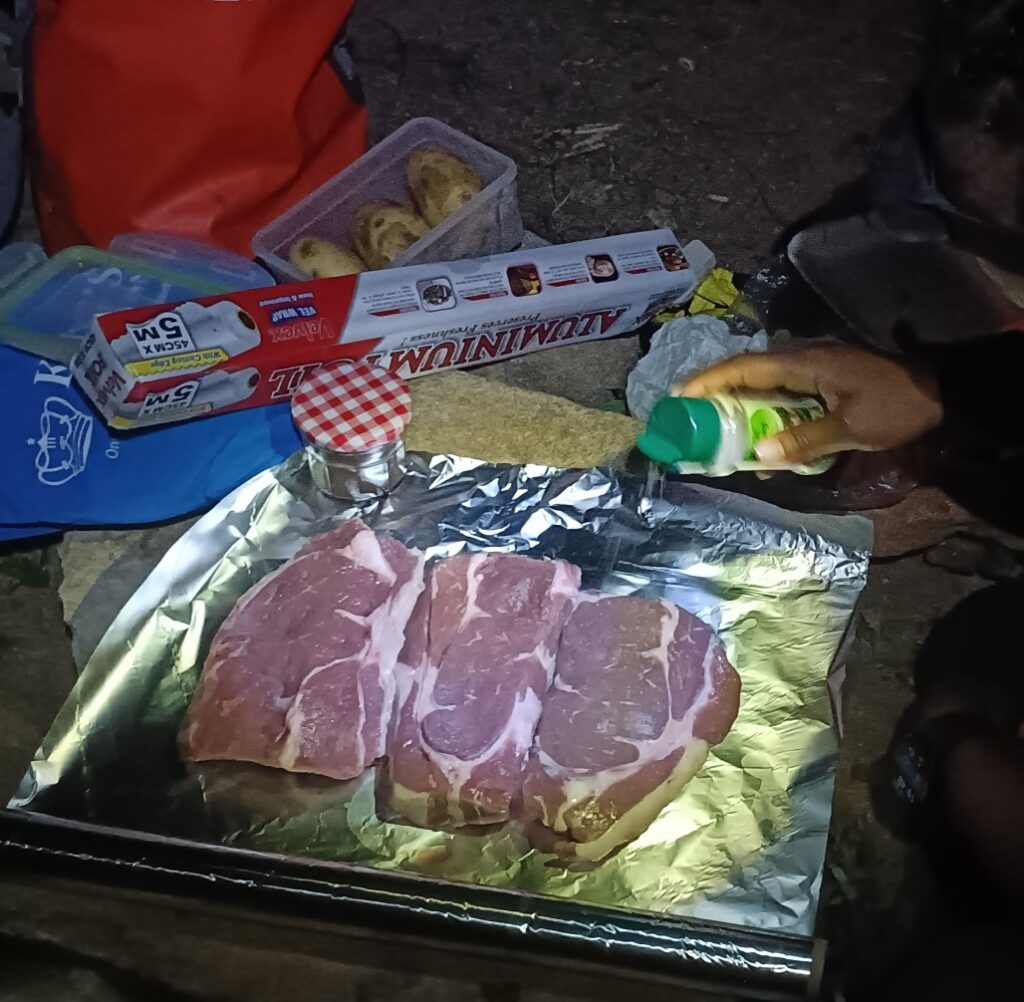
Incredible nature and views as we slowly make our way up the 800m mountain. We arrive with the last sunlight and pitch the tents at the cliff. What a luxurious meal, prepared in the campfire!
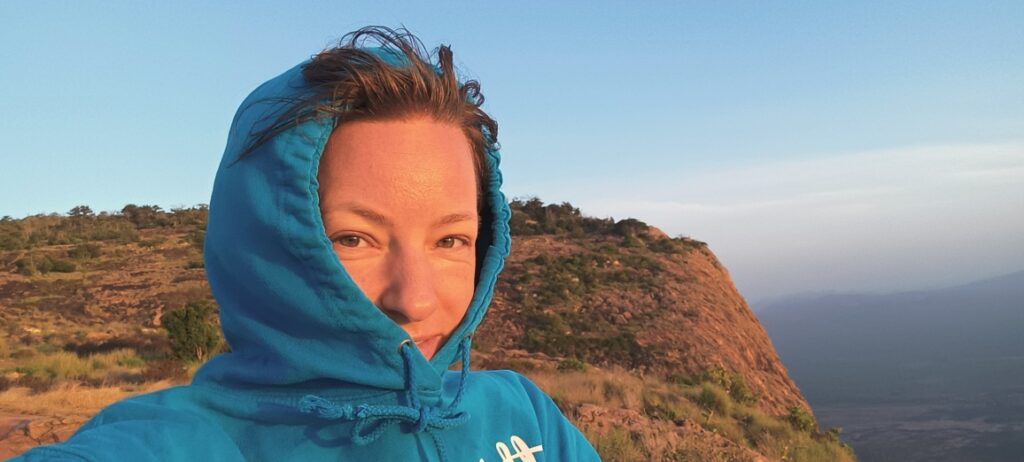
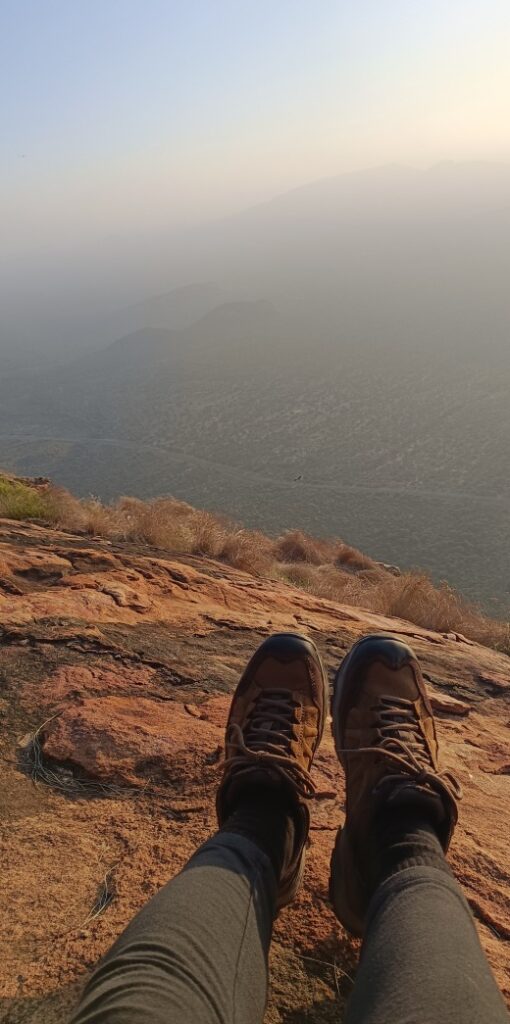
The views at sunrise are breathtaking. This is my third time on this mountain, and definitely one of my favourite spots in the entire country. Watching the birds enjoy their flight in early morning sun is just so peaceful!
Day 5 – Offroad to Koija Star Beds
Riding with Grace there’s one thing you don’t have to worry about: Route Planning. She knows every road in this area. How amazing when someone makes their hobby and passion their career!
We start by taking the main road to Wamba. Luckily it was recently graded and we don’t get many corrrrrugations. We get a long sandy lugga, and boy it’s tricky with the heavy bike! I can’t say I’m very skilled, correctly geared or courageous on the throttle. And slow rarely works well on sand but even less so at 320kgs 😮
Samburu is green atm and the scenery amazing.
After the Wamba junction we take beautiful smaller side roads, crossing many sand rivers. Some rivers have concrete bridges, as well.
I’m indebted to my co-riders for sharing tips for riding on sand, and lending their muscle power every time the tricks don’t work!
All in all we do about 120km until we get to Oldonyiro, a small shopping center where we meet our fourth rider Topo, yet another nature lover and motorcycle tour guide, and top up on food supplies.
Today’s destination is Koija Starbeds, a community run eco-lodge at the Ewaso River, about 20kms further into the bush. The route is a little messed by floods and we end up passing through backroutes around sunset time. No, we don’t get lost, we just find new ways that aren’t leading to the destination. But every time we pass by fresh heaps of elaphant dung, we confuse the gods by praying that we meet them but don’t really meet the giants.
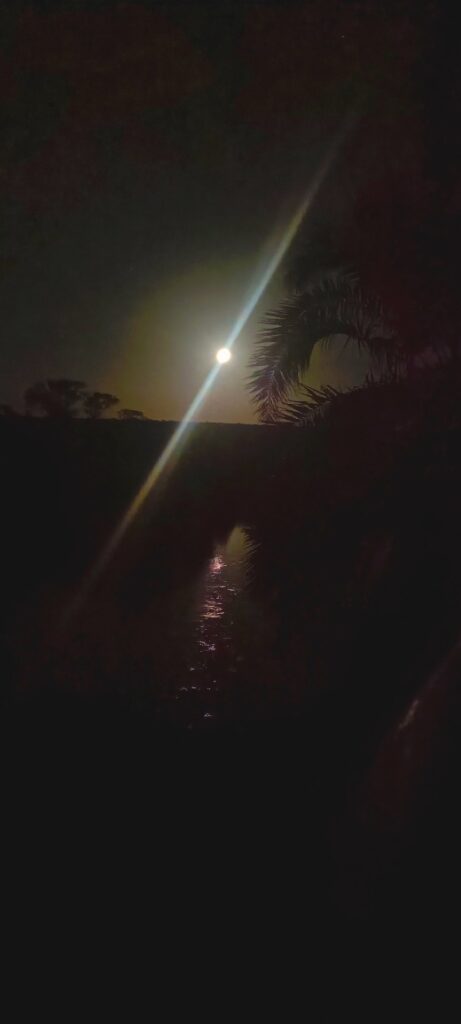
On arrival, we make some amazing dinner, and relax at the bonfire. Oh, the full moon!
Day ? – Somewhere between Naibunga and Loisaba Conservancies
The concept of the starbeds is so clever! A huge, comfortable bed is mounted on wheels, so you can push it out on the balcony of your banda. Under a thick duvet and a tight mosquito net, I watch the moon and stars and the sunrise. The banda also has solar heated shower and a very clean toilet! In the morning a monkey family comes to play in the tree next to my bed.
The place has a well equipped kitchen (even a freezer, toaster and coffee plunger!), a rain water tank for drinking (nearly empty), river water supplies for washing, and a friendly team who takes care of house keeping and cooking. I’m astonished how well kept it is, given it was built in 2002 and how much care wood needs out here.
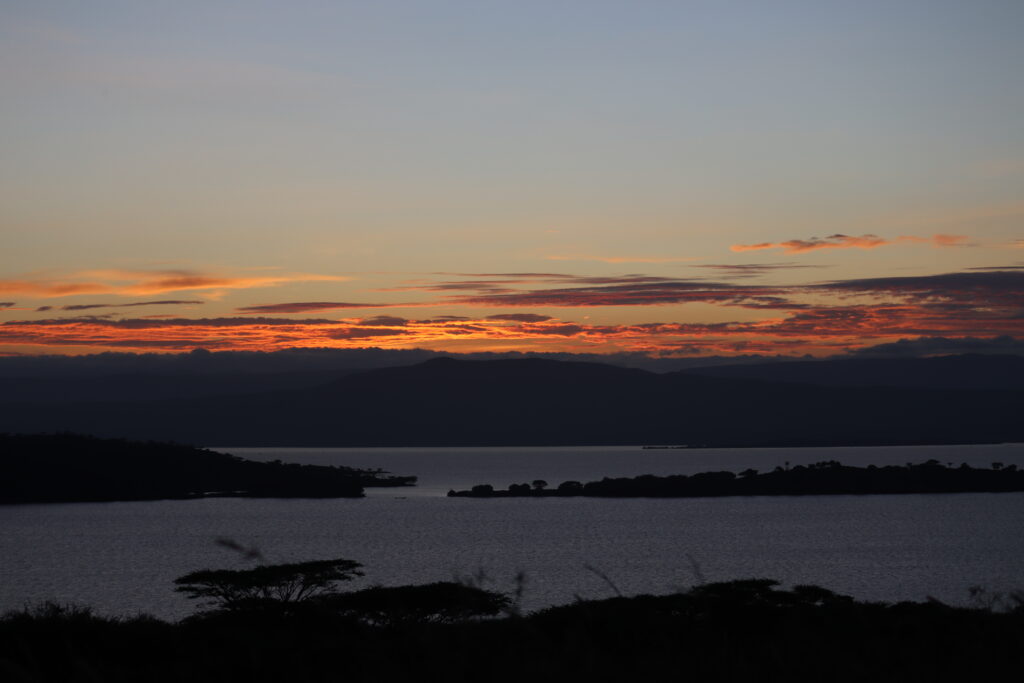
Naibunga Conservancy is community-owned and part of Northern Rangeland Trust. Limited funding makes it challenging for them to repair the roads and riverbeds soon after every rain, but the place is well accessible with a 4×4 car or the right bike. Simply book through Big North, who connect community-owned accomodation with tourists, here.
The dirt bike riders go out to look for elephants while I enjoy a quiet day by the river, more coffee, tuna wraps and conversation with the team.
And elephants they found!!!
Final Day: Exploring Laikipia towards Nanyki
Today we’re doing some easy riding, mostly on graded roads with a few short dry river crossings. There are various conservancies here, some private-run and some community-owned. We also pass by the power line coming from Ethiopia.
It’s about 100km today, pleasant riding when spotting zebras, various giraffe species, elephants, different deers and birds. As we get close to Nanyuki, the road gets more busy and passes between conversancy fences. Not soooo exciting, but the thought of a tasty Somali lunch in town keeps us going.
A week very well spent!
If you’d like to try out such a motorcycle tour, I highly recommend reaching out to Grace’s and Topo’s companies for some tailored options.
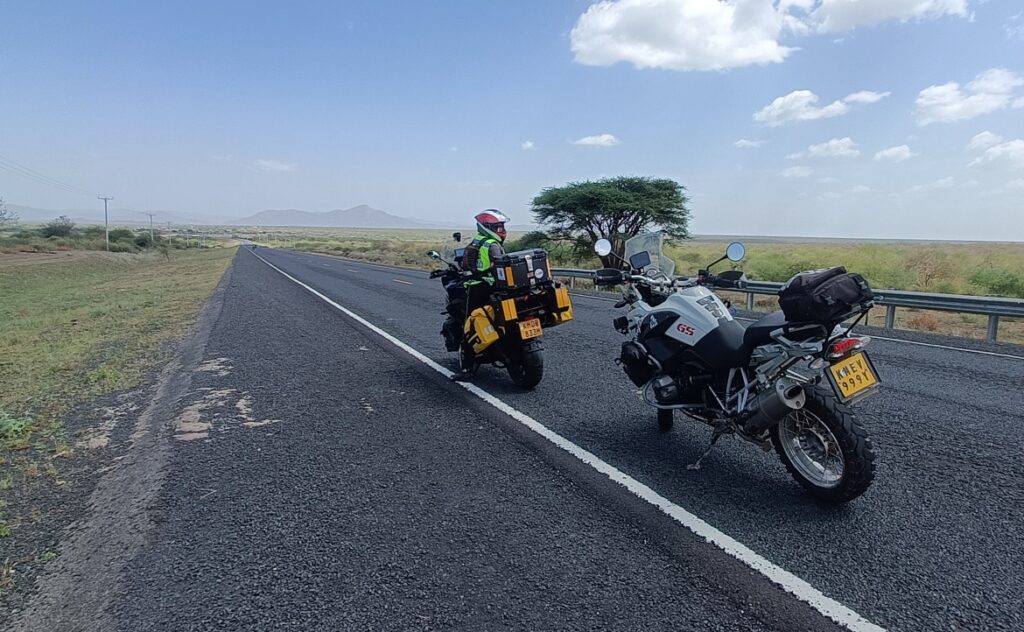
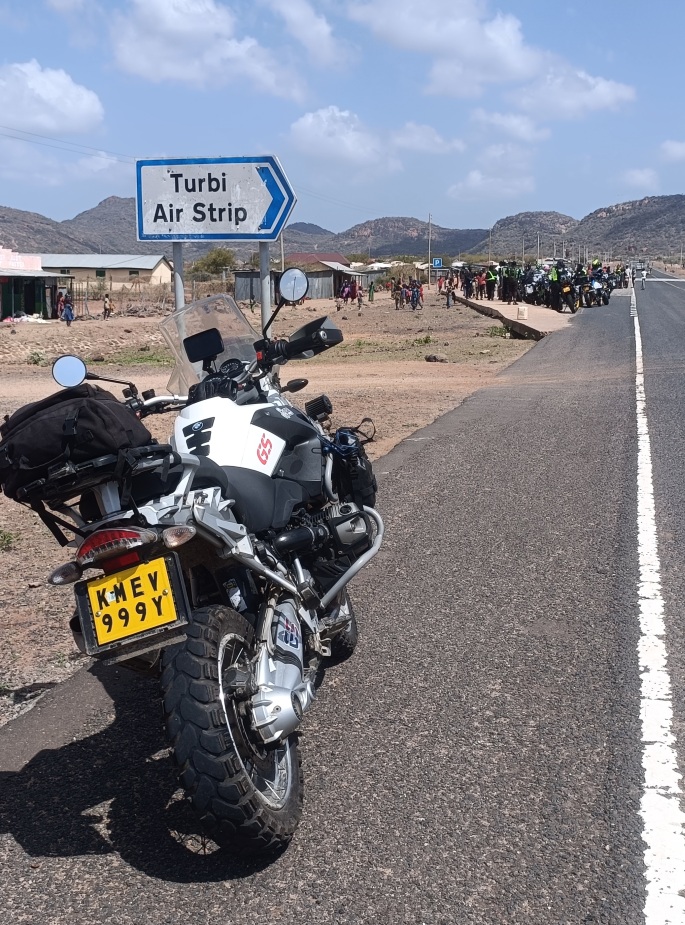
An epic ride was coming up for Jamhuri Day: Escorting the Around Africa team to the Ethiopian Border. 🇪🇹 After Moyale, taking the slow route home sounds amazing to enjoy some Northern terrain!
With work winding down, I leave the laptop at home for this three birds with one stone trip: Sending off my good friend Havana and her team on their historic ride (more info here), enjoying some magical nature in Samburu (#rideAndHike), and testing my new bike off-tarmac 🥳
The day before, I packed the camping stuff and grabbed my hot weather mesh gear (and food, and rain gear, and tools, and water filter, and spare water, and bikini). In the end, the bike looked a little heavy, probably 250kgs without me 🙂
Day 1 – Quick dash to Marsabit and lunch in Isiolo
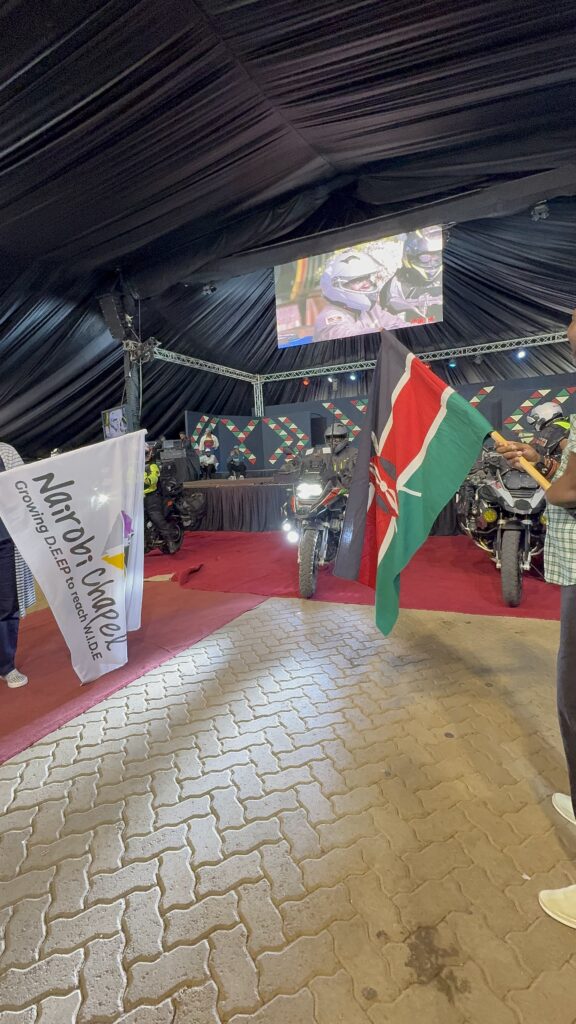
While everyone else meets at Nairobi Chapel for an impressive send-off, I get a little delayed in the morning and leave just before noon. Sagana is not far when your bike has above 100 HP. I meet a number of bikes along Thika Road, who are already returning from escorting for the first 50km. An amazing community!
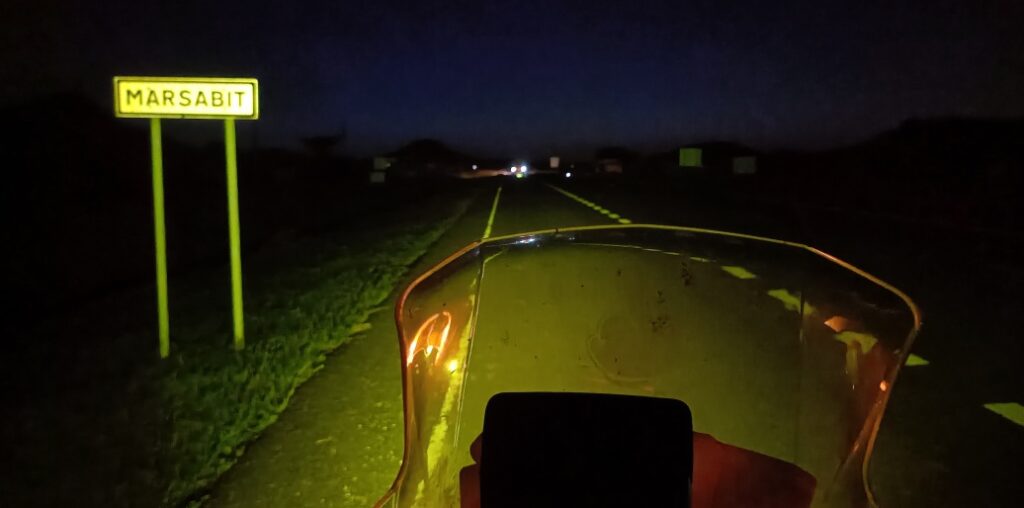
By the time I’m in Nanyuki, it’s nearly 3pm and the maths for a daylight arrival in Marsabit town look tricky. I decide to skip lunch at Isiolo and simply get some samosas at The Outpost in Kisima.
I plan to fuel in Isiolo and that’s when I catch up with the big group! We exchange greetings but I decide not to interfere with their ride formation and keep moving until Mt Ololokwe.
I promised Havana we’d take photos there together, and I’m keen to catch up with her. The core team was riding in front of the escort teams… At the security stop after Archers Post I tell the officer that I’m part of the bikers who already passed. He looks at me with puzzled eyes.
The A2 highway is EMPTY. Ololokwe is always an incredible sight!
A few bikers catch up and we pose for pics together. At this point we have 201km and about 90 minutes of sunlight left to Marsabit town. Doable!?
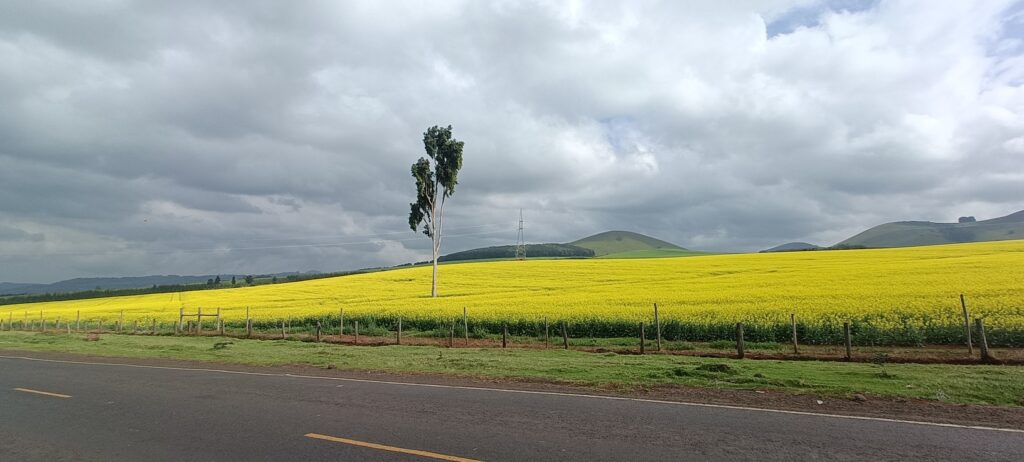
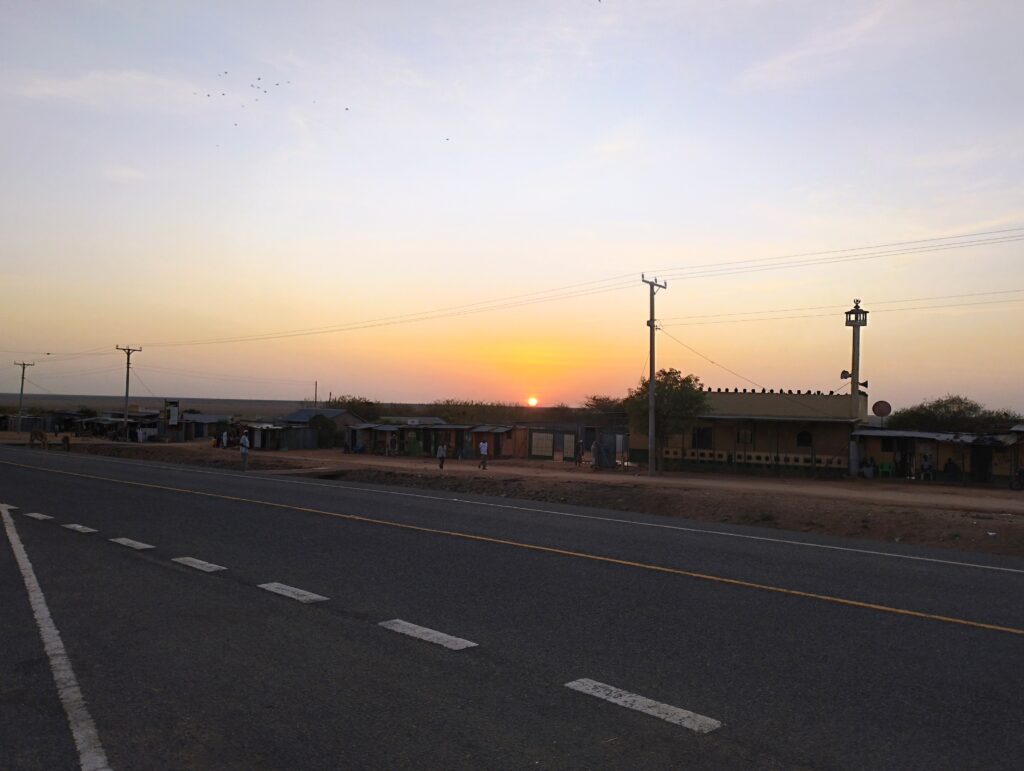
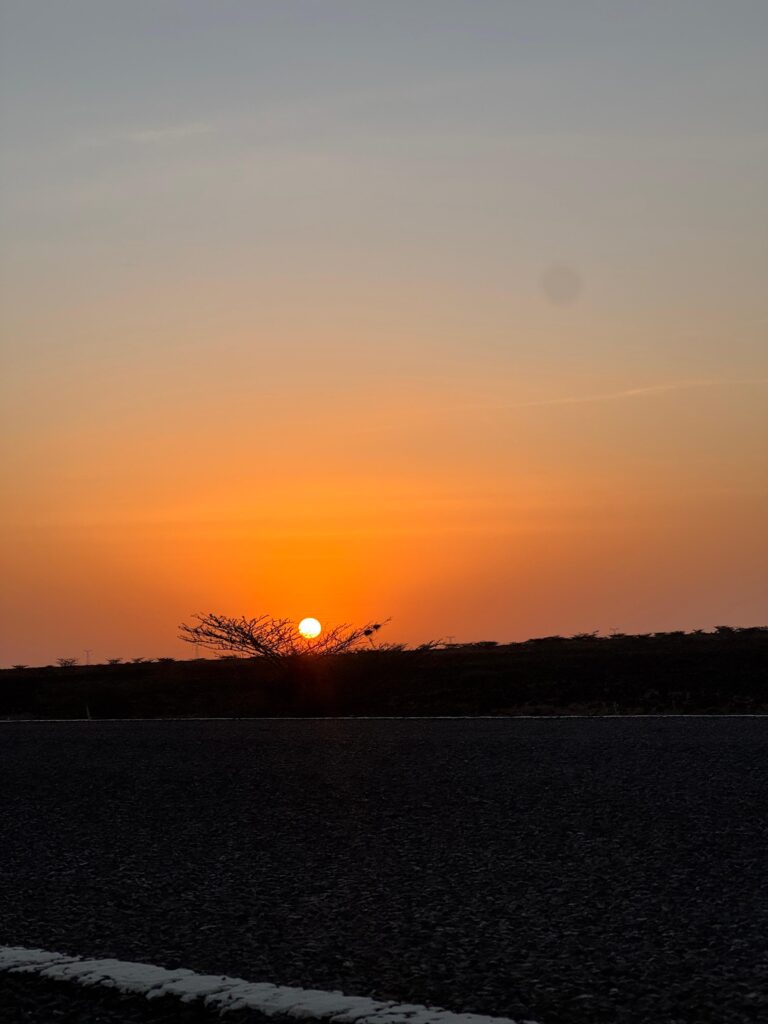
The ride through Samburu and Marsabit counties with setting light is simply beautiful!
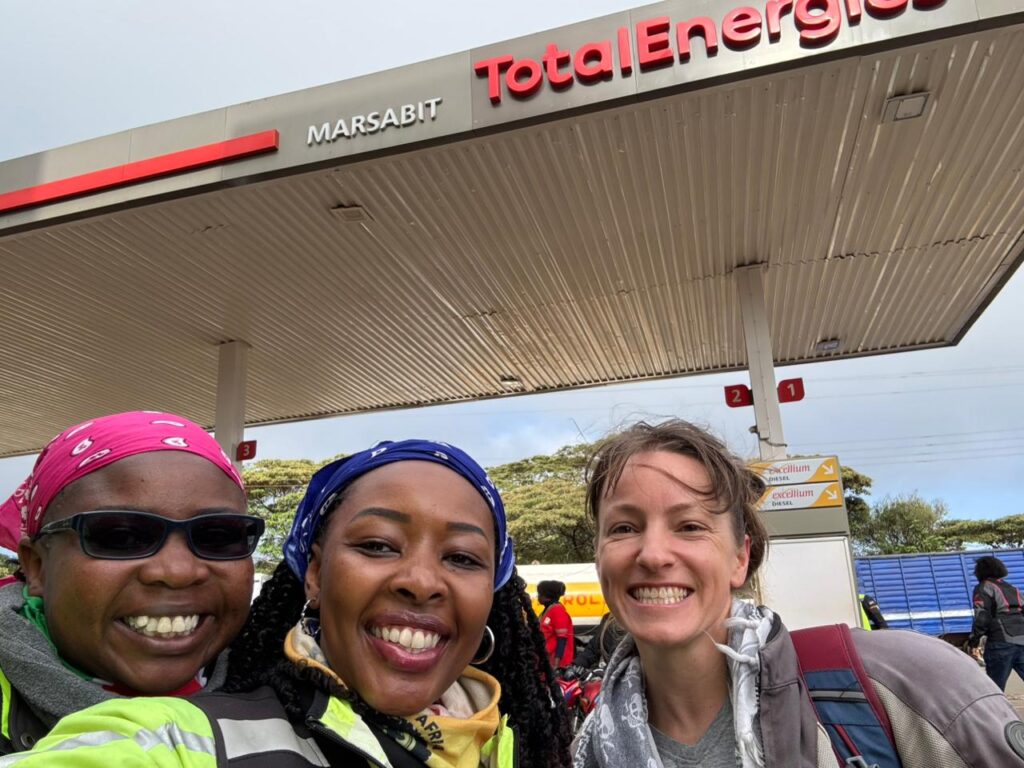
On arrival in Marsabit I fuel at the Total. To my suprise I find only one bike in the hotel’s parking lot! Where’s everyone? I make calls and learn that the entire team was behind us. Only Mbuthia had stuck to the plan of a daylight arrival. Everyone makes it safe to Marsabit this night and hoards of bikers pour into three different hotels.
Bikers from the LaKiKi neighbourhood. We’re more likely to meet in Marsabit than Nairobi 😂
Marsabit county is huge! The second largest county after Turkana – with about 67,000 km².
Day 2: Moyale, here we come!
It’s about 250km to the border and we don’t expect a formal fuel station in between. Fuel is usually sold in bottles from barrels in the North. As we all assemble at the Total, I realize how big our convoy is! Lots of good vybes – new and old faces!
And off we go!
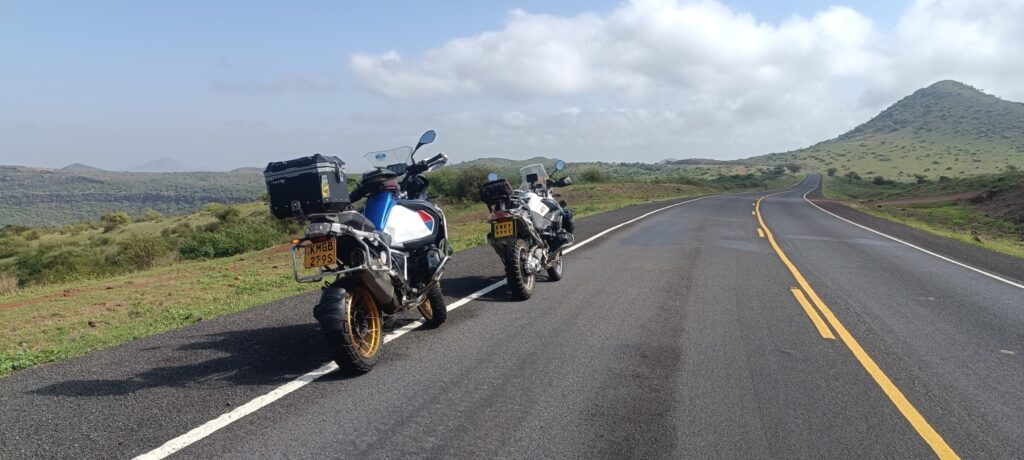
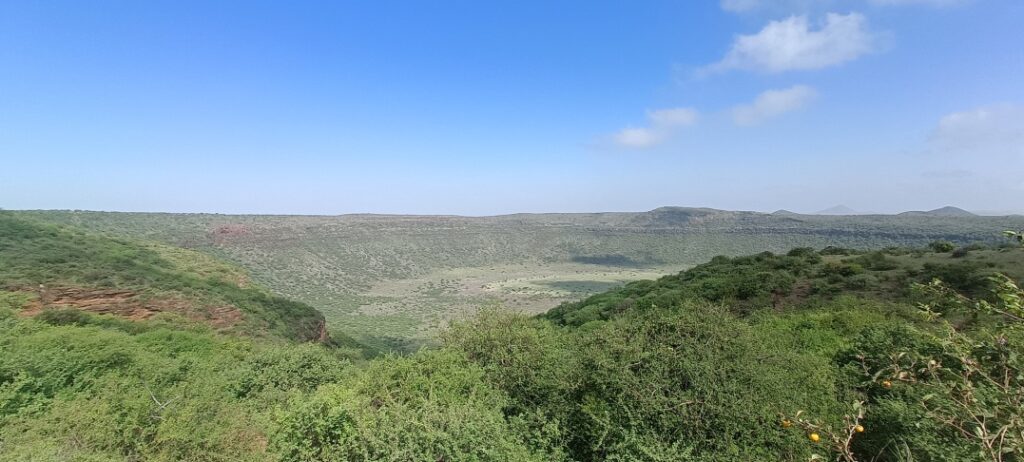
Imagine me being the sweeper on a legit group ride! I love this bike! And being the sweeper means I can stop at this beautiful crater for photos!
One thing about this generation of bikers is that they combine their loves for the adventure and their family. The best dad award goes to Champ Mohamed today, who is caging in the coolest BMW convertible (is it still caging if there is no cage?) and is taking his cutie daughter along all the way up to Moyale.
Can you imagine what the locals think when they see us rocking up in their desert like this?
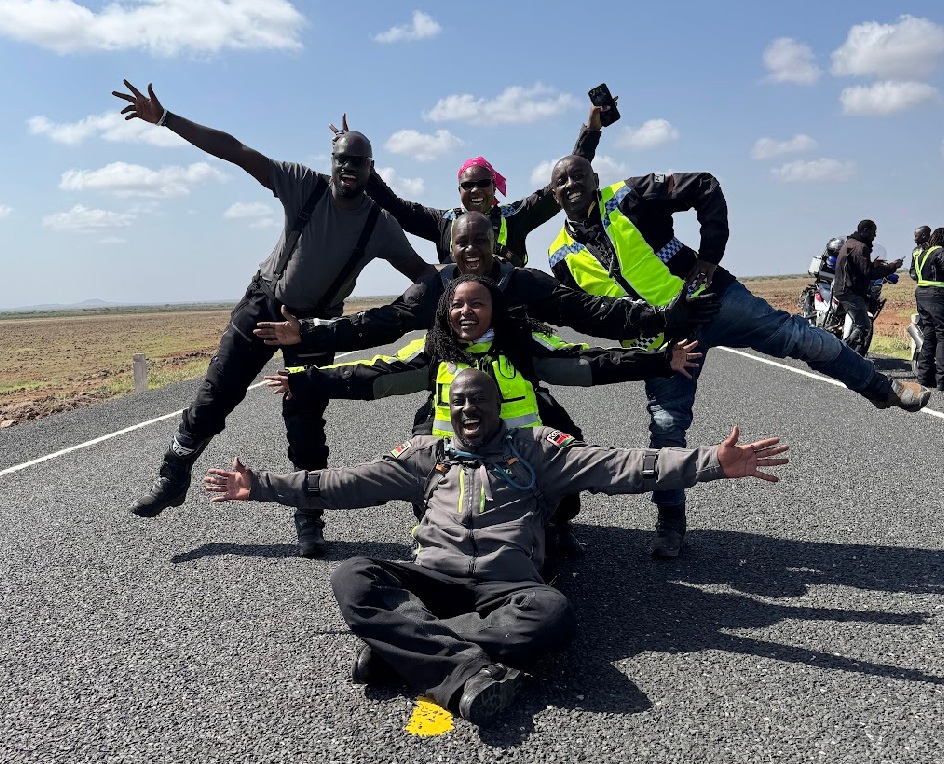
Yes, we are in a hurry but a selfie stopover at 37° lazima!
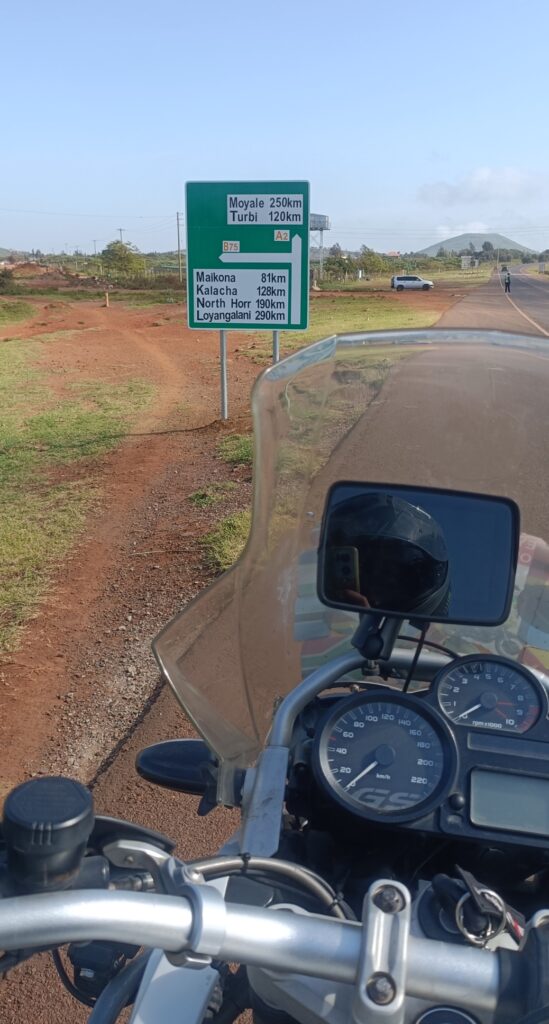
The A2 up here is probably the best road in East Africa. No pothole since the Subuiga junction. Reflective paint. Well-marked bumps. Signage for bends. About 500km of bliss.
Our stopovers in towns excite kids and adults alike.
Around 1pm we get to the last junction before Moyale.
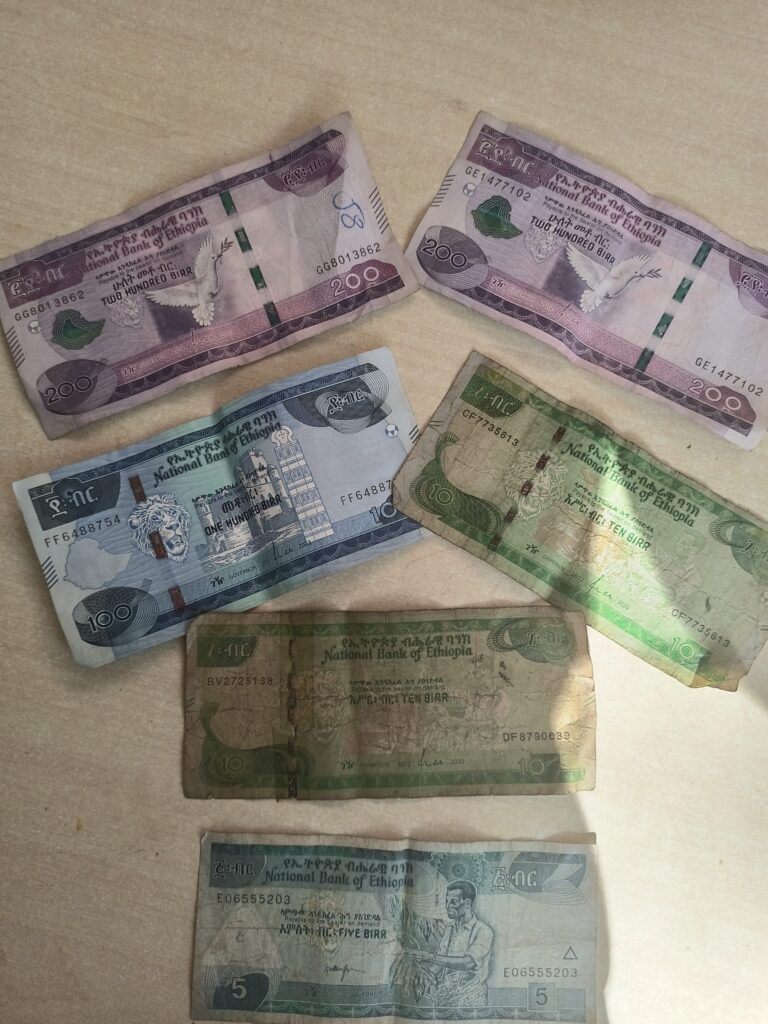
Moyale town is up a few twisties and we enter the border area (a One Stop Border Post) and park the bikes directly at the fence. We find someone who exchange KES to Birr.
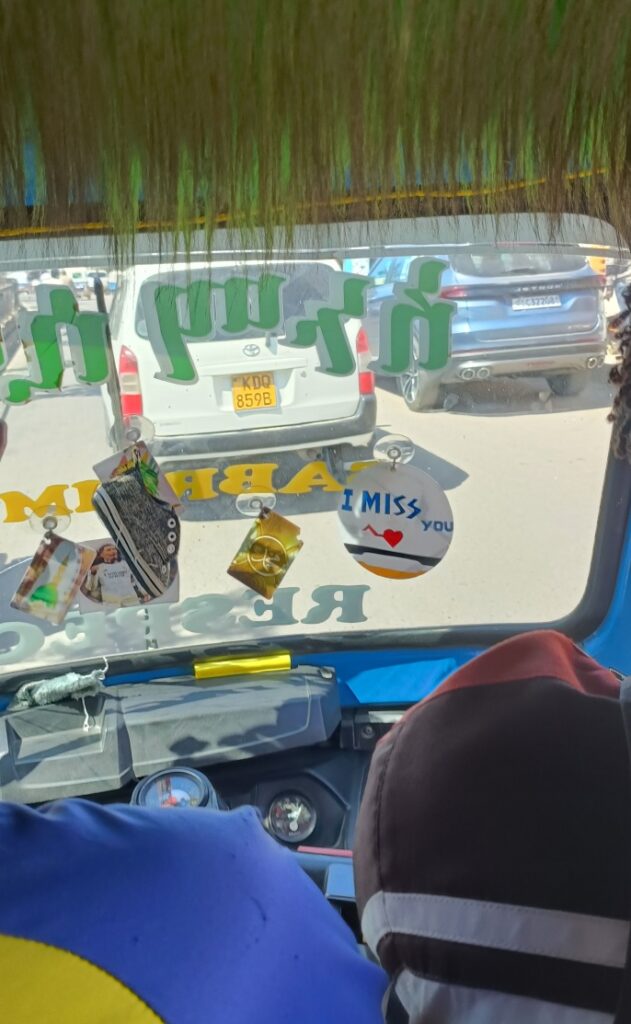
As the core rider team proceeds to the customs office, the rest of us request a security guard to watch our bikes and take a stroll to the Ethiopian side. It looks like the bigger part of town is on the other side. How amazing that Kenyans can enter Ethiopia without a visa. The Ethiopian border guard even recommends a restaurant (Koket Hotel) and we crowd into TukTuks to take us there.
Embarassing! This Kenyan probox cuts off our tuktuk driver.
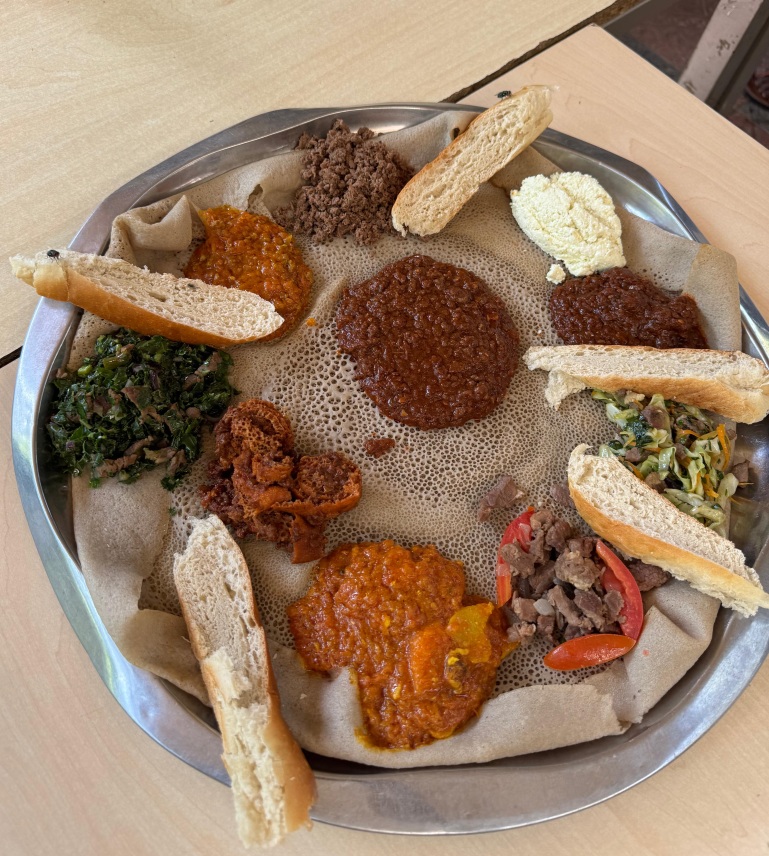
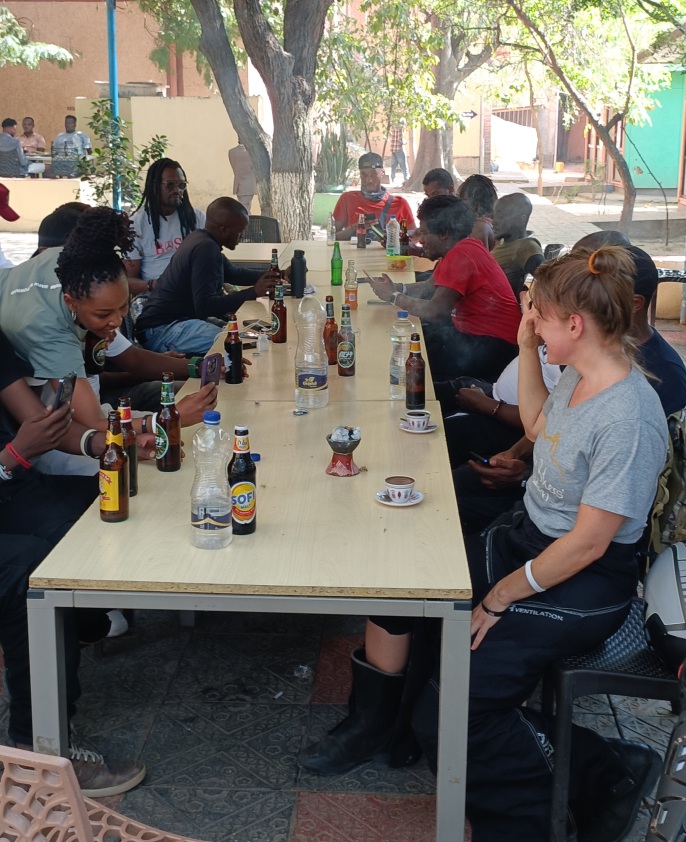
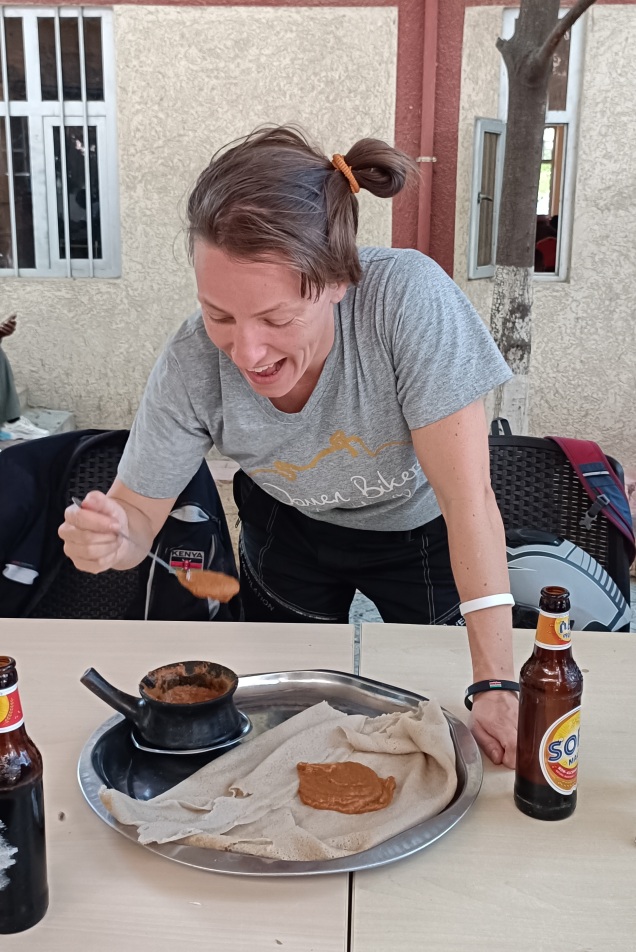
We find a great variety of non-alcoholic beers at the bar, and order a few mixed plates of Ethiopian dishes to share. I have a feeling that this food will be very spicy, so I order Shiro instead.
It is time to say by to the core team who are riding onwards into Ethiopia. And just as we finish paying our bills, they enter the restaurant.
Enjoy your journey, many beautiful encounters and safe roads always!
PS: Look at the photo bomber at the back! 🤣
Day 3: Moyale to Archers Post
Before riding back to Marsabit, we have to get fuel. We’re about 15 bikes and that takes some time. It’s just before 5pm when we leave Moyale town.
This ride has some amazing people! Such diverse bikes and even a drone!
The playlist is zen, the skies are clear and the full moon bright. The last smooth bends before Marsabit through the hills are absolutely magic and meditative.
Day 3 – Exploring Marsabit and back to Archers Post
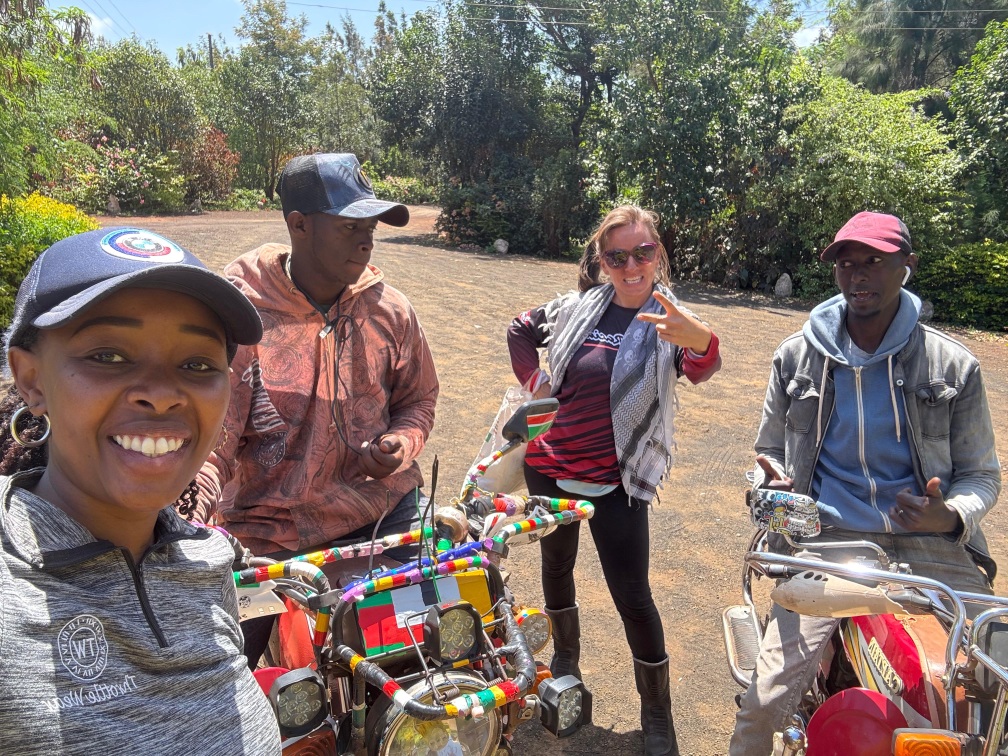
Most bikers are leaving early to attend to commitments back in Nairobi. Nyawira and I want to see a bit more of town, and are also keen to visit the Botanical Garden of Marsabit. We are warmly welcomed by the team and they help us to arrange bodas to go see the place.
Good chats and safe riding with the boda riders!
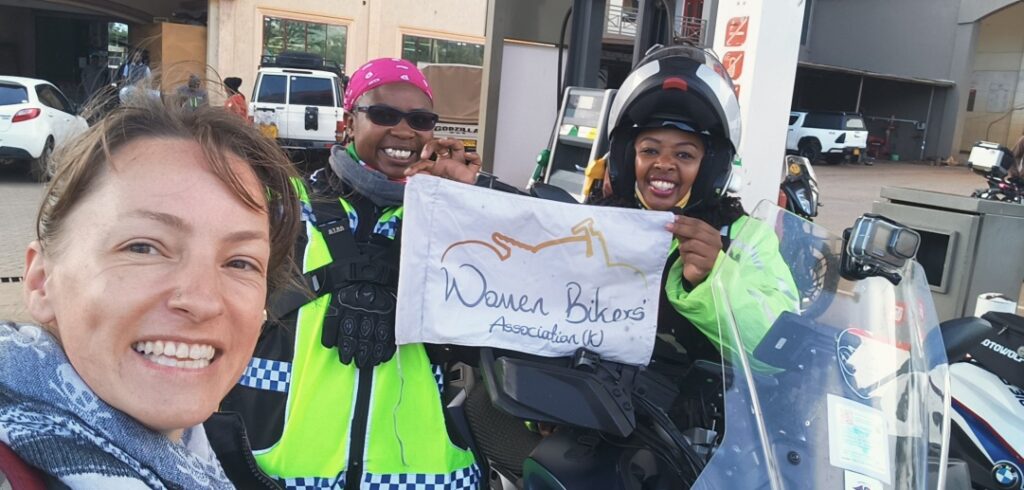
Riding out of town through backroutes we see farms and red soil. It had rained briefly in November. Marsabit town is farmland, while most of the county is pastoralist land. It is great to learn more about the vision of the Botanical Garden, and their progress. Preserving some of the indigenous trees and medicinal plants of Kenya is an urgent and important cause, but how to make it work when the rain seasons keep failing year on year? They hope to grow much faster once they secure a water source. We hope to come back one day through our partnership between Miti Alliance and Women Bikers’ Association!
Sunscreen plus offroading without helmet = trouble
And then we check out of the hotel and head southwards, back to Samburu county, past Ololokwe to Archers Post.
Then we meet these two incredible cyclists, on their way from Cape Town (!!) to Addis (!!). What an achievement 💪
At some point we are waved down by one of the other bikers on their way back with a chain issue. Sadly we don’t have the right tool to help, but a local rider manages to get it from his house.
Back at Ololokwe Nyawira is doing the most to secure the best shots.
The security check takes us a little longer to clear this time round. They are doing a thorough job and requested to examine all our luggage. We still get to Archers Post before sunset and ride into the beautiful Lions Cave Camp.
What a beautiful journey this was!
Two more bikers join us here for the offroad saga that’s to come: We want to first hike Mt. Ololokwe (yes!) and then cross over through some scenic trails in Samburu, Isiolo and Laikipia.
Get all the pics and stories in Part 2 of this article! Both are motocross racers. Well, at least my bike has the Dakar sticker 😉
PS: The photos on this article are not all mine. They are from various riders in the escort team! Thank you all for an amazing time together, and the great comradery 🏍️🏍️💨💨💨
I got my KTM 390adv (2020) in late 2022, with 2 previous owners just broken in at 4,600km. I promised a 10,000km review, but it took a little longer 😂 The odo just hit 25,000km and I’ll say it’s a fun, reliable bike! Even my GS friends look at it with shiny eyes and I’ll tell you why later.
But let me start at the beginning.
When I started riding in September 2018, my first rides were on a 108cc bike. That’ll be a whole story in itself. From 2019-2022 I was riding my Spirit Motorcycle to the remotest corners of Kenya and also all the way to Lake Kivu.
A custom scrambler. Nimble, lowered, carburetted, light, a reliable Honda 125cc frame and engine, with some great additions like adjustable shocks, LED lights, and an extremely cool design, we covered 35,000 Kms together.
Our trips are documented on this blog including how it jump-started a Super Tenere 700 after crossing Lake Turkana on a boat.
On my first solo roadtrip I spent more time taking pics than riding!
Riding this amazing bike taught me discipline on the road, resilience on offroad, how not to tie luggage, how to take photos and how steering bearings are changed. And many other mechanical things because you don’t just ride 2,000km through Northern Kenya or 5,000 through East Africa on a custom bike without a little DIY here and there.
BUT . A ride to Watamu would take me 12 hours, and on group rides, I’m guaranteed to be left behind (unless it’s offroad of course 💪). So what could possibly be my next bike? A little faster, more ergonomical, but equally reliable?
Anyways, what’s an upgrade? (Part 1)
A quote I read about bike upgrading on the internet went something like: You can only upsize your engine, the upgrade will be in your skill.
I borrowed a KTM 390 adv from a friend for a 600km tarmac roadtrip back in 2021 already and had lots of fun in the Chogoria twisties. But I just couldn’t see myself riding it offroad or in town traffic. Too high! (855mm seat height) Too heavy! (172kg wet, so 200kg with luggage)
With my 1.59m, I can’t get two feet down, and I was used to that safety net of walking it through sand or mud if needed.
So I went for offroading classes with Offroad Adventures in Karen. On their tall but light dirt bikes, I learned to shift my weight to the right or left so that I could stop the bike and start again with only the toes of one foot down. I managed the sitting and standing position correctly on uphill, downhill and cornering, and how to brake on offroad.
Late 2022 I got an option to buy a relatively new KTM 390 adventure 2020 model from a rider in my circles. At 4,600km with two previous owners it was very gently used.
I never saw myself as a bike reviewer, so when guys started asking for my review, I wondered what exactly I would write that isn’t yet covered in many other online reviews.
Part 2: Pros. Things I love about the 390adv
Rusizi at Lake Kivu (Rwanda)
Safety
The braking system is impeccable and the ABS has kicked in a few times!
I’m sitting higher above traffic and can see what’s going on a few cars in front of me. Sitting higher, with higher backlights also means drivers behind see me better.
I’m getting a lot more respect from drivers on this bike and can flash my not-so-boda looking lights at oncoming cars/mats/trucks which are overtaking in my lane on highways. 80% of cases they move back into their lane.
And if I’m pushed off the road, it feels much more stable with the larger front wheel!
Rusinga Island at Lake Victoria
Power and Acceleration
If you ride a T7 or GS1200 or one of their siblings, please skip to the next chapter (fuel consumption) and only then come back 🙂
The 373cc produces 43.5 horse powers (just like my first car!). You can google the torque numbers, but let’s just say very few cars, no matatus and zero trucks matches the acceleration between 20 and 130 kmh, meaning you can leave behind many drivers, but maybe not all large SUVs. The bike comes alive upwards of 80. It also sounds and shifts better here.
Something really nice happens at about 6500 rpms, when the top end torque kicks in. You’ve got to be ready for it.
A2 Highway at Ololokwe
And it’s a forgiving bike! Whether you find yourself in 2nd or 4th gear at 35kmh, you will make it. I have stalled this bike only twice on tarmac.
Fuel Economy
The power/fuel ratio is fantastic! I have NEVER gotten an average above 3.1/100km on any tank filling. Cruising around town is about 2.9l and if you push it on long uphills or highways, it goes up to 3.3l/100km.
This is still nearly double from my previous Honda engine, but gives the big boys teary eyes.
2024 May Edit: On looong, empty highways (Namibia), when the average hit 121 km/h that morning, the fuel consumption went up to 4.5 l/100km.
Offroading
This is an adventure bike. Standing ergonomics were a game changer for me. The 19 inch front and 17 inch back tire give stability and amazing handling. You can zoom along rough roads at 70 and roll down rocky hills or forest roads without thinking twice. (Obviously skills come in handy and I have taken countless offroad trainings!)
Tarmac offroading is very common in Kenya: With this bike, you’ll sail bumps, and rumble strips and potholes disappear once you hit 50. No gravel on tarmac can scare you. (Okay, maybe the one in the twisties…!)
The WP forks are amazing. Not ridden this bike with the stock tires. I ride Mitas Trail+ tires, which are 60:40 (Road:Offroad).
Every 390adv review speaks about the fact that offroad ABS does not mean ABS is off, and that Traction Control will come back on after every time you restart the bike. The ABS doesn’t bother me much, given my riding style, but Traction Control being on while you want it off can really annoy you, especially on bumpy roads, and I have stalled on a few rocky uphills cause of this.
Magoroto Forest in Tanzania
Fun little things
Finding neutral is impossible on this bike. But you can connect your phone to the display via bluetooth, then see who’s calling or even navigate using the KTM app.
The quick shifter is a fun little extra, and works best when accelerating nicely.
This bike looks amazing when completely clean or quite mucky. In between it looks pale. I rarely wash it, actually, and prefer a bucket wash. Once the display throw an ECU error, after a pressure wash.
Following 390 forums on the internet it also seems the 2020 version was quite reliable, and later versions may have more electronics issues and faults.
Manyara Region, Tanzania
Part 3: The cons / not so great things
There’s nothing I hate about this bike, honestly. But if I could get less vibrations on the the handlebars and footpegs, that’ll be great. Sometimes a foot or hand gets numb. The footpegs have rubber to buffer the vibrations from entering your boots, but in the rain season it’s so slippery you remove the rubber.
Minimal fender distance on front tyre could create issues with black cotton soil or bad mud, but hasn’t been an issue to me. Some people modify to raise the fender.
The sound: I mean, it’s a single cylinder 373, people! Nothing too sexy, no roar 🤕
Vanga, at the Indian Ocean
Part 4: Cost & Maintenance
After sales service: I had been told that once you buy a KTM in Kenya, you’re by yourself. The dealership that sells the 390s is not like the BMWs or Kibos that are putting intentional effort into smooth and customer-focussed after sales service.
So I embraced this mindset from the get-go. I printed (!) the workshop (!) manual. I research and know the fluids that go into my bike. I do as much as possible maintenance myself, or with the help of other bikers. I chose different mechanics for different issues based on their strengths.
When thinking of getting a ‘big bike’, get out your calculators! Everything, absolutely everything will cost 2 to 10 times what a small CC carbureted bike needs. And because most things are imported, prices change with the dollar.
Oil & Filters: Oil filter and oil every 7000km. The bike uses 1.6l of synthetic oil. While Motorex 15W/50 is recommended, I like Motul better. Currently about 1900 a liter, and 1500 for the filter. I changed oil at about 5000, 10000, 17000 and 23500km.
Air filter: You can and should clean it regularly of course, but replacement is due every 7-10k (3,500 KES when I last needed one). A washable one would be more economic in the mid-term.
Wear & Tear: I replaced the stock drive set at 17,800kms, the chain was completely worn out at this point. The new DID 520 vx3 chain and JT sprockets came to 137 Euros. I hope these will last at least 20,000 km.
A set of tires sets you back around 30-35k, including balancing. My first set of Mitas was changed at 23,500km and I’m hoping the second set will do the same mileage.
Not needed to replace the spark plug, any cables, brake pads, etc yet. No malfunction of the cooling system yet. Still on stock coolant.
And here’s a picture of taking my brandnew Mitas tires offroad:
Part 5: After Market Parts
Lowering the bike: After reviewing various options, I decided to go with a lowering option by Metisse, a German company. You replace the spring plate under the mono shock, thus lowering the back of the bike by 20mm without actually changing the spring. Fully reversible. Then you just push the forks through the handlebar by the same 20mm, and voilá: Manuela has one foot down while the majority of the booty is still on the seat. (They also have a 30mm option but I didn’t wanna loose a lot of ground clearance.)
Saddle Stays: The cool orange bags I got that everyone’s asking about are called DrySpec D20. They never even got close to touching the exhaust or tires, but I still ordered Saddle Stays from India (AdvenTOUR 3-point) just to be sure and to be prepared for larger saddle bags. The saddle stays are sleek and sexy!
Topbox / Toprack: The previous owner had added at topbox but sadly the mount didn’t last for long once I went on bumpy roads and slight offroads. A bolt broke and I ended up leaving the topbox in Naivasha at my friend’s place one day. Then I looked for a mount that would attach to at least 4 points on the bike. I imported a Toprack from Motouren from India, which sell custommake parts for KTM and other brands.
Mounting both the top rack and the saddle stays was a little finicky, as they lock on the same bolts on the bike’s frame.
Bike Protection: Crash bars were already mounted by previous owner, and giirrrllll, I have used them!! I also added a display protector (from India). Not yet added a headlight protector, which could be recommended when riding offroad in groups, as a stone could jump and break your expensive headlight.
Final Verdict? And what next?
It took me a while to embrace the fact that the bike doesn’t have muuuuch character. It is exactly what it is. The truth is that you as the rider add the character.
I’m not at all tired of this bike! And I’m about to embark on a 6-country 7,000km trip. Let’s talk afterwards!
Samburu County, Kenya
PS: I have never even sat on a KTM Duke 390. As mentioned, this review is about the KTM 390 Adventure.
PPS: Links to riding stories on the KTM:
East Africa Loop part 1: Nairobi – Kampala – Cyanika – Lake Kivu here
Part 2: Lake Kivu – Kigali – Singida – Kilimanjaro here
Part 3: Moshi – Usambara Mountains – Vanga – Diani – Nairobi here
High blood pressure has been a chapter of my health journey for about a year now. I thought to share my experience and learnings for anyone who’s on a wellness journey, too!
How I found out…
In September 2022 I underwent a minor day surgery. I had a similar procedure done before in Germany, removal of a skin cyst. It’s 20 minutes: inject, cut, scoop, stitch. My biker pal and surgeon of choice, Dr. Hungu suggested Nairobi Hospital for ease of billing. (My insurance kubwa in a smaller hospital would have meant reimbursement)
Now, Nairobi Hospital follows all sorts of international protocols for surgery. I’m a bit annoyed by all the procedures (i.e. I had to fully undress, was taken to the theatre in a bed, and asked to remove my nose piercing 🫣).
My Blood Pressure was monitored for a whole hour and was between 135/90 and 145/100. Must be the emotions, right? Probably. Doc suggests I buy a BP monitor for home use, just to be sure. Easy. MyDawa delivered the same day!
In the next two weeks I didn’t measure numbers below 135/88 and 145/100 on the upper end.
Indeed I was hypertensive! At 39!
I had been through triage at doctors many times but honestly had never paid attention to the BP they measured for me. Good lesson!
In October I had another surgery lined up. Something was growing in one of my ovaries. It was benign but I wanted it out and all mental energy went to preparing for this and finishing key work assignments.
My surgeon and anesthesist weren’t too worried about the BP in relation to surgery. The numbers in the various checkups kept showing hypertension stage 1.
“But please see a specialist!”
Yes, sure. When all this is done.
I stayed in hospital for a night and someone suggested to call the hospital cardiologist as part of the ward round. My encounter with said specialist was a disaster. After the laparoscopic surgery I was in pain. I could hardly walk as my core was still numb, my shoulder hurt like hell, my breathing was shallow, my voice hoarse from being intubated and the opioid side effects were just starting to wear off.
The cardiologist walked in with three other people who all lined up in a row in their white coats looking expectingly (I guess it was some sort of training?). I wasn’t wearing much under the back-open-hospital-gown. He asked to touch/examine my legs (not sure why). Then gave me a prescription for Amlodipine and an appointment to see him 3 weeks after starting the meds.
😵💫
Needless to say I didn’t start the meds. I wasn’t heard. No questions asked. I started crying when my gyna surgeon came to discharge me. He surely has seen hundreds of women in tears, but still. The great intention of linking me with an expert hadn’t been fruitful.
I recovered from surgery for around two weeks. Lots of time to research on blood pressure (German and English resources, medical sites and alternative sources) and interview both my parents separately for family history.
Other than a headache I hadn’t had any symptoms. But knowing that my heart is pumping my blood with high pressure around my body, for God knows how many months already, constantly affecting all blood vessels, which over years would damage potentially all organs incl my beloved brain and eyes was just crap.
I got a referral for a caring internal medicine physician from another biker doctor pal.
~~~ Diagnosis ~~~
I went to see her at her clinic at KNH. I carried the family history, my blood works for the last year and BP recordings for the month. Dr. Jackie Kagima, although a busy clinician, took her time to review everything. She explained the body’s functioning and we discussed possible causes and scenarios (from lifestyle to medical). We talked about treatment options and while I was keen on lifestyle changes, in the end she proposed to start the meds as I was working on lifestyle. I learned a lot from that conversation and it put what I’d read online in perspective.
From the examination, she agreed that my heart is “loud”. Palpitations is the term. I always thought that everyone hears their heart beating, like I do! Apparently not. 🤯
Y’all okay never having heard your own heart beat? 😂
My thyroid results were okay. My sugar, cholesterol, and bone chemistry were great. A baseline cardiogram was neutral.
I had a diagnosis but no “medical” root cause.
Great news actually! Nothing was wrong with my body. I decided to stop searching.
And to rely on my intuition.
I just knew deep down that this was related with -1- big emotions around effort-output-ratio in various departments of my life, -2- lack of exercise since the pandemic which had also led to a few extra kgs, -3- some compulsive and anxious thought patterns, -4- not enough good sleep
In short: lifestyle changes were in order!
And I got the meds.
The tablet is tiny and easy to swallow. And the heart shape inspires one to take charge of cardiovascular health.
~~~~ Lifestyle changes ~~~~
Eating less salt wasn’t going to cut it. This is a private joke for anyone who’s ever eaten my food 😄
I immediately got the annual membership in the local Karura forest. 3-4 days a week I walked 4-7km. Soon I was able to incorporate sprints and sets of pushups! I rearranged my work schedule to find the 2 hours regularly. I got drenched during rain season, and met a fox at dusk. Friends cancelled forest dates but I still went until I knew all paths offhead.
I prioritised talking to people who would be supportive of my self-healing approach and who have high standards for their own wellness.
Mental health. I cut down social media scrolling. I listened to many interesting podcasts. Read more books. Fiction but also nonfiction written by psychologists and therapists to gather new perspectives on my self and my relationship to myself.
Saying no to requests. Not volunteering for projects. Taking it easy when things go south. Smiling instead of getting mad/sad. More memes.
Arts, mental health meetups, breathwork, massage. Reiki, herbs, types of cooking oil. More home cooking, no more caffeine. Reducing evening carbs, cutting liquid calories. A lot of experiments.
I made fruit juices and baked oven vegetables. All my life I’ve incorporated exercise into my holidays and long weekends (cycling, hikes) now adding meditation and stretching sessions.
It helped that my close peeps are also fitness and outdoors freaks. We catch up over a walk, not a coffee.
With some friends we started a WhatsApp chat group to share our fitness and wellness updates. Determination is contagious 😀
Sleep. I read up on REM sleep and sleeping tips. The social media and bad news detox helped. Time in nature combined with cardio helped. Cuddles helped. But a major insight was skipping the last bottle of water before sleeping so my bladder wouldn’t wake me up. Sometimes it’s random things like this 😳
Anyways, taking meds daily for many months is interesting. They soften your blood vessels, in turn lowering the pressure. It works like charm. Within 3 days on this really low dosage, my BP was down by 10/8 points more or less.
Now my BP hovered around 120-130/83-86 which is considered upper range but not hypertensive.
(They cost around 2300 KES for a month’s supply btw. Not everyone will afford them!)
I was of course measuring regularly. Tracking apps.
Do you know I carried the machine around East Africa for 4,613kms on my motorcycle roadtrip? Wueh. 🥲
~~~ Getting off meds ~~~
Around two months after starting the meds, I stopped them. The internet is full of confusing advice on how to do this. Anyways, it failed. My blood pressure went up again to earlier Stage 1 values after around two or three weeks.
I met another doctor, a holistic thinking GP, my biker friend Dr. Tasneem. I was now back on the meds but my goal remained to get off them. She mentioned that even the most radical lifestyle changes can take a year to take effect.
Makes sense, right? Your cardiovascular system has clogged up for years yet you expect it to clean itself up in four months? I’m ambitious 😁
It’s not linear
Some days the BP goes up. Or morning is great, evening not. Then I wonder what you did “wrong” or what “right” you ommitted. Then I worry about it. Then you remember that you shouldn’t worry too much because stress is a trigger. (See the compulsive thoughts mentioned above? I set out to rewire my brain to stop them whenever I noticed them. Lots of )
What’s the right balance? Not getting too attached to immediate changes while staying attentive to the trends. Exhausting sometimes. So the meds really come in handy. Swallow, relax and forget about all this for a bit.
And I should say: When I accepted the meds as a (hopefully temporary!) partner on my journey, my spirit and emotions became lighter.
~~~ Success in unexpected places ~~~
Honestly, meds or not, I was loving the changes. I was feeling great. Fit, sexy, stronger. Very in touch with myself. Connecting with animals. Doing great work for my clients. Being creative. Having energy for things I love. Waking up refreshed.
I got back into Ashtanga Yoga, doing the full primary flow without needing breaks. If you know about Chakras and Prana/Chi/Qi, this definitely contributed. I hiked up hills and mountains.
I felt 30 again. Well, no. I’m just saying this to show how worth it was for me to invest time in myself and my fitness and wellness.
I saw other friends with similar intentions who weren’t able to pull through. I honestly don’t know how a wellness journey on an 8-5 job plus nasty Nairobi commute and a toddler would look like.
It feels like our environment is just not set up for wellness. If this statement rings true, I highly recommend this reading: The Myth of Normal by Gabor Mate. (In short: why “normal” isn’t necessarily “healthy” and what we can do about it as individuals and society)
Yet, I was on meds. Btw, on the lowest dosage (2.5mg Amlodipine). It’s not even on sale in that dosage in some countries!
Around my 40th birthday I decided to try something new. Every time I decide to learn a new skill without an end goal, it’s transformational.
I signed up for the gym with the sole goal of trying out weightlifting. I have no interest in indoors cardio, or being counted for or motivatingly shouted at.
I want to be able to lift my motorbike if I drop it. (It’s around 170kgs)
And I was curious if the benefits for hormones and bone health would come through for me now having entered the 4th floor as people call it.
A good friend and experienced lifter suggested a 3-day-split. A what?
It’s been fun! Learning the techniques, names for different exercises, listening to my body and distinguishing different types of sensations and pain. Oh, and actually getting stronger every single session is incredible!
Four weeks in, I got a bad cold. After all, 50+ people were breathing heavily together in a closed space.
I lost my appetite for many days. I only realised a week later that I forgot to take my meds.
Alarmed, I went to measure. My BP was great. I even took a photo
What?!?
I decided to dis-continue the meds. I continued the weightlifting.
I’m still a gym newbie! But there’s something amazing about lifting 20kg weight above your head or moving 60kg with your lower back!
Apparently weight training is highly recommended for management of hypertension, diabetes, thyroid and other diseases.
Noone told me. Now you know 😜
Let’s see how it goes from here! Right now my blood pressure is normal. Who knows about next year?
Wellness clearly is not a destination but a journey. And it’s not a straight line either. You get there through trying out things, self-observation, seeing what works, engaging professionals as thought partners, applying research to your context, combining things and building on your learnings.
And accepting that your body and your soul will throw some curveballs at you but you’re becoming amazing at catching.
I’m currently integrating everything. Strength training, mindfulness, nature. I’ve upped the carbs again to support the heavy workout and muscle building, of course healthy carbs. I still go to the forest and prioritize yoga and stretching sessions. I drink coffee with no effect on my BP.
Wherever you are in your journey, I wish you all the best!
It’s like gazing at eternity: A 900m rock wall glistering in the many shades of sunset.
On the next dinner table: A conversation of a Malagasy tourguide and his two Spanish clients. Perfect Madrid accent. Obviously from the tourists, but also the guide. I chat him up later and ask him how he speaks at least four languages, all fluent.
Everytime someone on this trip asks me where I’m from, I say Kenya. It’s the truth but I’m also testing a little theory here. The answers have ranged from “Not possible. I won’t believe you unless you show me a photo of your parents (???)” to “But Kenya is in Africa, right?”
Back to the story. Other than most, this guy knows where Kenya is.
Santatra tells me he’s hosted a European tour group before who loved their Kenya trip so much that they extended their Africa stay by a week and visited Madagascar. What noone told him is that they’re all gay and when welcoming the all male group at the airport he couldn’t reconcile what he saw with the room allocation on his briefing documents. We end up chatting about how it feels for a typical Malagasy father if his son is gay, we move on to Pan-African socioeconomic issues and then he’s very curious to hear what I found most unique about Madagascar, considering I’ve lived and travelled East Africa for 15 years.
After some thinking I tell him it’s not the beaches nor the landscapes. It is the genuine and proactive offer of support by locals to a stranger passing by without wanting anything in return!
I tell him about Fabian, a hotel staff who offered to pay my dinner bill with his own money, after I got stranded because I couldn’t get Forex that evening, happy for me to come back the next day to refund him.
And the cyclist who waved me down in his village to state that I’m probably lost but he’ll take me back to the correct route, cycling ahead of my motorcycle at high speeds for about 4km!
Oh. Santatra studied Spanish Studies at the University of Antananarivo, just like Malibu.
Things are coming full circle on this Madagascar trip.
Well. Doing a circular motorcycle tour in Madagascar isn’t that easy. Because of the limited road network, many people end up flying or backtrack the same route. I made it, and you’ll find out how, as you keep reading.
Malibu (the chief trainer at Inked Riders, who taught me and hundreds others in Nairobi how to ride a motorcycle), as I recently found out did Spanish Studies in university – at the same University of Antananarivo.
He also taught me how to check the spark on a spark plug but this will become more relevant later in the story.
Welcome to my birthday roadtrip through Madagascar.
Enjoy your read!
Part 1 – Exploring Antananarivo, the capital
I land in the afternoon after a 3-hour flight from Nairobi. I am surprised to see that the locals have to queue with us internationals at the same immigration counters. Nuts! The taxi ride from the airport to town towards sunset is amazing, first passing rice fields then entering the busy town! I spend two days exploring the old town, the Museum of Photography and catching sunsets from rooftops.
Part II – My motorcycle adventure ride through Southern Madagascar.
Renting a motorcycle abroad is not a cheap affair. From my research, in many countries an international brand adventure bike goes at upwards of 70-100 USD per day. Not very affordable for a three week trip!
Also, I was solo on this trip, so wasn’t too keen on a heavy bike. After some research and google-translate supported email exchanges, I settled on a Chinese off-road model rented out by a small firm in Antsirabe, a city south of the capital. I found positive reviews online by European tourists, and the owner was quite responsive and helpful via email.
The minivan bus ride to Antsirabe takes about 5 hours and I’m happy I’m not riding a bike. The roads are narrow and busy. At the many corners and single-lane bridges, we have to wait for trucks to pass before proceeding. I watch the scenery, listen to the local music from the radio and enjoy the driver’s safe driving!
Day 0: Prep Day (Antsirabe)
After lunch, I pass by the bike rental place. Finally, I will see and feel the bike! Jean-Marc and I finalize the rental paperwork, and I get a hundred tips about the route, and what might be realistic in 17 days and what not.
Day 1: Exploring Vakinankaratra
Route: Antsirabe to Miandrivazo
It’s views after views!
Hilly, twisty, hot, dusty, and a lot of “former tarmac”
Day 2: Menabe Region
Route: Miandrivazo to Morondava
Heading 280km westwards towards the Indian Ocean. A lot of nothing and wilderness but I love getting a glimpse of life near the large rivers.
Just before Morondava to the right is the famous Baobab Avenue. Because much of Madagascar’s indigenous forests have been lost (not unlike Kenya!), protected areas like the Allée des Baobabs and national parks are important for protecting remaining tree cover and giving locals and tourists alike a vision of what reforestation could do for biodiversity!
When you’re on the West Coast of Madagascar, you can watch the sun set over the Indian Ocean!
Day 3: Beach Day (Morondava)
Today was a tourism day. It was also a planning day!
In preparation for this trip, I’d been researching about the next 200km. From Morondava to Manja is Off-road. Deep sand, pure bush, “strong enduro skills” needed, no network, no town and 4 “in the water river crossings” is what I found out. Sounds amazing, actually. But not alone and without camping equipment, medical kit or language skills.
If I can’t figure it out, I might have to backtrack to Antsirabe, which sounds super annoying. I get an offer of 1.5m Ariary at a hotel’s tourism desk, which is much more than I’d want to spend.
So towards evening I walk to the bus station and ask around (sign language + basic french + google translate) until an industrious bus ticket lady arranges a 4×4 pickup for me. 960,000 Ariary.
Getting money in Madagascar proves to be an unexpected challenge. Every second ATM isn’t working with my card. There’s also a withdrawal limit of 200,000 Ariary (about 50 USD) so everyone takes 5 turns at the ATM, so even if there’s money in the ATM, the queues are endless (up to an hour!). I also try to send money from my bank accounts to the local mobile money systems (unsuccessfully), and by this point I have three local SIM cards.
The most reliable and fastest way to get local currency was carrying USD and EUR in cash and exchanging in bulk at the bank counter.
Day 4: Wilderness Challenge.
Route: Morondava to Manja – on a pick-up truck.
An adventurous 6 hours drive, lucky I got a madly skilled driver!
Breakfast waiting for the driverThe equipment that will hold the bike on 200km rough roadSome rivers have bridges! 🙂The town half-way through
Manja has exactly one hotel, and all tourists stay here. I hadn’t booked. The main house is full, and I get a room in the neighbouring compound for about 5 USD (inclusive of some rodent visiting at night). They also sell sodas and beers so guests can sit on the roadside of the main village street.
And fuel from bottles. Fuel in Madagascar is green.
Day 5: Manja to Tulear
Brand-new tarmac and one river crossing.
First time I’m seeing Chinese road and bridge construction in Madagascar! The ride is quite smooth but not very entertaining. Until I get to the river. Which is much wider than I imagined.
From the two options offered by locals, I choose the floating ferry (that cars use) over the canoe (that locals use).
Getting off the ferry I have about 500m sand to cover, which is good fun. On the remaining 200 Kms tarmac to Tulear, more baobab trees give a coastal feel.
And now it’s time for a few beach days!!
Beach Day in Tulear
This is the Indian Ocean. Just like in Morondava, it’s a West-facing Coast which I’m so fascinated by. You get the sunset over the ocean!
Day 6: Tulear to Isalo National Park
Today’s 270km are loooooong. Starting from mangrove forest at the Indian Ocean, most was monotonous, empty landscape along the national highway RN7. Soooo few cars! I realize just how low the economic activity is. There is barely any traffic between towns.
My humble 200cc bike isn’t made for speeding, so I end up listening to many podcast epidodes today. This highway is in a pretty bad shape in some spots, and smooth in others.
There were just about 3 interesting things today:
1. A 3km stretch of protected indigenous forest remaining from the once lush thicket that must have covered much of the island. The level of deforestation is incredible.
2. A town that sprung up a few decades ago after gemstones (Sapphires) were found in the river. It’s a ghost town really, with most of the gemstone shops shuttered.
3. Golden Hour in Isalo National Park. Beautiful rock formations. Hikers paradise!
Bye bye to the Ocean for now!Vaaaast emptynessYes, this is still the National Highway!
I stay two nights, though in two different places. First I pull up at a family-run “ecolodge”. The shower water is being warmed in plastic bottles stored in a metal box standing in a sunny spot – genius! (But not as helpful for early morning showers). The food is fine but pretty basic. Of course I am offered rum in the family’s living room.
I try to arrange a hiking experience, to see some of the forest and natural rock pools in the National Park. But I find Madagascar’s National Park fee structure fairly costly, and the guide fee is dictated by the government and not negotiable. Even as a solo traveller, you pay the guide fee for 4 people. It is cheaper to get a full-body massage at one of the town’s hotels. To which I move for that second night 🙂
Day 7: Isalo National Park to Andringitra Mountains
I wake up alive which I find a big deal after eating crocodile for the first time in my life yesterday evening.
Today I plan to ride to the Andringitra Mountains, paradise for outdoorsy people!
After 100 boring clicks, the route is getting more and more scenic with huge granite mountains around.
In Ihosy I’m meant to get cash, fuel, snacks and do chain service. Both ATMs in town aren’t working so I spend 90 minutes to exchange some cash and forget everything else.
I pick up some snacks at a small town. The final 25km are offroad. It’s lovely cruising through the valleys, and testing the bike on its home terrain: rocky dry rivers and gravel turns.
The lodge is up a steep hill, what pretty views!
Exactly 300m to the gate, on a bumpy uphill, my chain chains. If this was to happen on this trip, this is the best spot. After taking some photos and updating my biker pal back in Kenya about my situation, I try to lift the chain back on the sprocket. But it’s stuck behind some metal and I just can’t lift it.
The lodge’s team comes with pliers and we open the chain then fix it back.
The poor bike isn’t starting but without batting an eyelid the lodge crew happily pushes it up the remaining hill and parks it at the reception.
We try to start it, kick it, push it, choke it, unchoke it, drain pipe it… Nothing! A little crank but no roar.
It’s getting dark so we decide to deal with this another day!
The place is so beautiful! The views of the mountains and the valley! I book a local guide for the next morning to take me around.
I unstrap my luggage and move into a beautiful round, tiny hut with a comfy bed.
Before dinner, I run into a snake and the owner of the place. He’s a famous French rock climber and he assures me that snakes are great news and that the valley’s bike mechanic will figure it out.
The Morning After Day 7.
After an early breakfast, I head out for a walk with my local guide and an animal spotter. We walk through the forest, and he shares some local tales.
King Julian!
Bike still isn’t starting. When kicking or pushing, it starts but immediately dies. Two of the hotel staff push the bike around the hilly reception area. They’re having fun but clearly there’s no progress. Something keeps killing the engine. Strange!
The Morning After the Day after Day 7
Location: Tsaranoro Valley, Andringitra Mountains, Madagascar
The morning after, the valley’s bike mechanic is called. He’s called Safi which makes me very happy. Calm, fun guy who speaks great English. Together we analyze the bike. Spark, fuel, air.
We have veeeery little spark when kicking the bike. By now we’ve finished the battery. We change plugs, we sandpaper the coil connector, still no sustained spark.
We try the mechanic’s bike’s battery. Nothing.
The team even pours some local rum on the bike. Nothing 🤯
It gets real hot, so someone suggests beers. This works – as we rest our brains, a new idea comes.
Let’s check if the chain broke something around the front sprocket, when it fell. And voilá, we find two strands of the cable coming out of the engine cut!
A minute and some tape later, the bike roars to life! Really grateful to the mechanic and the team. Lots of learning and fun across languages!
Time to enjoy the beautiful nature around the valley!
Day 9: Tsaranoro Valley to Fianarantsoa
From this beautiful location and the mechanical misadventures, it’s 20km back to the tarmac and another 100 or so of beautiful riding to Fianarantsoa.
But the main question in my head is whether I’ll be able to get a train ticket for my bike.
Exactly. I’ll explain.
I found this train that passes from the Highlands to the Ocean through remote villages and beautiful mountain scenery, dating from, you guessed it, the colonial times, but still operating as a lifeline to many villagers and an attraction to tourists.
Arriving at the train station just after 12, I find it closed for lunch. People here take lunch breaks very seriously, so I head out for some smoked fish, too.
At 3, I explain at the information desk that je veux voyager avec mon moto sur le train. I’m pointed to the cargo section where I can inspect the relevant car and I’ll be given a price. The only caveat is that the cargo car only goes up to Sahasinaka and I’ll have to ride the remaining 55km after offloading the bike, of which 15km “not so bad offroad”. Noone can tell the journey time, but 10 hours is the best estimate.
Which would mean arriving very close to sunset 🤔
No risk, no fun, I think! And I sure want to see the Eastern coast! Wouldn’t be cool to ride there and back the same route, right?
We load the bike on the cargo car where it’ll sleep for the night
Day 10: Fianarantsoa to Manakara
Train+Bike
I’ll let the photos speak for themselves today! But how BEAUTIFUL is this train ride, how breathtaking the views, how diverse the local crowd at each stop and yummy the snacks on sale!!
At each stop, dozens of people are ready for our arrival with various offerings. Beer, Pasta salad in small plates, samosas in buckets, cooked local dishes, steamed banana bread, etc
After the cargo car gets disconnected from the train in Sahasinaka, I strap the luggage back on the bike (whole village watching). Then I ride some pretty muddy 15km or so with the last rays of light towards the highway. I drop the bike in a deep long mud puddle and of course it falls head down into a trench. At this point it’s pitch black dark already. Gladly a local biker passes by the scene just a minute or so later and helps me to lift the bike.
This is (of course!) the last mud pitch 400m before hitting the main road. I cover the final 40km tarmac to Manakara town with smooth light bends up and down hills in total darkness listening to my reggae playlist.
After seafood dinner in town (La Vanille Hotel) where I meet the tourists from the train again, who were able to travel all the way until town in the passenger car of the train. After a mandatory ATM visit, I ride some fun 5km sandy tracks to their satellite camp on the beach! (Vanille á la plage)
Day 11: My Birthday! Beach Day
📌 Manakara, Madagascar
There is no power at this camp. My phone dies shortly after I speak to my family. So I end up reading and resting my knee from last night’s fall. And watching the beautiful wild coast!
Day 12+13 Manakara back to Antsirabe
I’m nearly finishing up my roadtrip through Southern Madagascar. Already! 435km left and I split it into two days.
First off: Riding back to town from “Vanille a la plage”. The canal is really fascinating. There’s a spot by the ocean where the road is sandwiched between the two. I HAVE to come back here with my tent!!
Didn’t see this when I rode down here at night.
And a little bit of rain makes sand easier to ride
The Canal in Manakara
Manakara to Ranomafana must be the most beautiful riding of 2023 so far! 182km worth of twisties, views, nature on mostly smooth tarmac.
Ranomafana National Park has some stunning indigenous forest, and could definitely be worth a hike. Well, I don’t visit any national park on this trip, because their prices for foreigners and forced group guiding fees just don’t add up for my budet. I take several stops along the way watching waterfalls and trees.
The road passing through Ramofanana National Park
But unfortunately by not entering the forest, I don’t see any of the cute chameleons with the curled tail 🦎
I’m a bit sad, but start my journey back to the city anyways…
From Ranomafana back to Antsirabe, I take a detour from the Google Maps route, as advised by local bus drivers to avoid an off-road shortcut that potentially has some bandits waiting, according to them.
On climbing up a hill, kids stop me in a corner to sell me bananas. (It’s school holiday).
The boys also have a small hustle going on where you can take pictures of chameleons for some cash.
Amazing surprise 💖
Later on the RN7 I found a good 80km of baaaad potholes. Entered Antsirabe by evening and found my first traffic jam in three weeks I returned the bike to the owner and we had a chat with laughter about my tour.
A massage is due! I decide to relax in this Spa town for a day, exploring local crafts and food in the market.
Then I take the bus back to the capital, Tana, and visit the famous Analakely Market on my last day.
All good things come to an end. I travelled around 2600km in Madagascar, of which 1930km on the bike.
Amazing adventure! And certainly only saw a fraction of what there is What a massive and diverse country!
Highly recommend Jean-Marc Ney and the team at Rando Raid in Antsirabe for Motorcycle hires in the southern part! In my research before the trip, I also found other providers renting bikes based in the capital Antananarivo, and I’ll share them here. (I also found individuals renting out bikes by posting on facebook groups)
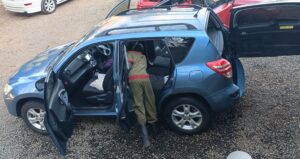
You’ll find them on Facebook or Instagram
* 100% Moto Madagascar
* Just Ride Mada by Rhyno Jesse
* Moto Tour Madagascar
* There’s also Badass Motorcycle Community, a biker restaurant.
If you know additional biking resources or contacts in Madagascar, feel free to add below in the comments.
It’s been a little over two weeks exploring East Africa with the new girl. She’s done great so far and I reached Kilimanjaro via the longest and most scenic routes ever: From Nairobi via Lake Kivu and Nyungwe Forest in Rwanda.
It’s been amazing spending time with biker friends, first Havana and then Mbeche – and now it’s back to solo-ing as he’s headed back to Nairobi. If you missed it, jump to Part 1 (Nairobi to Lake Kivu) and Part 2 (Kivu to Kili) first!
Kwaheri! Thanks for good company, mechnical entertainment, chain lube and bike wash! ✌️
From Kilimanjaro I want to continue to the Usambara Mountains. As a child I heard of a beautiful flower from this place (which is named after it). Plus I enjoy hiking so this was going to be great 😁
And somehow I want to find my way to Diani in the end. I’ll be starting my 2023 work schedule with a week long engagement there!
A scenic but hoooot and windyyyy 200km until the foot of the mountains.
They got some pretty unique road signs in TZ!
I can’t help but think that in Kenya, the main “produce” in such geographies nowadays is charcoal, sacks lined up by the roadside. 🥴 But here they deployed an irrigation scheme and flooded some fields in the plains. Sacks of potatoes and tomatoes abound in all markets!
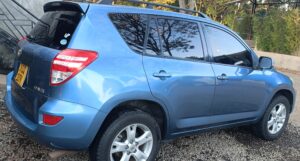
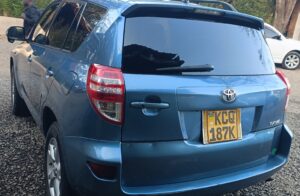
Turnoff from the highway and up to Lushoto on a well maintained, sometimes narrow road twisting up 800 or more metres. The journey takes an hour with photo stops.
After a late lunch I check into a decent room and dig out my walking shoes. An evening stroll takes me to Irente Viewpoint. Beautiful sunset and incredible views!
Day 2: More hiking and exploring!
Today I want to hike in Magamba Forest, a beautiful thick indigenous forest. Instead of using a guide I search for routes on Wikiloc. It’s a 5km walk through town and fields, and by the time I enter the forest I’ve finished my drinking water 😌
Up at the Viewpoint, there’s a young friendly ranger who sells water, charges the entrance fee and gives me directions for the remainder of the walk. I take his number just in case, because I wouldn’t be the first tourist getting lost at night here.
Once out of the forest, Lushoto town is a 3km walk back along the tarmac. It’s quite nice, mostly down hill and I glance at people’s houses and gardens and collect lots of greetings and smiles by school boys and girls. I realize that most women wear head scarves and skirts or dresses.
Everything’s great until I run into a group of construction workers who are walking uphill. One eyes me top to bottom, then stares at my breasts and loudly tells the others (in Kiswahili) to get for him that prostitute’s number because he really likes what he sees. Some of the others laugh, as we pass each other. I decide to let it slide, because who wants to deal with this kind of shit on holidays? Or any days?
After a micro seconds of self-doubt about the appropriateness of my clothing, I decide to shake it off.
It rains all night so I shelve the off-road route to Mambo viewpoint. Bucket list stuff! There has to be a next time!
Day 3: More mountains!
Day 18 on the road! Time to continue eastwards. Magoroto Forest is just 150km further. I book some recommended accomodation ahead, Mathias Cabin, having no clue how the road or place would look like 😅 But first back down to the Highway!
Onwards to Muheza town, I pass through Korogwe. I wonder if this Ginnery offers tours 🤔
The cabin’s caretaker meets me in Muheza town and gets on a boda to guide me to the place. He says it’ll take around 30 minutes. Shock on me!
Once out of town, we twist up a dirt road, the more beautiful views the higher we get. There are some sharp corners with ruts and big stones. It’s so comfortable and pleasurable with the 390s torque! At some point we enter a forest and as we exit, I realise we’re inside the clouds. Drizzle!
The road to the cottage becomes a steep single trail 😂 Quite slippery! I have no plans of dropping the bike, yet it’s too tall for me to put a foot down securely on this slope. When in doubt, gas it out! I run into some traction control related issues, but make it in the end. 💪
These are some beautiful and simple huts on top of the mountain! It rains all afternoon and night so I sleep inside clouds 💤
Day 4 – The longest day on this trip
Today I’m meant to get myself from mountains to the sea! But!
Everything is muddy. Visibility is low, it seems we’re still inside the clouds or some thick fog! I’m quite unsure whether to wait it out, as no-one can predict if the clouds or sun will win the race today.
The team sees my concern about the muddy steep corners and generously offers to help get the bike downhill to the village, which I happily accept 🤧
From the village it’s easier riding to enter the Forest Estate, which is a campsite and restaurant by the lake, complete with forest trails and a curio shop. The caretaker makes sure I’m comfortable and hands me over to the staff here.
I’m the only visitor this morning and swimming in this beautiful rain forest is just incredible!
Back down to the tarmac! I’m getting to practice standing cornering. Beautiful views across the valleys!
I’m really enjoying the larger wheels of my new girl. Quite a difference actually!
At 3pm I hit the tarmac. Onwards to Tanga!
Mabuyu trees, palm trees, humidity, the coastal feel is amazing 🤩
I receive a contact for a very beautiful beach place to stay at which is run by a biker. They closed for the week though (guess what, for a ride!) so I add Fish Eagle Point to the bucket list.
(Y’all didn’t know there’s tarmac in Mandera, right?)
Wow! I’m less than 100km from Dar! This country is so massive, yet somehow I crossed it.
Finally: Tanga! I ride around town looking for the Indian Ocean
NOTHING beats the smell and sight of the Indian Ocean. It’s been around 2,200km since leaving Lake Kivu. Thoroughly enjoying this trip!!
And yes, the crocodile in front of my bike looks like a log. 😂
After a quick meal in Tanga, I feel the urge to continue to Diani today. It’s 5pm and that’s only another 150kms.
Can you imagine such a sign in Kenya? Because bumps are so rare, they tell you how many to expect!
Somewhere just before the Kenyan border my bike turns 10,000km! I’ve basically doubled the new girl’s mileage in the last month since adoption her 😎
This is the least pleasant border crossing on the entire trip. First, the security staff want me to bring my entire luggage from the bike to a scanner (I decline). It’s five counters (health, immigrations, customs, immigrations, customs) and – excellent timing – a whole busload of travellers from a certain place in the West of Kenya with an entirely different concept of personal space pours into the hall. Finally, the customs team are watching soccer. Me and a truck guy knock at their window for several minutes to get their attention. 🤦🏼♀️
Wueh!
On entering Kenyan network my Airtel One Africa bundle that has taken me round all these foreign hills and water bodies stops working. Absolutely recommended at one thousand bob only! I top up a 254 bundle and head out
It’s 19:09 when I inform my ICE virtual escorts that I’m officially stamped back into Kenya and by 9pm I’m having pizza under palm trees in Diani.
Let me not tell you too many unnecessary details about how long I stay in Diani and what amazing, fun and relaxing things I do here!
But yes, I did carry work clothes all the way around East Africa, as I had a week-long workshop with one of my favourite clients!
Final day: Back to Nairobi! Today is day 30 of my roadtrip.
There’s something about bracing yourself for a ride back to Nairobi.
The drivers mostly actually. That carelessness, aggression and impatience. But also the state of the roads. Potholes, speed bumps or concrete pillars could have grown since the last time I was there!
I get some premium juice for the KTM and leave Diani just before 11am, curious to see how long the final 570kms may take!
I took the ferry quite a lot recently, so I choose the Shimba Hills route from Diani for today. The 22km rough road are in a terrible state with a thousand huge holes. Heavy trucks and some construction attempts are messing the road and it’s quite sandy, too. I remember beautiful smooth cruising from my last visit, but this time it’s not much fun even on an adv bike. Achieng may agree on this and Dindi disagree.
Riding between Voi and Emali is bsolute bliss… Fairly empty and the Tsavo road has been recarpeted in the bad spots!!
I have lunch in Mtito around 4pm. I take around 80-90 minutes for every 100kms today, with stops for photos, bush toilet and snacks.
Sunset over Makueni hills… Quite a treat 😊
Riding at night between slow and unlit trucks between Salama and Machakos junction takes up all my remaining energy… I’m happy when I get to the dual carriageway finally.
Athi Roundabout, Southern Bypass, Western Bypass – search for food – home!
4617.7km. What an amazing experience!
People ask me what on earth I do for work to have such opportunities to travel. Well, as a team we work pretty hard. We support fast growing organisations in answering big strategic questions. So we sat down and did the maths. We decided to close the office for three weeks to rest and rejuvenate after an intense business year and in anticipation for a kickass, energized 2023!
It might be different in other workplaces. Yet people love traveling! Adventure lovers all over are perfecting the ROI on their meagre leave day policies 🙂
Other bikers were also sharing their holiday trips on African Motorcycle Diaries (a Facebook forum). It was a fun exchange 😂 I missed a KTM lady by a day in Lushoto and Wakili passed Western Tanzania a few days before us.
Seeing how people live in other places and how they make things happen is such an inspiration. We have many big questions to answer as humans in 2023, from healthcare to livelihoods and climate justice. How do you feel about this saying: Think globally, then act locally!?